
If you have interacted in the past few years with a medical chatbot, you probably walked away feeling like it was helpful for simple tasks and frustrating for anything even slightly complex. Reset a password, confirm an appointment, or perhaps find a clinic location. Beyond that, the experience tends to break quickly. The system stalls, loops or pushes you towards a human agent anyway. That gap between promise and reality is exactly where agentic AI is beginning to change things.
The shift is small at first. It does not look like a brand new interface or a dramatic redesign. It looks like systems that can actually take action rather than simply respond. In healthcare customer service, this difference matters more than almost anywhere else. Patients are not just looking for information. They are trying to navigate insurance confusion, coordinate care, manage prescriptions, and understand the following steps that often feel unclear. Static chatbots were never built for this level of responsibility.
Agentic AI is. Or at least that is the idea.
From scripts to systems that actually act
Traditional chatbots follow the decision trees. Even the more advanced rely heavily on pattern matching and predefined responses. They can seem conversational, but underneath, they are still limited. Agentic AI shifts the model from answering questions to completing tasks. That means that the system can interpret intent, break it into steps and execute through different tools or data sources.
In a healthcare setting, this could mean more than telling a patient how to reschedule an appointment. It could actually check provider availability, account for insurance constraints, suggest appropriate time slots, and confirm the change, without handing the process off midway. The same applies to billing questions, prescription refills, or follow-up care instructions.
What makes this interesting is not just automation. It is coordination. Medical systems are notoriously fragmented, with data spread across electronic health records, billing platforms and third-party services. Agentic AI has the potential to move across these layers in a method that feels more unified to the patient. This alone can reduce friction significantly. According to a report from McKinsey on the future of medical care consumerism, patients increasingly anticipate seamless digital experiences similar to those in other industries, which current systems frequently fail to deliver.
There is also a shift in how these systems are evaluated. It is no longer sufficient to measure whether a chatbot provided a correct answer. The focus is moving toward whether the system actually solved the issue. That sounds obvious, but it changes the way teams think about design, testing and accountability. Research from Stanford highlights how evaluation models for AI are evolving to focus more on real-world task completion than narrow benchmarks.
The stakes are higher in healthcare
Customer service in healthcare is tied directly to outcomes. A missed appointment, a misunderstood instruction, or a delay in getting the right information can have real consequences. That raises the bar for any AI system operating in this space.
Agentic AI offers both opportunity and risk. On the one hand, it can reduce wait times, improve access and help patients move through complicated processes more efficiently. On the other hand, it introduces questions about reliability, oversight and trust. What happens if a system makes the wrong decision or interprets a request incorrectly? How do you audit this behavior, especially when the system is designed to act autonomously?
This is where health care organizations are forced to think differently. The focus is shifting from the launch of new technology to figuring out how to support it with the right structure, oversight and accountability. That includes defining clear boundaries for what the system is allowed to do, establishing monitoring mechanisms and guaranteeing there is always a path to human intervention whenever needed. Guidance from the U.S. Food and Drug Administration on AI and machine learning in healthcare emphasizes the importance of oversight, transparency and risk management when deploying AI-based systems.
An example of this are AI systems that bring applications that support people directly in their daily lives. For instance, smart glasses can help individuals living with Alzheimer stay more independent. A user could look at a pill bottle, a doctor’s note, or even a handwritten name. The system would read the text, understand spoken input and automatically set a notification, without requiring the user to use a phone or remember multiple steps.
The inbound side is just as demanding. When a patient calls, the first sixty seconds matter. Agentic AI systems listen in real time, understand the patient’s context, assess urgency, and route the call to the right clinical team, often before a human agent even picks up. The system then continues to support the interaction by guiding agents regarding next steps, identifying missing information and guaranteeing that all edge cases are covered. This helps patients place medication orders seamlessly, book appointments, troubleshoot device issues, or request replacements. What makes this possible is deep integration across data sources, called transcripts, messaging systems, EMRs, clinical notes, device error codes, and internal guidelines so agents always have the right context at the right time. At the core is a multimodal LLM layer that connects inputs and drives actions in real time.
In healthcare, mistakes can create gaps in care. The challenge is building systems that know when to act and when to escalate. Explainability, governance, and auditability are what make these systems safe and usable at scale.
What adoption really looks like right now
Despite the attention around agentic AI, most healthcare organizations are still in early stages of adoption. What is happening now is less about full scale transformation and more about targeted use cases. Teams are recognizing specific workflows where agentic capabilities can make a measurable difference and starting there.
Customer service is one of the most practical entrance points. It sits at the intersection of the patient experience, process efficiency and cost. Improving it does not require a complete overhaul of clinical systems, but still delivers impact. That makes it a useful test ground.
Early implementations tend to focus on areas such as appointment coordination, insurance verification and patient intake. These are processes that involve multiple steps, structured data and repeated repetition. They are complex enough to benefit from agentic behavior, but contain enough to manage risk.
The difference between an AI initiative that stalls after a pilot and one that reaches production is seldom the model itself. It is the discipline around it: containerized deployment to provide consistency, structured logging so that all decisions are traceable, and escalation channels that ensure humans stay meaningfully in the loop. The gap between what is technically possible and what is operationally deployed in real-world care environments is narrowing rapidly and often faster than organizations are prepared to manage.
The idea of agentic AI in healthcare customer service can sound abstract, but in practice, it is grounded in very specific problems. Missed appointments, long hold times, and confusing billing processes. These are not new issues, but the tools being used to address them are starting to change in meaningful ways.
It is still early. There are gaps, limitations, and plenty of open questions. But the direction is clear. Healthcare is moving beyond chatbots that simply respond, toward systems that can take responsibility for getting things done.
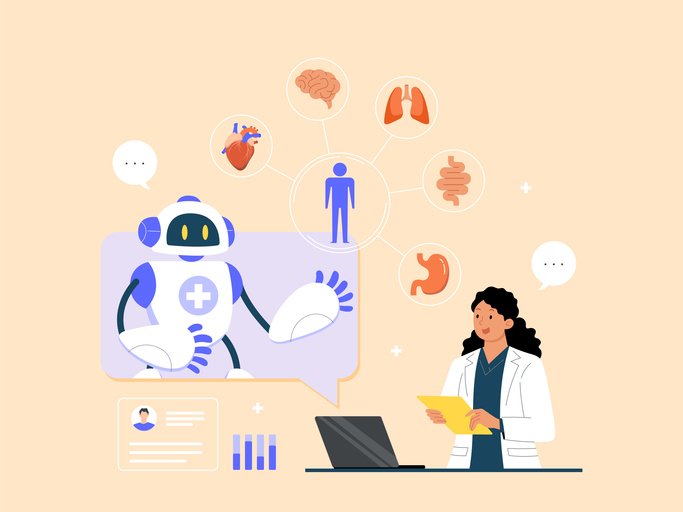
Photo: ThongSam, Getty Images
Jahnavi Kachhia is a global product owner for AI and ML with experience spanning regulated healthcare environments and large scale AR and LLM platforms at Meta Reality Labs. Her research spans explainable AI, human-in-the-loop systems, and responsible AI deployment in clinical settings, with publications in IEEE Xplore and peer review roles at IJCAI, PAKDD, AAAI, and IEEE conferences. She is a keynote and invited speaker at HealthAI 2026, the Applied Healthcare AI Summit, the IEEE International Conference on AI-Driven Smart Systems, the International Entrepreneurship Summit 2026, Neuroscience 2026, the Global Vaccines Summit, the Women in Tech Conference, and additional international AI and healthcare forums in 2025–2026.
This post appears through the MedCity Influencers program. Anyone can publish their perspective on business and innovation in healthcare on MedCity News through MedCity Influencers. Click here to find out how.
