
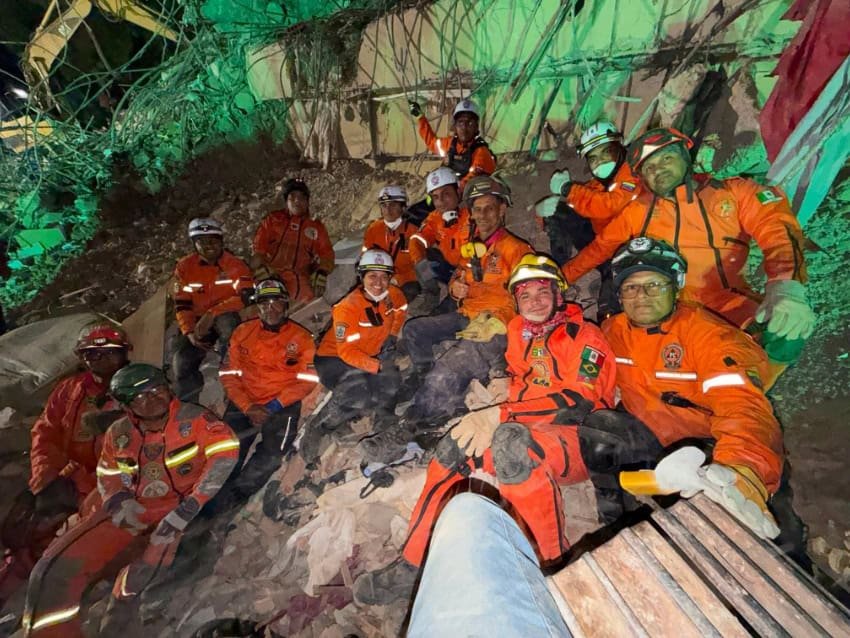
As they have previously done in Mexico and in countries around the world, Mexican rescuers known as topos (moles) are currently searching for survivors and victims of a natural disaster — twin powerful earthquakes in Venezuela, in this case.
One group of topos — so named because of their ability to crawl and tunnel through rubble like moles — that is assisting the search and rescue efforts in Venezuela is the Topos Azteca International Brigade (Brigada Internacional de Rescate Topos Azteca), or Topos Azteca for short.
Some members of the group, which was founded by “El Topo Mayor” Héctor “El Chino” Méndez after the devastating 1985 earthquake in Mexico City, departed for Venezuela soon after the 7.2 and 7.5 magnitude earthquakes in the South American country on June 24, while others followed this week.
One such person is Miguel Jiménez Pérez, a 46-year-old veterinarian from the state of Hidalgo who has been a member of the Topos Azteca for more than a decade.
According to the media outlet La Silla Rota, Jiménez has been working amidst “mountains of rubble” practically since he arrived in Venezuela, where the twin earthquakes claimed the lives of close to 2,300 people, according to a death toll update on Thursday, and injured more than 11,000 others in places including the capital, Caracas, and the hard-hit state of La Guaira.
Without concern for the risks to his life, Jiménez has climbed across sections of collapsed walls and roofs of residential buildings as he searched for signs of life, La Silla Rota reported.
In a video posted to Facebook, he described the situation in Venezuela as a “true tragedy,” but said he was willing and able to do his bit to help those in need.

The commitment of Jiménez to his work, which he performs as a volunteer like all the other Topos Azteca, is shared by all the members of the group founded by Méndez, who at the age of 80 continues to do rescue work and also traveled to Venezuela.
“There is no hunger, no heat, no sleep,” Merry Valencia, another member of the Topos Azteca brigade, told the Associated Press, reciting part of the group’s code of conduct.
“There is no fear,” she added.
According to AP, the topos, after assessing the stability of collapsed structures, “split into small teams assigned to different sections of the debris” where they are working.
“They crawl through narrow openings and voids inside pancaked buildings. … They often use thermal cameras and other specialized equipment to search for signs of life,” the news agency reported.
“Armed with shovels, hand hammers and other tools, they slowly remove rubble, inch by inch, trying to avoid triggering further collapses.”
At the Mexico City International Airport, AP spoke to Germán Bello, a 39-year-old rescuer, on Tuesday before he flew to Venezuela to join other members of the Topos Azteca.
“The hardest part is telling someone that their loved one has died,” said Bello, an auto repair shop owner who was taking body bags with him to Venezuela as well as rescue equipment.
He, Jiménez and other members of the Topos Azteca will stay in Venezuela for extended periods as they work with local authorities and rescuers from around the world — including Mexican military personnel and rescue dogs — to search for survivors, or, as is unfortunately more likely now, recover the bodies of people from the rubble of buildings that collapsed. Jiménez will stay in Venezuela for two months. Bello does not know when he will return home, AP reported.
The history of the Topos Azteca
After the 1985 Mexico City earthquake toppled a significant number of buildings in the capital, Méndez went out to look for his brother in the Guerrero neighborhood, located near the historic center. He determined that his brother was fine so he turned his efforts to looking for survivors of the quake amid the rubble of collapsed buildings.
According to the newspaper Telediario, on the day of the earthquake — Sept. 19, 1985 — Méndez worked with young members of the military police for 10 hours to rescue a woman trapped in rubble in the neighborhood of Tlatelolco.
At that time, Telediario reported, he realized he had a mission in life — to help others. Méndez consequently founded the Topos Azteca International Brigade and has now worked with the group for four decades, saving a significant number of lives in the period.
In 2021 — a year in which the Topos Azteca assisted the rescue efforts at the site of a collapsed beachfront residential building in Miami — Méndez told The Washington Post that his brigade has participated in rescue efforts in over 70 operations across five continents.
Among the countries the Topos Azteca have deployed to are Chile, after a 2010 mining accident; Indonesia, after the devastating 2004 Indian Ocean earthquake and tsunami; and the United States, after the 2001 terrorist attack on the Twin Towers in New York. The Topos Azteca have also worked in Haiti, Turkey, Morocco, New Zealand, Brazil and Spain, among other countries.
“When you have seen death and have had the opportunity to rescue someone … that instinct inside of you to preserve the human race just awakens,” Méndez told the Washington Post in 2021.
“It changes your life,” he added.
With reports from AP, La Silla Rota and Telediario
