
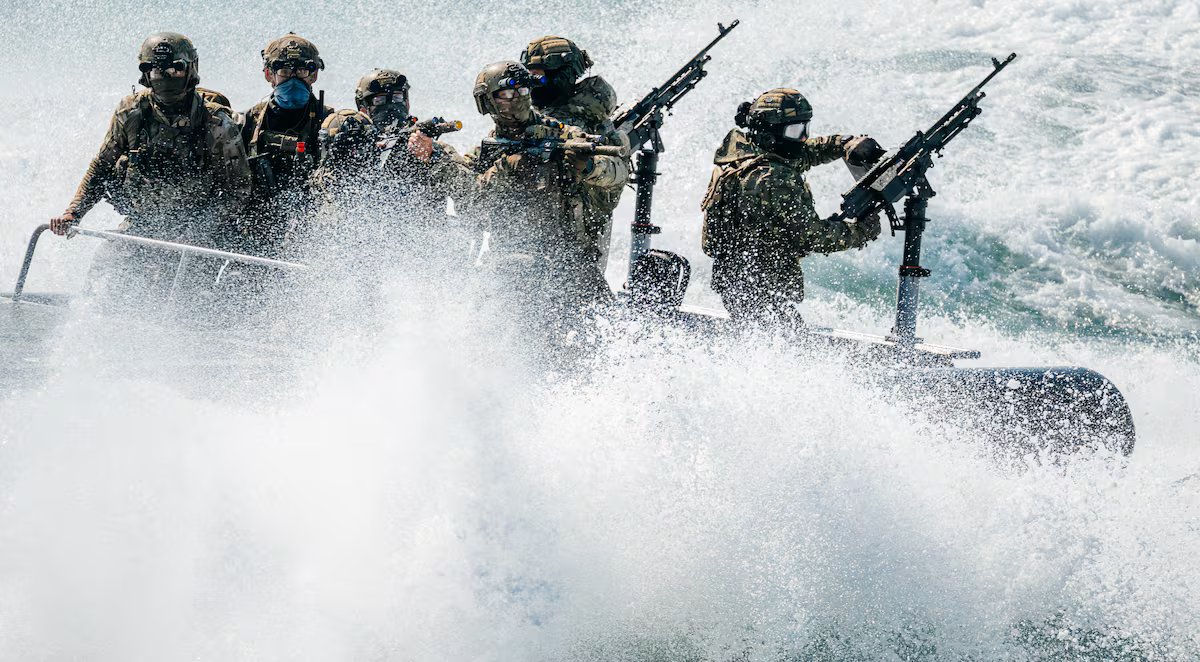
Europe is undergoing its largest rearmament since the end of the Cold War. Spurred by the war in Ukraine, the threat from Russia, as well as growing uncertainty about the United States’ long-term commitment to the continent’s defense, NATO’s European members are facing a historic shift. Consequently, they’re boosting their defense budgets to record levels and reshaping the entire continent’s security architecture. They’re preparing to embrace the paradigm transition toward a more European-centered alliance and are moving to fill the gaps that will be left by the troop cuts on the continent, which have been announced by Washington.
U.S. President Donald Trump’s repeated attacks against the military alliance — which he calls a “paper tiger” — and his constant questioning of the “loyalty” of several European allies are testing the organization’s resilience and structure.
The real estate mogul — now the leader of the country that has guaranteed Europe’s security since the end of World War II — wants to express his discontent directly to his European allies. This will likely take place in Ankara, the capital of Turkey, where a NATO summit — predicted to be crucial for the organization’s very survival — will be held on July 7 and 8.
The meeting will be a major test — both of allies’ defence spending, which continues to rise but never seems enough for Washington, and of the United States’ own military commitments. It will also serve as a gauge of the alliance’s future in its current form, 77 years after its founding. Furthermore, the summit comes on the heels of an announcement made by the Trump administration: there will be a six-month-long review of the U.S. military presence in Europe and an analysis of the allies’ commitment.
“There’s no going back to the old Atlantic Alliance, and there’s no alternative to plan B, [which consists] of a European-led NATO, based on a European command structure and force model,” says Jamie Shea, who was a senior NATO official for 38 years.
“If the U.S. decides to contribute, so be it,” he adds, “but NATO cannot be built around a central U.S. conventional and nuclear presence in Europe as in the past.”
That’s the key to both NATO’s survival and the security of the Old Continent, according to analysts and experts. The draft declaration from the Ankara summit — which the allies are still working on — speaks of “a stronger Europe within a stronger NATO,” as several sources have described to EL PAÍS.
This path, however, conceals a paradox. Washington is pushing Europe to rearm, but without relinquishing strategic control and without giving up the expectation that this rearmament will largely translate into purchases of U.S. technology. It is, Shea points out, the art of wanting to have your cake and eat it, too. The urgency of capacity gaps — especially when it comes to missile defense, as the rate of consumption of Patriot and THAAD interceptors during the Iran war has created acute shortages — is pushing European capitals to buy U.S. systems, even when their industrial strategy points in another direction.
“For Washington, Europe ‘doing more’ has, for a long time, meant spending more on NATO priorities that [involved] U.S. leadership and spending more on U.S. weapons systems in particular,” notes Katja Bego, defense policy and transatlantic security analyst at the London-based think tank Chatham House.
The current push toward strategic autonomy and “European procurement” is disrupting that tacit balance. Bego warns that Washington increasingly perceives the shift in policy as an act of hostility by its European allies. “This is a view held not only by the Trump administration, but also by more transatlantic elements of the Washington security community. And it will only become an increasing source of tension as Europe rearms,” she adds.
The atmosphere leading up to the summit is tense. So, on June 24, NATO Secretary General Mark Rutte traveled to Washington to prepare for the summit and to do damage control with the Republican president. In the past, Trump has accused European allies of “free-loading,” even referring to them as “cowards” for not participating or collaborating in his war against Iran. In the Oval Office, he summarized his demand with a phrase that encapsulates the new American doctrine toward its European allies: “We don’t need their money, we don’t need anything. We have the most powerful military in the world by far, but I just want loyalty.”
Defense gap
Weeks earlier, Washington informed its European allies of plans to reduce the military assets available to NATO in the event of a crisis. According to several allies present at the meeting, the U.S. will make cuts in virtually all major categories. The number of fighter jets will be reduced by a third. There will be half as many strategic bombers. Washington will no longer contribute destroyers or submarines, while tanker aircraft and armed drone supplies will also be affected.
This cutback is part of the United States’ plan to focus on other areas, such as the Indo-Pacific. And it was accompanied by the withdrawal of 5,000 troops from Germany — including an armored brigade combat team and a long-range fires battalion — and the freezing of a program to deploy Tomahawk missiles on German soil. These decisions were made by the Trump administration after German Chancellor Friedrich Merz criticized the U.S.-Israeli offensive against Iran.
Demands for greater burden-sharing and the withdrawal of capabilities are occurring simultaneously rather than sequentially, notes Liana Fix, a fellow at the Council on Foreign Relations. “And that gap — the period between the withdrawal of conventional U.S. assets and the arrival of credible European replacements — is the most dangerous interval for deterrence since the early 1990s,” she warns.
After decades of enjoying the peace dividend — which allowed Europe to reduce its military budgets while the economy grew and the Russian threat seemed like a relic from the 20th-century — the continent began to rearm. This was due to Russia’s war against Ukraine, as well as Europe’s broader realization of its neighbor’s voracious ambitions. But the arms buildup began to take institutional form in June 2025, when — pressured by Trump — NATO leaders (with the exception of the Spanish prime minister) committed to investing 5% of GDP in defense and security by 2035.
Record spending
European allies and Canada increased their defense spending by 20% in 2025 compared to 2024 — the largest annual increase since 1953 — reaching a combined total of more than $574 billion at constant prices, according to the latest NATO data. Total annual NATO spending approached $1.6 trillion. Since 2016, European NATO members and Canada have added an extra $1.2 trillion to their defense budgets.
But money alone isn’t enough to close the gap. If the United States reduces its presence, Europe will also lose a number of critical capabilities. Without U.S. intelligence, surveillance and reconnaissance assets, space-based collection systems, signals intelligence and data-fusion networks, Europe would still possess sensors and weapons — but the operational picture would update more slowly, with less confidence and less depth.
Missile defense, for instance, would be less effective, in the opinion of Ruben Stewart, senior research fellow for Land Warfare at the IISS think tank. “The crucial question is whether Europe builds up not only more mass, but also its own capacity to see, decide, strike, protect and sustain itself at a theater scale — that is, across the entire European combat space,” he argues.
According to Shea, Trump didn’t create the problem: he simply brought it to light. “Europe must build a true defense union,” he says.
He proposes three simultaneous courses of action to achieve such a transition: Europeanizing NATO’s command structures by replacing U.S. officers with Europeans and appointing a European forces commander; creating a European Security Council led by the five major powers — France, Germany, Poland, the United Kingdom and Italy — as the political engine of a genuine defense union; and deepening European Union (EU) financial mechanisms to standardize equipment and reduce fragmentation. Today, NATO’s European allies operate five different types of fighter jets and 14 types of armored vehicles.
Europe had previously envisioned a slow transition to greater strategic autonomy. But that timeline has been thrown into disarray. “We expected to make this transition over 20 or 30 years,” says the former senior NATO official. “[But] Trump is forcing Europe to compress it into a decade.”
The question now is whether NATO can reinvent itself quickly enough to survive this new balance of power.
Sign up for our weekly newsletter to get more English-language news coverage from EL PAÍS USA Edition
