
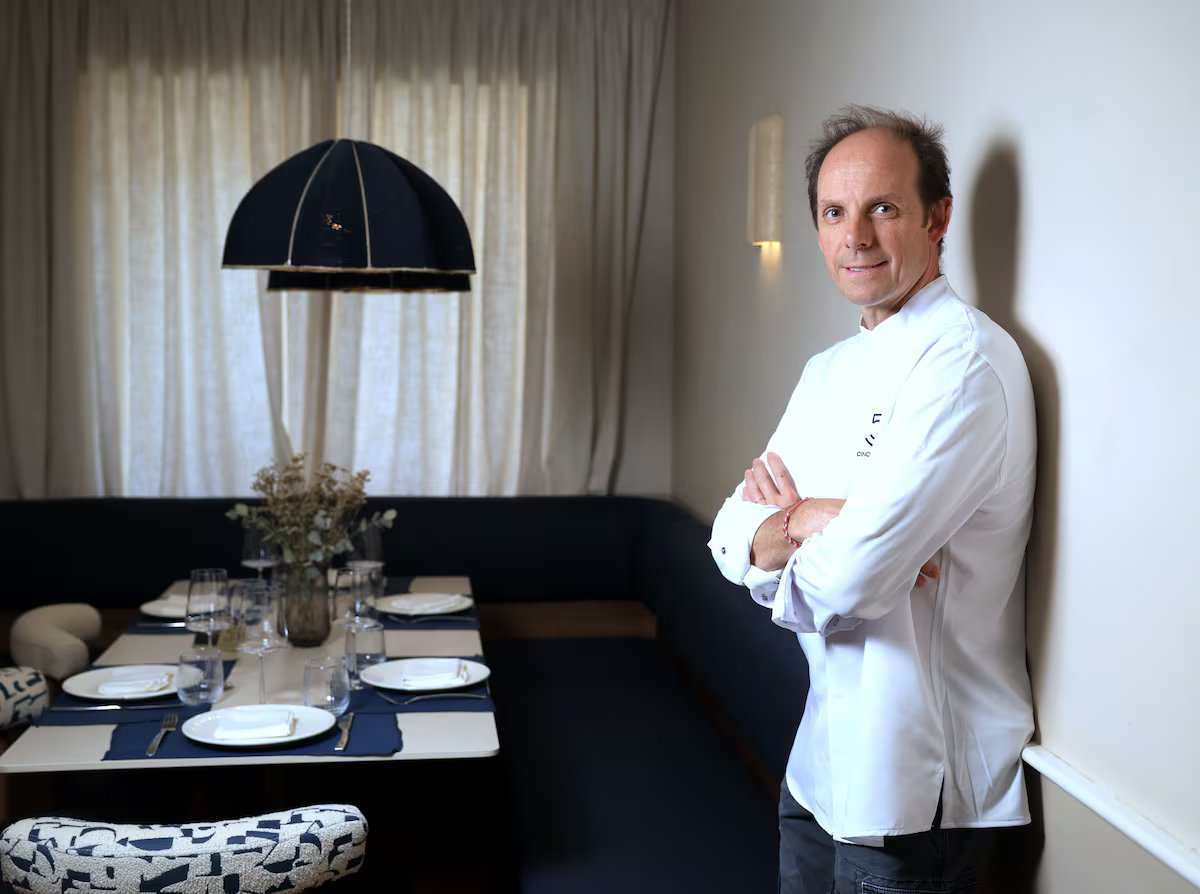
Luis Roger speaks quietly but clearly. He does not complain about the heat in Madrid because he says that he is used to the high temperatures in Houston, Texas where he has lived since 2012 and where he has two restaurants: the Michelin-starred BCN Taste & Tradition, and the more informal MAD – both names are inspired by the airports of Barcelona and Madrid.
Born in Barcelona, Luis Roger, 50, is visiting Spain, where he has come to prepare several dishes to feature on the menu of Madrid’s Cinco Jotas restaurant. At the top of his game, his success in the world of cuisine comes as no surprise. As a child he was most comfortable with his mother in his grandparents’ kitchen. Academia was not for him. Before doing his military service, his father enrolled him in the Hofmann School of Hospitality so that he would have something to look forward to when he was discharged. In 1998, he became an intern at elBulli, the famous restaurant run by Ferran Adriá until 2011. Once he finished at Hofmann, he went back. “I was there [at elBulli] for just four months, but it changed my life and my perception of gastronomy,” he says.
Roger subsequently worked as a chef on high-end yachts, during which time he met the businessman Luis Conde, founder of the headhunting company Seeliger & Conde, with whom he crossed the Atlantic. Conde hired Roger to manage the kitchens of his family farmhouse in Fonteta in Girona. It was in that house that Roger met another businessman, Ignacio Torras, president and founder of Tricon Energy, based in Houston since 1989. Torras proposed that they open a restaurant together in Houston.
At first, Roger’s wife and three children put the brakes on the project, but Torras insisted until in 2012 Roger gave in. “The first thing we talked about was the what, how and when. I worked on the BCN business plan and used it to get the visa,” Roger says. The restaurant was opened in 2014. “I spoke just enough English, but when you have nothing to lose you have to take risks,” he explains. Today, not only has Roger achieved a Michelin star, his two restaurants employ about 110 staff and boast a turnover of around $10 million (€8.8 million).
Question. Was Torras something of a visionary regarding your potential as a chef?
Answer. Totally, and he was persistent. Our idea was always to open a small restaurant, for a maximum of 60 customers, with traditional well-presented Spanish cuisine – a mixture of what I learned at Hofmann and elBulli.
Q. What exactly did you learn from working with Ferran Adrià and his team at elBulli?
A. Many things, but especially to observe and organize. Also respect for the product: if you have a tomato, it has to taste like a tomato, and nothing should overshadow that. I also learned about duck tongues there, which I have continued to work with, as well as foie gras and hot asparagus.
Q. Of all the chefs who have passed through elBulli, you are perhaps the one least seen in the media.
A. I love that. I like to be in the background; I’m more about the numbers and dealing with people. I love the work that José Andrés has done in the United States, but I’m more of an ant: I believe in the detailed, silent work.
Q. What helped to get you established in Houston?
A. When I arrived, I didn’t know anyone. Americans do not have a great gastronomic culture, but Houston is different, because there are a lot of travelers, with a broad knowledge and purchasing power. When we opened the restaurant, most of them already knew everything: they knew Ferran Adrià and were fans of the product we work with.
Q. The Spanish product?
A. Yes. What we avoided, at first, was tapas, paella and the folkloric aspect of much of Spanish gastronomy abroad. We wanted a fine restaurant, where you could eat well. And we invest in good products. Without a good product you can’t sell Spain. We bring Iberian ham, sea bass, suckling pig, cuttlefish, squid, octopus… BCN sells the most Vega Sicilia Único wine in all of Texas. We are committed to serving Spanish wine at a decent price. We also sell Iberian ham at cost price to compete with prosciutto. We can sell between 12 and 15 boneless shoulders of Cinco Jotas a week.
Q. How have Trump’s tariffs affected you?
A. They have not harmed us. I think it’s temporary. I’m not counting the cents.
Q. You got your first Michelin star 10 years after opening.
A. We didn’t expect it. That year we were in the running, which I didn’t like because it generated a certain nervousness among the team. Americans are immediately enthusiastic. I told them that it was unlikely, so that they would not be disappointed. But then we were asked to send a photo of the chef and some dishes. That’s when we curbed our expectations: we didn’t appear on the list of the 40 recommended and, for Bib Gourmand [a slightly lower rating] we are too expensive.
Q. Are you expensive?
A. A meal costs $150 per person. It’s expensive.
Q. Is it a profitable business?
A. Very profitable. I like to analyze everything. It’s something I learned at elBulli, where a number of different people tasted all the dishes. The amount of protein, fat, etc. were calculated, and the reaction to each dish was analyzed. When you sell a tasting menu, you also have to study it from a dietary point of view, so that there is no excess. A lot of priority was given to protein and fruit and vegetables. No one can end up vomiting on a tasting menu.
Q. In the end you succumbed and set up a tapas and rice restaurant in 2019.
A. Yes, that was after we were established. At MAD, we offer a more informal cuisine, including wood-fired rice dishes. I sell tons of rice a year. We make the dishes individually – 38-centimeter paellas of different types: chicken, duck with Provençal herbs, using 90 grams of bomba [short-grain] rice. One of the best-selling tapas is chistorra [fast-cured sausage] and chicken wings with blue cheese sauce and crispy carrot. We seek perfection in everything we do.
Q. In Spain, the hospitality industry suffers from a lack of staff. Is the same happening in the United States?
A. Yes, the same thing happens. Texas is the epicenter of capitalism. In the United States if someone doesn’t toe the line, you can fire them right away, and, likewise, they can just leave. Many do not even give notice or simply don’t turn up to work. There is a high turnover rate: for $100 dollars they go somewhere else. One of my greatest satisfactions is being able to provide employment. That was the condition of my visa when I submitted the business plan. My head chef is Mexican and he started working with me in the fryer.
Q. It can’t be easy right now with the Trump administration’s persecution of immigrants.
A. Many come from Mexico and Guatemala and do not dare to expose themselves. It’s complicated because they usually have two jobs and work up to six days a week. They have a significant level of exhaustion, and their diet is not always adequate. I eat two days a week while driving.
Q. You have two restaurants and you eat in the car?
A. Yes. I have two restaurants, which I open only at night, and I take care of a lot of things. I need to go shopping. It is necessary; I cannot delegate that because of the cost. So two days a week I eat in the car.
Q. In Spain, less and less wine is consumed in the hospitality industry. Is the same happening in the United States?
A. Alcohol sales have dropped considerably. Thirty percent of customers have a gin and tonic before dinner. At the level of invoicing, it is important. I have lowered prices and I sell more: I sell a bottle worth $20 for $35, when it would usually sell for $60.
Q. Have you thought about returning to Spain?
A. I have two businesses and my family there. And I love working in the United States. Everything is immediate: the system makes things easier for you, there is less bureaucracy. My life is there.
Sign up for our weekly newsletter to get more English-language news coverage from EL PAÍS USA Edition
