
Listen to this article
Estimated 3 minutes
The audio version of this article is generated by AI-based technology. Mispronunciations can occur. We are working with our partners to continually review and improve the results.
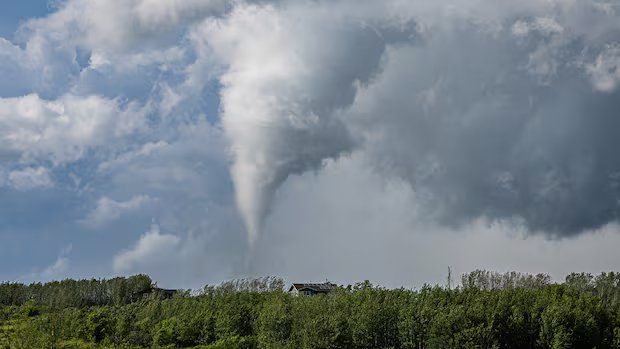
A tornado that passed through the east-central Alberta hamlet of Tulliby Lake damaged several structures and agricultural and oil sites, according to county officials.
In a news release on Sunday, the County of Vermilion River said no injuries had been reported to officials.
At around 5:30 p.m. on Saturday, an Alberta Emergency Alert was issued for the county after Environment Canada posted a red tornado warning. The alert, which was cancelled around 6 p.m. Saturday, said caution should be exercised in Dewberry, Tulliby Lake, Onion Lake and the Makaoo (Part) 120 First Nation.
Tulliby Lake is around 60 kilometres northwest of Lloydminster.
“This is a very dangerous and potentially life-threatening situation,” the Environment Canada warning read.
County officials also said on Sunday that energy operator ATCO indicated outages were affecting residents on Saturday, but that power has been restored.
Some roads in the affected area may have fallen trees, but crews are assessing the damage and working to clear any obstacles, the county said.
“The public is asked to avoid the area at this time as workers mitigate hazards.”
London Morning6:35Using AI to help detect past tornadoes
A new artificial intelligence tool is being used to identify tornadoes that have previously gone undetected. Northern Tornadoes Project Director Dave Sills told London Morning what kind of data they can now see thanks to artificial intelligence.
Both the Northern Tornadoes Project and the Alberta Emergency Management Agency have been notified of the weather event by the County of Vermilion River.
The Northern Tornadoes Project, based out of Western University in London, Ont., confirmed the “supercell tornado” near Tulliby Lake in a social media post.

In an interview with CBC News, Dave Sills, the director of the Northern Tornadoes Project, said the most intense tornadoes come from supercell thunderstorms.
“The balance of the instability and the wind … is just right to produce these highly organized thunderstorms where the thunderstorm itself actually has a rotating updraft,” he said, adding these storms can produce “the strongest, most intense tornadoes and also the largest hailstones.”
“The confirmation is based on multiple photos and videos, including imagery from an OTUS Project drone, as well as radar imagery,” the group said.
This year’s tornado season has been worse than in previous years, Sills said, noting the number of tornadoes this summer is “unusual.”
“It’s not a surprise that we saw this. It’s unfortunate that it happened, but when the conditions, the ingredients come together in that way, you’re going to see these kinds of storms.”
The group will investigate to learn more about how the tornado formed and to assess its strength, Sills said.
“Aside from from the classification of what type of damage and the intensity of the damage, we’re looking for how long is the path, how wide is the path and also any community impacts from that event.”
