
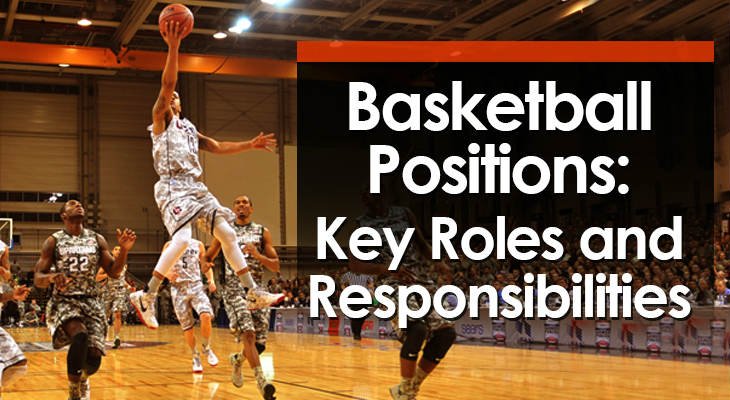
Basketball has five positions: point guard (1), shooting guard (2), small forward (3), power forward (4), and center (5).
Each position has specific roles and responsibilities on both offense and defense, though the lines between positions have blurred significantly in modern basketball.
Below, I’ll break down what each position does, what skills they need, what the numbers mean, how positions have evolved, and the biggest mistake coaches make when it comes to positions at the youth level.
Quick Reference: The 5 Positions
1. Point Guard (Floor General) – Runs the offense, distributes the ball.
2. Shooting Guard (Off Guard) – Scores from the perimeter.
3. Small Forward (The Wing) – Does a bit of everything.
4. Power Forward (The Four) – Scores inside, rebounds, defends the paint.
5. Center (The Five) – Protects the rim, rebounds, scores inside.
The 7 Basketball Positions Explained
1. Point Guard

Notable Point Guards: Steph Curry, Chris Paul, Magic Johnson, and John Stockton.
The point guard (also called the floor general or the “one”) is the team’s primary ball handler and the player responsible for running the offense.
Their job is to bring the ball up the court, call plays, control the tempo, and get the ball to teammates in positions where they can score. Think of them as the coach on the floor.
This requires elite ball handling, court vision, and decision making. A point guard who can’t see the open player or makes careless turnovers will kill an offense.
The best point guards are unselfish. They know the playbook inside out, they understand where each teammate is most effective, and they put the ball in those spots consistently.
On offense, the point guard’s scoring usually comes off dribble penetration. Attacking the lane and either finishing or kicking out to an open shooter. But in today’s game, point guards are also expected to be capable three-point shooters.
On defense, the point guard typically guards the opposition’s primary ball handler. This means playing aggressive on-ball defense, fighting through screens, and using quick hands to disrupt the dribble. All while always staying between their player and the basket.
Key skills: Ball handling, passing, reading defenses, free throw shooting, on-ball defense.
2. Shooting Guard
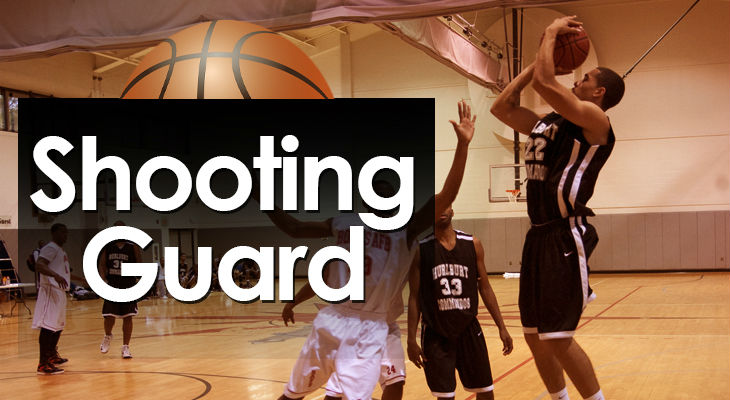
Notable Shooting Guards: Michael Jordan, Kobe Bryant, Ray Allen, Devin Booker.
The shooting guard (also called the off guard or the “two”) is typically the team’s best perimeter scorer.
They start most possessions on the wing and spend a lot of time moving without the ball… using screens, cutting, and finding open space to receive a pass and shoot.
A great shooting guard can score from anywhere. Outside, midrange, off the dribble, at the rim. They need to be comfortable catching and shooting in rhythm, pulling up off a screen, and finishing with a variety of moves including floaters, euro steps, and reverse layups.
On offense, the shooting guard also serves as the team’s secondary ball handler. When the point guard is pressured, trapped, or doubled, the shooting guard needs to be able to take over and advance the ball.
On defense, the shooting guard guards the opponent’s best perimeter scorer. This means chasing them off screens, contesting shots without fouling, and staying disciplined when the offensive player uses jab steps and shot fakes to create space.
Key skills: Shooting off the catch and off the dribble, off-ball movement, secondary ball handling, perimeter defense.
3. Small Forward
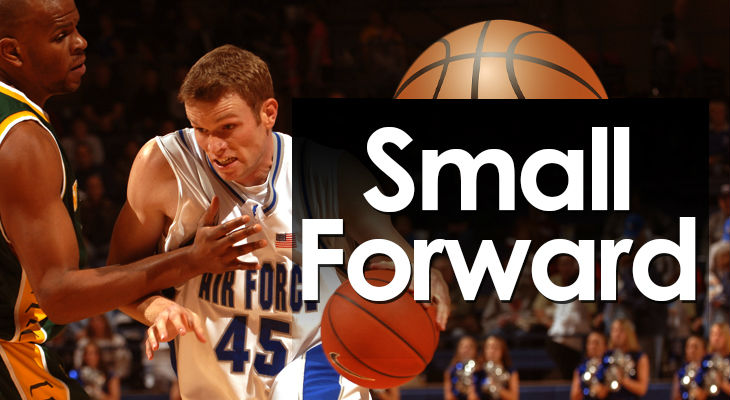
Notable Small Forwards: LeBron James, Scottie Pippen, Kevin Durant, and Larry Bird.
The small forward (also called the wing or the “three”) is the most versatile position on the court.
A great small forward can shoot from outside, score inside, handle the ball, pass, rebound, and defend multiple positions. They’re the Swiss army knife of a basketball team.
Because of this versatility, small forwards are often the team’s best overall player. They can impact the game in ways that don’t always show up in the box score. A timely defensive stop, a cut to the basket that creates space for a teammate, a rebound that sparks a fast break.
Small forwards typically start on the wing and can operate from both the perimeter and the post depending on matchups. If they’re bigger than their defender, they can take them inside. If they’re quicker, they can attack off the dribble.
On offense, the small forward scores from everywhere – outside, midrange, in the post, off the dribble, and in transition. They’re often the team’s go-to scorer in crunch time because of their ability to create their own shot from multiple areas.
On defense, the small forward often guards the opponent’s best scorer – regardless of position. Their size and athleticism usually make them the team’s most versatile defender, capable of switching onto guards or forwards depending on what the offense throws at them.
Key skills: Versatility is the key word. Shooting, driving, finishing, rebounding, defending multiple positions, basketball IQ.
4. Power Forward

Notable Power Forwards: Tim Duncan, Dennis Rodman, Karl Malone, and Kevin Love.
The power forward (also called the “four”) is one of the team’s two “bigs” and typically plays close to the basket.
Traditionally, power forwards were physical inside players who scored in the post, grabbed rebounds, and set screens. Think Karl Malone or Charles Barkley – strong, aggressive, dominant in the paint.
That’s changed a lot.
On offense, the power forward position has split into two types:
a. The traditional power forward still plays primarily in the paint. They score with post moves, drop steps, and putbacks off offensive rebounds. They set screens for guards in the pick and roll and protect the rim on defense.
b. The “stretch four” is a power forward who can shoot three-pointers consistently. This pulls the opposing big out of the paint and creates driving lanes for guards. Players like Karl Anthony-Towns and Anthony Davis have redefined this position by combining the physicality of a traditional four with the perimeter skills of a wing.
On defense, the power forward is responsible for boxing out and securing defensive rebounds, protecting the paint alongside the center, and switching onto smaller players when the offense forces mismatches.
Key skills: Rebounding, post moves, mid-range shooting, screening, interior defense. Developing a three-point shot is increasingly important.
5. Center

Notable Centers: Shaquille O’Neal, Joel Embiid, Wilt Chamberlain, and Bill Russell.
The center (also called the “five” or the big) is usually the tallest and strongest player on the team.
Their primary job is to protect the rim, rebound the basketball, and score close to the basket. They’re the anchor of the team’s defense and the player opponents have to deal with every time they drive to the lane.
On offense, most centers score close to the basket – off offensive rebounds, lob passes, post-ups, and short passes when a driving guard draws their defender away. The best centers have a reliable hook shot and can finish with either hand.
In today’s game, some centers have expanded their range to the three-point line. But at the youth and high school level, a center’s offensive development should start with post moves and finishing around the rim before worrying about outside shooting.
On defense, the center is the last line of defense. They take up space in the paint, alter shots, and make opponents think twice about driving to the basket. A good center makes every shot near the rim harder just by being there. They don’t need to be an elite shot blocker – simply forcing opponents to change their shots is often enough. Rebounding is the center’s bread and butter on both ends, using their size to box out and secure possession.
Key skills: Rebounding, rim protection, post moves, screening, finishing with both hands, communication.
What Do the Numbers 1-5 Mean in Basketball?
Coaches use numbers as shorthand for positions:
- 1 = Point Guard
- 2 = Shooting Guard
- 3 = Small Forward
- 4 = Power Forward
- 5 = Center
You’ll hear this constantly during games and practices. “Get it to the 5 in the post.” “The 1 needs to push the ball.” “Switch 3 and 4 on defense.”
The numbers also show up on play diagrams and basketball court diagrams where each position is represented by its number. Learning the numbering system is essential for understanding any playbook.
At the broadest level, positions 1 and 2 are “guards” (the backcourt) and positions 3, 4, and 5 are “forwards and centers” (the frontcourt). But in practice, the lines between these groups are much blurrier than they used to be.
Hybrid Positions in Modern Basketball
The traditional five positions are still the foundation, but modern basketball has created several hybrid roles that blend two positions together.
Combo Guard
A player who can play both point guard and shooting guard. They can run the offense AND score from the perimeter. Some combo guards are primarily scorers who can handle point guard duties when needed. Others are point guards who can also shoot at a high level.
Point Forward
A small forward who handles playmaking responsibilities typically reserved for the point guard. LeBron James is the most famous example. A 6’9″ player who brings the ball up, runs the offense, and creates for teammates like a traditional point guard.
Stretch Four
A power forward with a reliable three-point shot who “stretches” the floor by pulling the opposing big away from the basket. This creates driving lanes for guards and opens up the paint for cutters.
Small-Ball Center
An undersized center (often a power forward or even a large wing) who plays the 5 position, sacrificing traditional size for speed, shooting, and defensive switching ability. Teams use small-ball lineups to increase pace and floor spacing.
Wing
“Wing” isn’t an official position, but coaches use it constantly to describe players who play the 2 or 3 — the shooting guard and small forward spots. When a coach says “we need a wing player,” they mean someone who can shoot from the perimeter, defend on the wing, and contribute on the boards.
The Problem with Basketball Positions
Everything above describes what positions look like at the high school, college, and professional level. And at those levels, some degree of positional specialization makes sense.
But at the youth level? Positions are doing more harm than good.
Here’s the biggest issue I see in youth basketball:
The tallest kid on the team gets told to “stay in the low post” the moment they walk into the gym. Don’t dribble. Don’t shoot from outside. Don’t guard on the perimeter. Just stay under the basket.
I’ve seen kids who score 20 points a game in the post but have never been allowed to take a dribble outside the key. Their coach locked them into one role at age 12, and now they have zero perimeter skills.
Here’s why this matters so much:
Height is unpredictable. The tallest 12-year-old on the team might end up average height by high school. If all they’ve ever practiced is posting up and rebounding, they suddenly have no perimeter skills and don’t “fit” anywhere. I’ve seen this happen dozens of times.
And it goes the other way too…
A JV coach once wrote to me saying she lost her point guard to injury and had nobody else on the team who could advance the ball up the court. Nobody. Because for years, only two players on the team had ever been allowed to handle the ball in practice.
That’s the problem with locking kids into positions too early.
You end up with players who can only do one thing.
What I Recommend Instead
Don’t define position roles before high school. Let every player develop every skill. Your smallest point guard should practice post moves. Your tallest center should practice ball handling. Everyone learns everything.
Don’t split practice into guards and bigs. I’ve been to too many youth practices where the short kids go to one end to work on dribbling and the tall kids go to the other end to work on post moves. Don’t do this. All players should work on all skills together.
Run a positionless offense. Some offenses lock players into rigid roles that limit development. The 5-Out Motion Offense is my go-to recommendation for youth teams because every player can fill every spot. Everyone handles the ball, everyone screens, everyone cuts, everyone shoots.
Play man-to-man defense. Zone defense lets certain players hide and avoid developing defensive fundamentals. Man-to-man defense forces every player to guard every area of the court, which is exactly what they need.
Encourage anyone who gets a rebound to push the ball. Don’t make your players wait for “the point guard” to come back and get it. If the center grabs the rebound and has a lane, let them go. This develops ball handling and decision making for every player on the team.
How Basketball Positions Change at Each Level
Youth Basketball (Ages 7-12)
Positions should barely exist at this age. Every player should rotate through every spot in the offense and defense. The goal is skill development across the board, not winning games by exploiting the one tall kid.
Focus on teaching basketball fundamentals (dribbling, passing, shooting, footwork, defense) to every single player regardless of size.
Middle School (Ages 12-14)
Players start to show natural tendencies. Some gravitate toward ball handling, others toward rebounding and interior play. It’s fine to lean into those tendencies during games, but practice should still develop all skills for all players.
This is the age where early growth spurts can be misleading. The tallest kid in 7th grade might be average height by 10th grade. Don’t pigeonhole them.
High School (Ages 14-18)
Positional specialization starts to make sense here. Players are physically mature enough that their body type gives a clearer indication of what position they’ll play long-term. A 6’5″ high school junior is probably going to be a wing or forward, not a point guard.
But even at the high school level, versatility wins. The best teams have players who can guard multiple positions, switch defensive matchups, and contribute in ways beyond their listed position.
College and Professional
By this point, positions are well-defined but also more fluid than ever. The trend toward positionless basketball means that even at the highest level, teams value players who can do multiple things over players who can only do one thing really well.
The NBA has essentially come full circle. In the 1960s, positions were rigid. By the 2020s, the best teams play five players who can all shoot, all dribble, all pass, and all defend multiple positions. The labels still exist, but the boundaries between them are thinner than ever.
Frequently Asked Questions
What are the 5 positions in basketball?
The five positions are point guard (1), shooting guard (2), small forward (3), power forward (4), and center (5). Guards are the backcourt and typically handle the ball and shoot from the perimeter. Forwards and centers are the frontcourt and typically play closer to the basket, though this distinction has blurred significantly in modern basketball.
What is the hardest position in basketball?
Most people say point guard because of the leadership, decision making, and ball handling responsibilities. The point guard controls the offense, has to read the defense on every possession, and is responsible for making their teammates better, not just scoring themselves. That said, every position has its own challenges. Playing center against a dominant post player or guarding an elite scorer as a shooting guard is no walk in the park either.
What is the most important position in basketball?
There’s no single answer. A team without a competent point guard will struggle to run an offense. A team without a rim-protecting center will give up easy baskets inside. The most important position on any specific team depends on who you have and who you’re missing. That said, if you ask most coaches, they’ll say point guard – the position that touches the ball every possession has an outsized impact on winning.
What position should I play in basketball?
Historically, your height determined your position. Short players played guard, tall players played center. That’s becoming less true every year. The better question is: what are your skills? If you’re a great ball handler and passer, you’ll likely play guard regardless of height. If you’re a physical rebounder who protects the rim, you’ll likely play in the frontcourt. At the youth level, don’t worry about picking one position – develop all your skills and let your natural strengths emerge over time.
What is a wing in basketball?
“Wing” refers to the shooting guard (2) and small forward (3) positions. It’s not an official position number, but coaches use the term constantly. When someone says “wing player,” they mean an athletic perimeter player who can score, defend, and contribute on the glass. The wing spots are on either side of the court between the three-point line and the baseline.
What is positionless basketball?
Positionless basketball is an approach where players aren’t locked into traditional position roles. Instead of the point guard being the only ball handler or the center being the only rebounder, every player develops a complete skill set. At the youth level, this means not defining positions at all and letting every player learn everything. At the professional level, it means building lineups where all five players can shoot, handle, pass, and defend multiple positions.
Can you play multiple positions?
Yes, and the best players usually can. A player who can play both the 2 and the 3 (a “wing”) or both the 4 and the 5 is much more valuable than a player locked into one position. Versatility gives coaches flexibility with lineups and makes it harder for the opposing team to exploit matchups. Developing the ability to play multiple positions starts with building a well-rounded skill set – which is why youth players should avoid specializing too early.
Conclusion
The five basketball positions give the game structure and help coaches organize their team.
Understanding what each position does, both on offense and defense, is foundational knowledge for any player or coach.
But don’t let positions limit development…
The best basketball players in the world aren’t great because they mastered one position. They’re great because they developed a complete skill set and can contribute in multiple ways.
Teach your players all five positions. Let them experiment.
Save the specialization for when it actually matters.
