
Tuesday, June 23. U.S. Secretary of State Marco Rubio lands in Abu Dhabi with a clear message: the Strait of Hormuz, he says, is an “international waterway” and, as such, “no country is allowed to charge tolls or fees” there. “That’s existing international law. That’s the way it is in international waterways all over the world, and that’s the way we expect it’ll be here.” His words were directed at several addressees: the United Arab Emirates, the friendly country he is visiting, and the other hydrocarbon exporters of the Persian Gulf, which should be able to export without hindrance. And, of course, Iran, which — in his words — will not be able to cash in on the ships transiting the crucial artery for the transport of oil, gas, and their derivatives.
Monday, July 13. All the hopes raised by the ceasefire agreement evaporate. Donald Trump has just notified Congress that his country is back at war, and his rhetoric on Hormuz takes a radical turn: “The U.S.A… will be reimbursed, at the rate of 20% on all cargo shipped, for any and all costs necessary to do the job of providing safety and security to this very volatile section of the World.” Shortly before, in an interview with Fox News, his favored network, he had called the U.S. the “guardian angel” of the strait.
Tuesday, July 14. As the clock ticks down toward the entry into force of a new U.S. blockade of Hormuz, effective only for Iranian ships, Trump doubles down… and then retreats in his own way: “I have decided to replace the 20% United States Reimbursement Fee with Trade and Investment Deals that the various Gulf States will be making into the United States,” he wrote on his social network, Truth, only to say later at a White House appearance that he does not believe “anyone should be able to charge a fee for the use of the strait.”
The damage, however, has already been done.
Despite how far-fetched the idea is — and despite the fact that the Republican magnate has made a habit of not keeping his word, his promises, or his threats — an administration source had assured on Monday that Trump’s position on this point was “very serious.” “This is what he’s always wanted to do, but people tried to talk him out of it. To him, this was his instinctual decision always, and he’s sort of just come back around to it,” the source told the news site Semafor.
Among those who publicly opposed that “instinctual decision” were Rubio, the vice president of the United States, J. D. Vance, and the secretary of defense, Pete Hegseth. A review of the archive turns up several statements against the idea of charging a toll… when it was supposed to come from Tehran.
Iran — which has been discussing the matter with its neighbor Oman for weeks — has repeatedly tabled an option that this Monday changed sides. It is Trump —who, together with Benjamin Netanyahu, launched the war that led to the closure of Hormuz — who now sees a possibility to charge for transiting those waters.
On either side, the mere idea wipes out any hint of security in an area critical to the global economy. It lends legitimacy to tolls that have “no legal basis,” as the International Maritime Organization (IMO, part of the United Nations) pointed out on Tuesday, but which increasingly seem closer to reality.
With this U-turn, yet another by Trump, the Republican also hands his opponents a powerful argument: Tehran can only see its proposal to charge for crossing Hormuz vindicated. “The president of the United States is completely right. Whoever guarantees the safe passage of merchant ships through the strait must be compensated for this service,” Iran’s foreign minister, Abbas Araghchi, wrote after the Republican’s proposal. He added his own interpretation immediately after: “Iran has always been the guardian of the strait and will remain so forever. Twenty percent is, of course, excessive. We will be fair.”
Trump’s outburst and subsequent backtrack in fact bring Iran and Oman even closer. This Monday, hours after listening to the White House, Omani authorities reaffirmed that their “priority” remained reaching an agreement “with Iran to guarantee freedom of navigation.” Even countries that initially wavered between the two contenders seem to be drifting further from Washington. No Middle Eastern capital was consulted by the Trump administration before it launched its proposal, according to reports by the Qatari outlet Al Jazeera and the U.S. site Axios.
From Trump’s Truth post on Tuesday, it is also unclear whether the “Trade and Investment Deals that the various Gulf States will be making into the United States,” announced ostensibly to mask his latest reeling in of threats and, according to Washington analysts, to avoid their unwanted effect on gasoline prices in an election year, are new pacts. Or whether the Republican was simply referring to deals sealed after his visit to the region last year, from which he returned with, among other gifts for him and his family, a plane donated by Qatar that the president hopes to use as Air Force One and that has already raised initial security concerns.
The Schrödinger strait
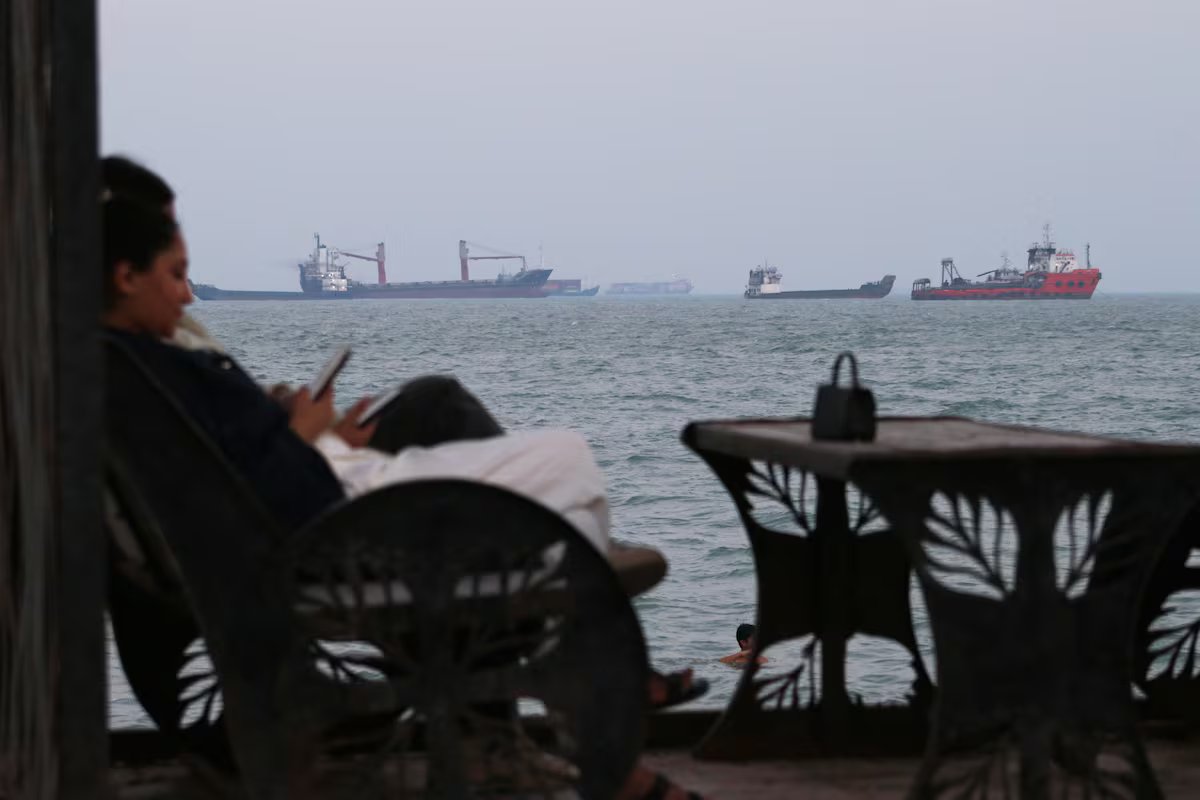
In recent days Hormuz has again been the Schrödinger strait: open according to the United States, closed according to Iran. On the ground, the reality is much more nuanced: some ships are still crossing, yes, but in dribs and drabs compared both with prewar transit volumes and with the weeks immediately after the memorandum of understanding was signed. Those who dare do so under cover, with their transponders switched off, to go as unnoticed as possible and avoid being attacked.
Transits have collapsed especially on the southern route, a lane that runs in Omani waters and which, on paper, is under the protection of the U.S. Navy. That, according to the specialist outlet Lloyd’s List, indicates that “shipowners’ confidence in that protection is eroding.”
In the last week alone, at least seven vessels have been attacked by Iran, mostly large tankers linked to Emirati, Saudi, and Qatari hydrocarbon companies that participate in a scheme in which these vessels, escorted by U.S. warships or monitored by aircraft, assume the risk of transiting Hormuz to then transfer their cargo to smaller ships off the port of Fujairah (United Arab Emirates).
“It is unlikely that ships will steam ahead full speed to assume the same risks while also paying a high tax,” warns Paul Donovan, chief economist at Swiss investment bank UBS, in an analysis published on Tuesday. “A 20% fee would be about 15 times higher than the levy Iran had considered and, as a proportional tax, would amplify fluctuations in the price of oil,” he notes.
The Baltic and International Maritime Council (Bimco), the largest shipowners’ association by membership, estimates that supertankers — which carry between one and two million barrels of crude — would have to pay about $27 million per voyage, while container ships would owe between $65 million and $260 million, depending on their cargo capacity. “While some cargo owners and operators might decide to absorb these additional costs, in most cases this expense will be passed along the supply chain and reflected in higher costs for consumers,” the analysis sent to this newspaper explains.
The shipping industry, which had already opposed the possibility of an Iranian fee or toll, is furious at Trump’s notion. “Charging tolls for passage through international waters would be fundamentally wrong,” Hapag-Lloyd told EL PAÍS in a comment sent by email. “Tolls for infrastructures like the Suez or Panama canals are different because they reflect significant investments in infrastructure. That is not the case in Hormuz.”
The UN Convention on the Law of the Sea (UNCLOS), the foundational text for governing global relations in this key area, prohibits imposing “tolls” in exchange for the passage of merchant ships through natural straits, although some, like the Turkish straits, do levy pilotage fees due to their greater navigational difficulty (the Bosphorus has a minimum width of 700 meters compared with Hormuz’s 30 kilometers).
Even harsher was Brazil’s president, Luiz Inácio Lula da Silva, who compared Trump to privateers: “He says he will clear the strait, but for every ship the oil owner must pay him 20%. This used to be called piracy. An important country like the U.S., which long fought against piracy, cannot now become a pirate.”
Price increases
Joining the toll proposal was the decision to reimpose the U.S. blockade in the Gulf of Oman to prevent trade to and from Iranian ports, a move that also raises tensions in the area and which, according to Jakob Larsen, Bimco’s head of security, will lead Iran to “increase its threats” against maritime traffic. Trump’s proposal, which raises transport costs and represents an “additional disincentive” for transiting the strait, would only make sense if it contributed to a “significant reduction of the Iranian threat,” something Larsen says “is unclear how it is intended to be achieved.” For that reason, he believes all this entails “a grave risk of escalation” in Hormuz which, combined with the restriction of Iranian crude exports that the U.S. naval blockade seeks, “will put further upward pressure on oil prices.”
The fragile peace promised by the June agreement “has come to an end,” declare Gregory Brew, Clayton Allen, and Firas Maksad of the risk consultancy Eurasia Group. It has happened, moreover, more than a month earlier than planned: the original agreement had been a cessation of hostilities until August 17, with Hormuz open throughout that period and the world finally getting a breather after the sequence of convulsions. “Although for now it is unlikely that the U.S. will resume large-scale bombings against Iran similar to those in the March war, the volume transported through the strait will fall from between 30% and 50% [of prewar levels, in recent weeks] to between 5% and 15% until both sides reduce tensions.” In plain terms: oil, gas, and fertilizers will be more expensive, until further notice.
Bridges and power plants
“Next week it gets really bad for them,” Trump declared. “We’re going to knock out all their power plants. We’re going to knock out all their bridges unless they get to the table and negotiate,” he added, repeating earlier threats that were at the time condemned by UN officials.
Sign up for our weekly newsletter to get more English-language news coverage from EL PAÍS USA Edition
