
ST. JOHN’S — The Assembly of First Nations passed a motion Tuesday denouncing what the Innu Nation says is the Newfoundland and Labrador’s government’s reliance on a “discredited and unscientific” theory that Innu arrived in the province just 300 years ago.
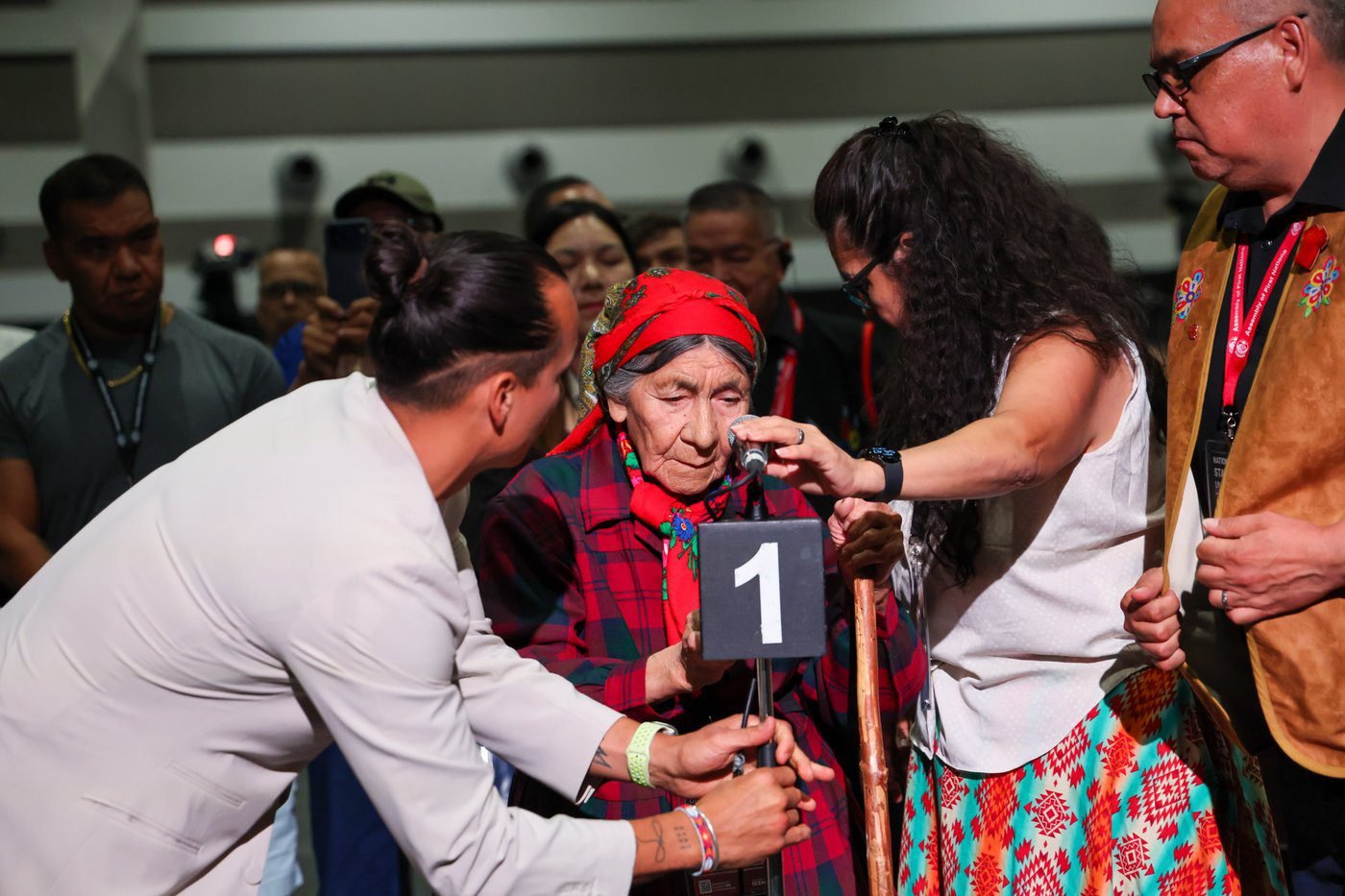
Passed by consensus, the emergency motion was brought forward at the AFN’s annual general meeting in Ottawa by Chief Eugene Hart of the Sheshatshiu Innu First Nation in Labrador. He made an emotional plea for support to the assembly, saying the provincial government has disrespected Innu elders and communities.
“It’s a slap in the face, basically,” he said. “I don’t think that was right for the province to say that to us and to our people, which were here many, many thousands and thousands of years.”
“I’m confused as a leader, myself,” he added. “Where does reconciliation stand?”
Elizabeth Penashue, an Innu elder born in 1944, also addressed the assembly, saying she did not accept the province’s position.
“The government of the province of Newfoundland has disrespected us as Innu, and she’s very hurt by that,” Hart explained, translating for Penashue.
The Innu Nation in Labrador was preparing to open a cultural exhibit last month about its history, but says it cancelled the show when it heard that the provincial government took issue with a planned timeline of Innu presence in the region.
Innu leaders have said the province believes a “fringe theory” that Innu arrived in Labrador in the 1700s, after the Europeans, thus erasing thousands of years of Innu history.
The theory came up in a court case about Innu hunting rights based on charges from 2013 which were stayed in 2022. Lawyer Senwung Luk, who represented accused Innu hunters, shared with The Canadian Press a report submitted by the provincial government in the case arguing the Innu arrived in Labrador in the 18th century.
Dated December 2021, the report from provincial archeologist Jamie Brake argues that the earliest known archeological evidence for Innu in Labrador is from the 18th century, and that there is little to connect the Innu with older known sites.
Last month, the Innu Nation shared a letter signed by eight archeologists and anthropologists from Memorial University in Newfoundland and Labrador which said the 300-year theory is based on a “methodologically flawed assumption” that changes in the materials at a site signalled a new distinct people had arrived and replaced another.
It also accused the provincial government of “colonial logic,” saying the position dismisses Innu knowledge and oral history.
Lela Evans, Newfoundland and Labrador’s minister of Indigenous relations and reconciliation, did not give a direct answer when asked when the province believes the Innu came to Labrador. Evans said she is working to understand the provincial archeology office’s position and what else could explain the scarcity of artifacts in its research.
Innu lands have been flooded in the past by government-led hydroelectric projects, she said, adding that she wants to know if any archeological collection took place before that flooding.
In the meantime, Evans said she and her government are committed to working with the Innu to complete their land claims as quickly as possible.
“The Innu have been here,” Evans said. “The Innu are first peoples of Canada.”
“We know where the Innu have had their land use, right? Because that’s been handed down through generations of stories that the Innu have,” she added. “I think that it’s just a matter of making sure.”
Chief Hart’s emergency motion for the Assembly of First Nations called for other actions, including that the AFN demand clear statements from the Canadian and provincial governments condemning political interference in public institutions which distort or minimize First Nations histories, cultural belongings and rights.
The AFN is a national advocacy body that takes its direction from some 630 First Nations chiefs through special and annual general assemblies.
The “Innu Pakassiun” exhibit was supposed to open in North West River, Labrador, last month, in partnership with the Rooms, the provincial art gallery, on National Indigenous Peoples Day. It was curated by Innu people and included artifacts repatriated from Ottawa, Hart said.
Jodie Ashini, an Innu cultural guardian who worked on the exhibit for several years, has said executives with the gallery said just days before the planned opening that the province opposed the timeline of Innu history in Labrador that was to be included in exhibit.
“We were told, ‘No, you can’t share your timeline. You’ve only been in Labrador for 300 years,’” she told the assembly in Ottawa on Tuesday.
“It’s embarrassing that a province has done this to an Indigenous group,” Ashini said.
“Once it starts with us…they’re going to start picking out all Indigenous groups across Canada to start erasing your culture and your history,” she added. “So we want you to realize what is happening, that colonial archeology is defining who we are.”
— With files from Alessia Passafiume in Ottawa
This report by The Canadian Press was first published July 15, 2026.
Sarah Smellie, The Canadian Press
