
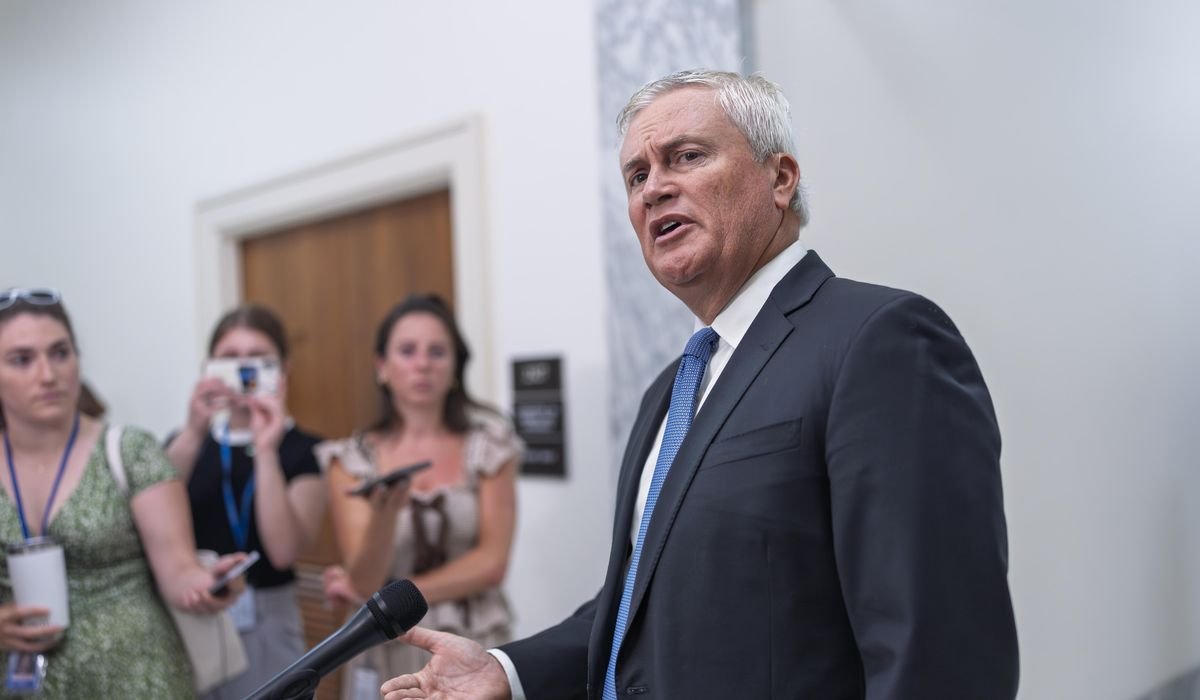
House Oversight Chairman James Comer on Thursday introduced legislation that would require congressional approval of any act passed by the D.C. Council that would impose or increase a tax or fee.
The Kentucky Republican’s bill, the D.C. Taxing Authority Review Act, comes as D.C. Council members are considering tax increases to help close a looming budget gap.
The bill stipulates that Congress would have 60 days after receiving tax or fee legislation to pass a joint resolution of approval.
Under the 1973 Home Rule Act, D.C. Council legislation goes through a passive congressional review period, typically 30 legislative days. If Congress does nothing, the law takes effect automatically, and Congress must act only if it wants to block a policy via a joint resolution of disapproval.
If Mr. Comer’s bill passes, D.C. Council legislation imposing new or increased taxes and fees would take effect only if Congress affirmatively passes a joint resolution of approval within 60 days. This means a D.C. tax hike could be blocked simply by Congress declining to act, not just by voting it down.
“Faced with a billion-dollar budget hole, the D.C. Council has rejected necessary spending reforms and is instead now considering tax increases that would punish residents, burden businesses, and further weaken the District’s economy,” Mr. Comer said in a statement to The Washington Times.
DOCUMENT: Read the text of the D.C. Taxing Authority Review Act
A council proposal, the Wealth Proceeds Tax, would impose a 3% surtax on passive income above $400,000 for individual filers and $500,000 for married couples, modeled on the federal Net Investment Income Tax. It’s slated for discussion at a fall revenue hearing.
Council member Brianne K. Nadeau, Ward 1 Democrat, said the tax would generate nearly $200 million in its first year and more than $100 million annually after that.
The council is also probing the feasibility of a new Business Activity Tax — levies on gross receipts meant to close loopholes that let some professional-service firms avoid the city’s franchise tax.
The council began exploring these options after passing a fiscal 2027 budget in June. To avoid service and program cuts proposed, it relied on one-time revenue measures and decoupled the local tax code from federal tax cuts to generate hundreds of millions in retained revenue.
Mr. Comer said his bill ensures Congress “fulfills its constitutional responsibility” by reviewing and approving any such legislation.
“The Constitution gives Congress clear responsibility over the nation’s capital, and we must prevent the D.C. Council’s reckless fiscal policies from jeopardizing its future,” he said.
He said that “higher taxes will not fix the financial mess they created.”
The Oversight Committee will consider and pass the legislation in a markup next week, a committee spokesperson told The Times.
“The committee is sending a message to radical D.C. socialists that they can’t tax their way out of bad financial decisions,” the spokesperson said.
Council member Janeese Lewis George of Ward 4, a self-described democratic socialist, supports increasing taxes on large, profitable corporations, specifically advocating in her campaign for a Business Activity Tax.
“Radical D.C. Democrats want to solve their spending problem by reaching deeper into taxpayers’ pockets and driving further on the path to socialism,” Mr. Comer said.
