
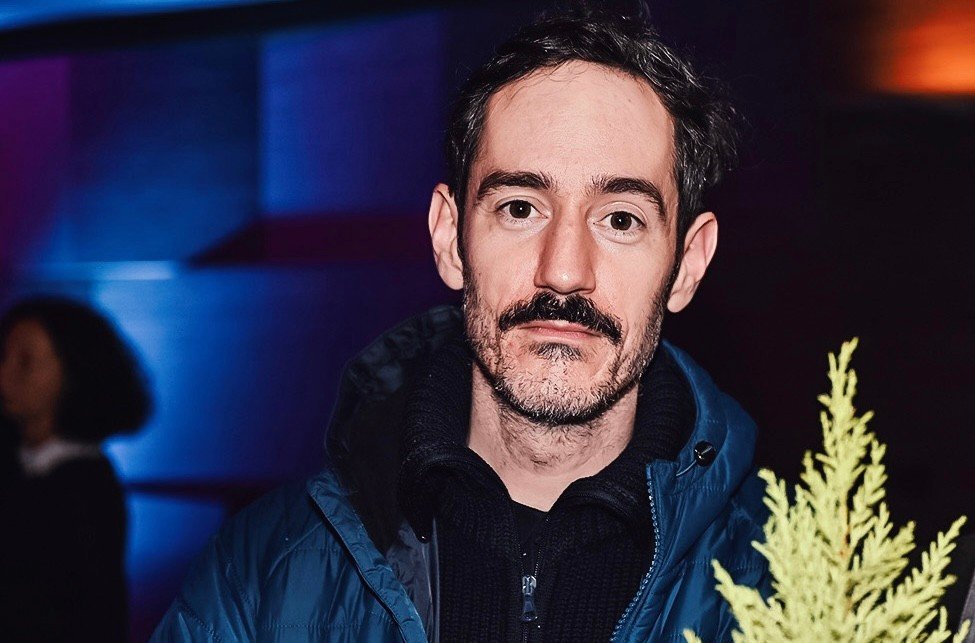
– The German filmmaker talks digital immortality and the “sweet spot” between kitsch and silliness
German writer-director Jon Frickey’s animated short film Ploo participated in the international competition at Fest Anča in Žilina, Slovakia. The film employs mathematical concepts and digital techniques to depict a world operated by algorithms and data-based systems, revealing the concerning fact that our reality is becoming repetitive. Reflecting different situations we come across in life in a teasing manner, Frickey interrogates our natural longing for immortality and eternity – existential questions the human race is obliged to face.
Cineuropa: Ploo combines vector graphics with screen display technologies to create a world governed by endless repetition. What first inspired you to approach the film from this perspective?
Jon Frickey: Originally, I wanted to make a film by connecting together a collection of GIFs that I had already created. At the same time, I had been experimenting with vector animation simply because I’m fascinated by retro vector-monitors. I realised there was a conceptual connection between vector graphics and GIFs. Vector graphics can be scaled infinitely without losing quality, while GIFs repeat infinitely over time. Both possess something fundamentally unnatural, because eternity only really exists in mathematics. Endless repetition is also a mathematical concept. That became the foundation of the film.
Do you see this visual approach as an extension of your previous creative practice?
It might actually come from my background in advertising and illustration. In those fields, it’s often more important to adapt your visual language to the project than to impose a recognisable signature style. Every project asks for something different. With Ploo, although it was my own film rather than commercial work, I approached it in much the same way. I wanted to find the visual language that best suited this particular story
To what extent does the film reflect your thoughts on AI, algorithms and big data shaping everyday life today?
Digital immortality is something many of us experience today. Social media, cloud storage and digital technology create the illusion that everything can be preserved forever. But everything ends, ultimately – that’s simply reality. I think that’s something we all struggle to accept.
Why did you choose Cantonese as the spoken language in one of the film’s sequences?
There wasn’t any symbolic reason why it specifically had to be Cantonese. The sequence is essentially a flashback, and I wanted that memory to take place somewhere that was manufacturing electronic technology during the early 1980s. I looked at many historical photographs of Hong Kong, where there was still a significant electronics manufacturing industry at the time. Japan was another possibility, but somehow Hong Kong simply felt more interesting.
Could you talk about the music you used at the end of the film?
I really like the sweet spot between kitsch and silliness. I also like it when people feel a little uncomfortable because something suddenly becomes emotional. At the same time, I wanted the music to sound like it could be the theme song of a TV show or a soap opera. The melody actually comes from a lullaby called “Good Evening James” that I used to sing to my son when he was little – one of only three songs I’ve ever composed. I adjusted the melody to make it stranger and changed the lyrics.
There was originally a much longer version, but it made the film too long. I also had someone translate every verse into Cantonese, which turned out to be much more difficult than I had expected. The composer, who’s also a friend of mine and a director I’ve worked with before, brought everything together. The voices are real. They’re not AI voices, although I think some people might assume they are. The English version is sung by a Filipino woman I found online. I thought she had a really beautiful singing voice.
