
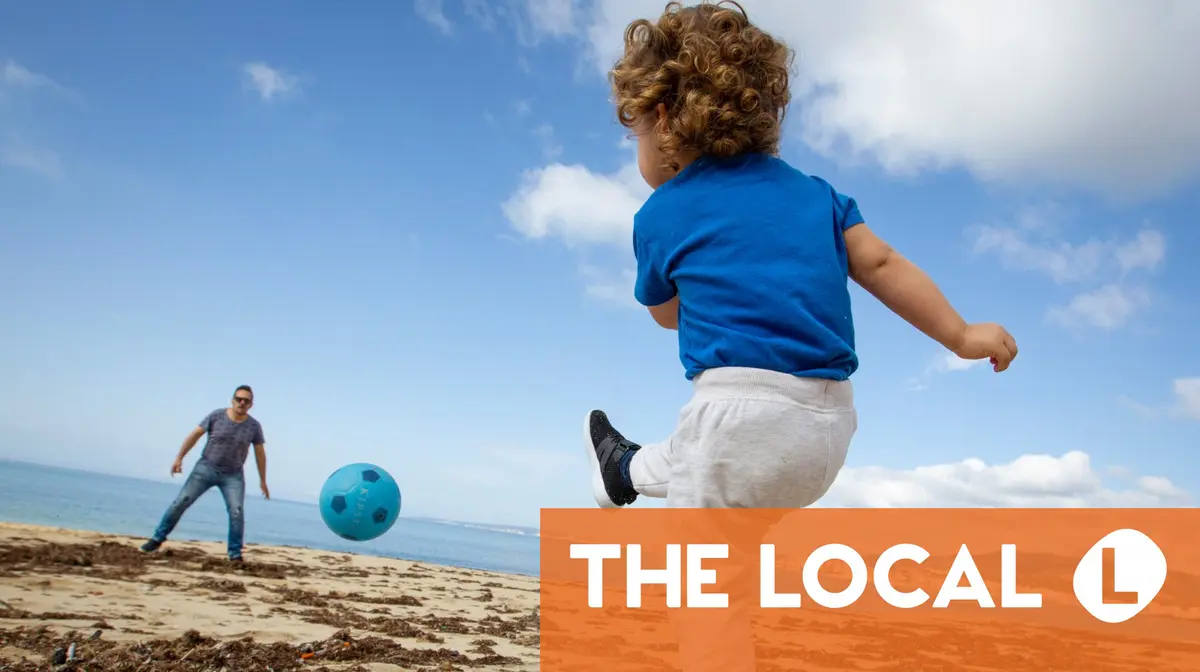
As Spain prepares to face Argentina in the World Cup final on Sunday, The Local’s Alex Dunham reminisces about the role the national side has played in his life in Spain, from childhood to parenthood.
I remember it clearly. The year was 1996, and a ten-year-old me was rollerblading with my friends in my hometown of Santa Cruz de Tenerife, ahead of the Euros 96 quarterfinal between England and Spain.
“Tú vas con Inglaterra y nosotros con España,” they said bluntly. “You’re rooting for England and we’re rooting for Spain”.
“No, yo también voy con España,” I replied, “No, I’m also supporting Spain”.
As a kid brought up in the Canaries by British parents, this was the first time I’d had to take sides regarding my ‘double’ identity.
I’d gone to a Spanish nursery and was at a Spanish school, but together with a boy whose mother was from Equatorial Guinea, I was the only ‘foreign’ child in my class.
At home I spoke English, but everywhere else it was Spanish, with a thick canario accent.
I was also football mad, and like the vast majority of Spanish kids, I spent hours kicking a ball in the school playground and in the square opposite our apartment.
The game ended 0-0, England beat Spain on penalties, but it wasn’t glee I felt, rather a sense of reaffirmation about the country I identified with.
Years later in 2006, while I was on Erasmus in Toulouse, I decided to join some university friends who were at the World Cup in Germany.
On the flight, some Argentina supporters who nicknamed me Fernando Torres (because of my Spain football jersey and blond hair) offered me a ride from Frankfurt to Berlin, where I joined my friends for a week of World Cup fun, watching the games at the fan festivals.
Spain got knocked out by France in the last 16, but on my last night in Germany, I met my future wife at a youth hostel.
Once again, Spain’s national football team was linked to a defining moment in my life.
In the years that followed, Spain became the sporting powerhouse that we’ve all come to know, winning back-to-back Euros and one World Cup from 2008 to 2012.
A jubilant Iker Casillas lifts the 2010 World Cup after Spain beat the Netherlands 1-0 in extra time. (Photo by ROBERTO SCHMIDT / AFP)
Living in Madrid at the time, I witnessed not only the pandemonium when La Roja lifted those long-awaited trophies, but how football became the primary beacon of national pride.
These tournaments became imprinted in my mind, shaping the timeline of my life in a veritable “Where were you when…?”.
Spain’s World Cup win in South Africa caught me in another part of Africa – Zanzibar – where I was filming a documentary.
There I sang the popular chant ‘Yo soy español’ (‘I am Spanish’) with a bunch of Kiswahili speakers from the village of Jambiani, who proceeded to dub me a crazy muzungu (white person) when Andrés Iniesta scored the winner against the Netherlands.
Sixteen years on, I’ve been enjoying watching Spain’s World Cup matches in the company of my three-year-old son, both in our Spain kits, forming memories for the years to come.
He, like I, is growing up bilingual and with an international background. But there’s no doubt in my mind which national team he’ll support for the rest of his life.
