
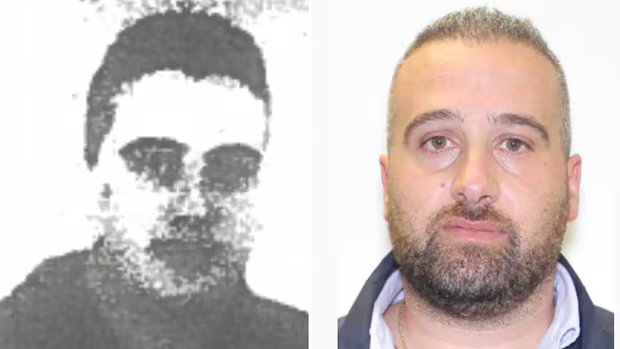
Comfortably settled north of Toronto in a five-bedroom, six-bathroom family home on a sprawling estate with a movie theatre and space for nine cars in the garage, Carlo Bruzzese doesn’t appear at first like a man on the run.
A married father of four, public records show he lives at the same address as his mother and owns a business in the construction industry.
But in his native Italy, prosecutors consider Bruzzese a high-ranking criminal operative — a fugitive wanted for 16 years — in the Calabrian ‘ndrangheta, a powerful syndicate known for drug trafficking, bid-rigging and extortion.
The son and son-in-law of purported mob bosses both expelled from Canada, the 41-year-old was himself convicted more than a decade ago for his alleged ties to the mafia.
Now, CBC News has learned Italian authorities are pressing to extradite Bruzzese to enforce the six-year prison sentence he received but never served.
According to an Ontario court filing, the Italian government’s evidence includes multiple wiretaps and a 2008 conversation secretly recorded in a Range Rover, where two senior mafiosos discuss “Franco” holding a “high” rank in Carmelo Bruzzese’s ‘ndrangheta unit.
Italian authorities allege “Franco” is in fact Carmelo’s son, Carlo.
Toronto police spokesperson Nadine Ramadan said the agency’s fugitive squad arrested Carlo Bruzzese on April 22 in nearby Vaughan “on the strength of an arrest warrant issued under the Canadian Extradition Act as he is wanted by Italian authorities.”
Court records show Carlo, a dual Italian-Canadian citizen, was granted bail nine days later.
Three family members pledged $4 million to secure Bruzzese’s release. He agreed to wear a GPS monitoring device and to return every night to his security camera-equipped, $3.3 million Vaughan home, which is registered to his mother and older brother.
Italian authorities first issued an arrest warrant for Bruzzese in 2010 following a large-scale mafia investigation. Two years later, he was convicted in absentia of mafia association — an Italian charge that Bruzzese’s legal team insists has no equivalent in Canada.

It’s not clear why Rome is seeking to carry out the six-year sentence now.
“The government of Italy has not sought extradition in this matter since 2014,” Bruzzese’s lawyer Marco Sciarra told a court in downtown Toronto earlier this month.
“Now, all of a sudden [the federal Crown is] really pushing us to move the matter along without delay, but we really need an opportunity to prepare a response.”
Canadian government lawyer Marin Nati told the Ontario court, “I don’t think it should be beholden on the Attorney General of Canada to control or demand when Italy seeks extradition.”
“They decide when they seek it, we act upon it,” he said.
Bruzzese’s lead counsel Michael Lacy declined CBC’s request for comment. He said in a court filing that his client will fight extradition.

Father described as mafia ‘capo’
Carlo’s father Carmelo Bruzzese once told the Immigration and Refugee Board of Canada (IRB) that Italian authorities were going after his youngest son “just to frustrate and harass the family,” according to IRB records reviewed by CBC News.
The IRB in 2015 found the Italian-born family patriarch, a friend of the late Montreal mafia kingpin Vito Rizutto, was inadmissible to Canada for being a member of an organized crime group.
“The evidence does not depict a depthless or superficial affiliation with the ‘ndrangheta,” IRB adjudicator Ama Beecham wrote.
Instead, Beecham said Carmelo appeared to be the leader or “capo” of the Italian criminal group’s unit (“locale”) in the town of Grotteria, Calabria.
Under oath, Carmelo admitted he had regularly used his children to transport large sums of money from Italy to Canada, rather than sending bank transfers. An Italian judge also reportedly described “a sophisticated hiding place” in the elder Bruzzese’s Italian home.
Carmelo claimed to the IRB that he knew nothing about the mafia, other than what he’d read in the newspapers and seen in the 1972 film, The Godfather.
As for his son Carlo, the Italian courts found he “facilitated communications among members, participated in meetings and carried out instructions by leading members of the Locale of Grotteria and the entire association,” Toronto police Det.-Const. Charlene Smith said in a sworn affidavit.

Carlo married the daughter of Giuseppe Coluccio, an ‘ndrangheta boss listed as one of Italy’s most-wanted fugitives until his August 2008 capture in the Toronto area.
Accused of international cocaine and heroin trafficking, Collucio was deported later that month on a private charter plane and handed over to Italian authorities.
Bruzzese said in an Ontario court filing that he owns development firm Hybrid Green Homes (HGH) Design Build and also works as a sub-contractor for a concrete forming company.
Provincial business records list HGH’s president, secretary and treasurer as Giuseppe Scarfo. The same name was reported to be an alias of Bruzzese’s father-in-law Coluccio prior to his arrest.
‘Mafia association’ not a crime in Canada
Bruzzese’s lawyer Lacy wrote in a court filing that it’s a “live issue” as to whether Canadians can be extradited for the Italian offence of mafia association.
Under Canadian law, an individual can only be extradited if their alleged offence is considered a crime in both countries.
Federal Crown lawyers say the Italian charge is equivalent to the Canadian offence of participation in a criminal organization. Lacy wrote the two charges are distinct because he said the Italian offence does not require an accused to “knowingly” assist a criminal organization.
A Federal Court judge made a similar finding in Carmelo Bruzzese’s case a decade ago.
“As there is no Canadian equivalent for the charge of association with a mafia-like organization, Canada would not extradite him,” Federal Court Justice Yves de Montigny wrote in 2014.
Authorities instead sent Carmelo Bruzzese back to Italy by other means. He was deported after the IRB found him inadmissible to Canada.
