
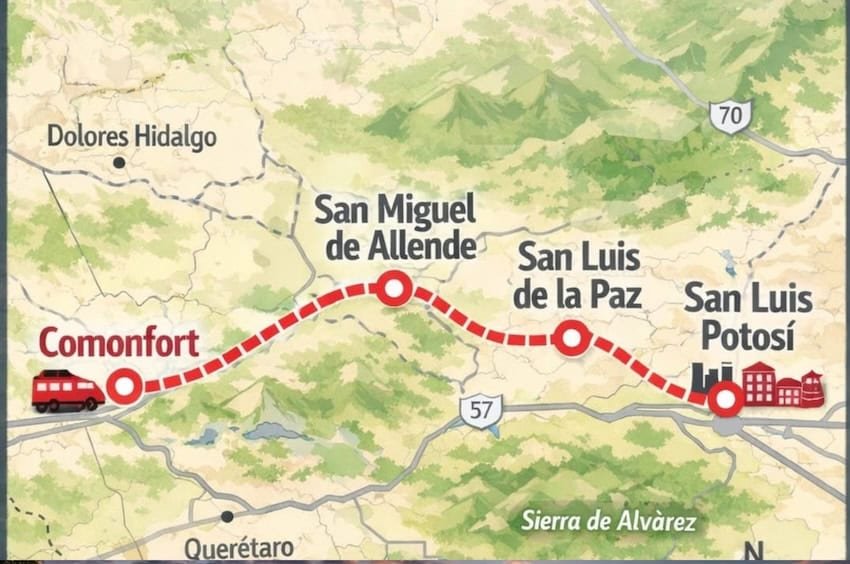
The Mexican government has launched the second construction phase of its ambitious passenger rail program, a phase that will connect central Mexico via high-speed trains to Saltillo to the north and to the Pacific coast to the west, as well as advance connections between El Bajío cities such as Querétaro, San Luis Potosi and San Miguel de Allende.
Speaking at the 25th National Meeting on Highway Engineering in Morelia, Michoacán, Efraín Deschamps Gutiérrez de Velasco, head of works at the Agency for Trains and Integrated Public Transportation (Attrapi), explained that the engineering and demand studies necessary for the next stage have been completed.
“We want to consolidate a modern rail system,” Deschamps said.
The second phase includes work on the Irapuato-León and León-Guadalajara sections, which will be built by the Felipe Ángeles Engineering Group – the same group responsible for the Felipe Ángeles International Airport near Mexico City.
Attrapi has also launched the international tender process needed to inject cost-saving competition into the selection of a contractor for the first section of the Querétaro-San Luis Potosí route, which includes the 68-kilometer stretch between Querétaro and San Miguel de Allende.
Construction for this section is expected to begin on Sept. 24, according to business intelligence platform Bnamericas.
Meanwhile, bidding for the northbound San Luis Potosí-Saltillo section will take place in stages between June and September, while the Mazatlán-Los Mochis section remains in the pre-investment study phase with no authorized start date for construction.
Finally, the Querétaro-San Luis Potosí route is part of the eventual Mexico City-Nuevo Laredo corridor planned for completion in a future phases
A third phase will expand high-speed rail service along 1,100 kilometers of the the Pacific corridor, with routes linking Guadalajara, Tepic, Mazatlán, Los Mochis, Guaymas and Hermosillo. Plans also include a potential fourth-phase project extending this western network north to Nogales on the United States border.
According to Attrapi, the new rail lines are expected to operate at speeds of between 160 and 200 kilometers per hour and will be dedicated exclusively to passenger service, with no level crossings or interaction with freight trains.
Mexico News Daily
