
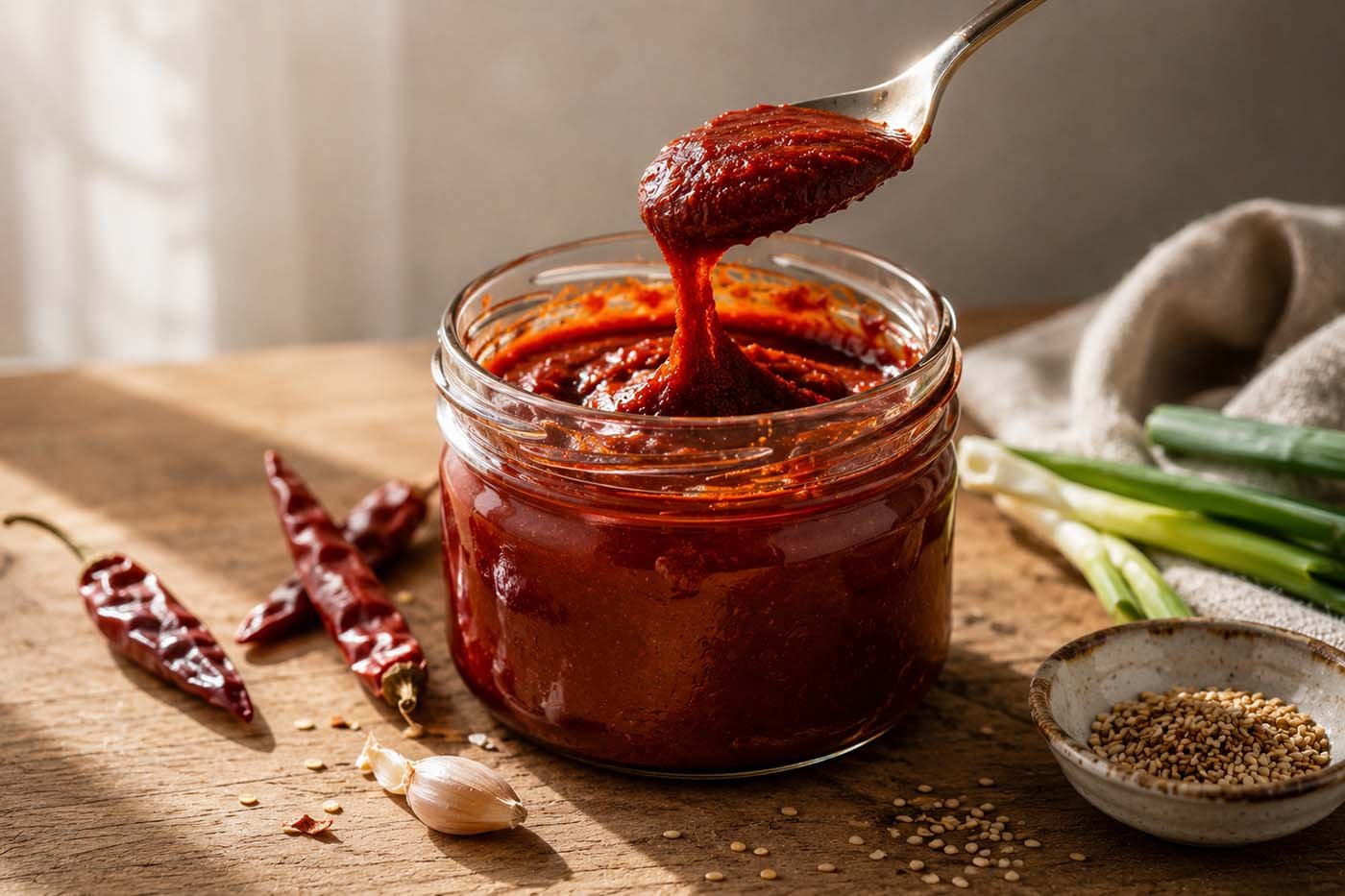
A jar of gochujang that bulges at the lid or leaks a little down the side looks like something has gone wrong. Usually, it hasn’t. Gochujang is a living, actively fermenting food even after it’s jarred, and that pressure is mostly a sign the fermentation is doing exactly what it’s supposed to do, not a warning sign on its own.
Does gochujang go bad?
The short answer: Eventually, yes, but gochujang is built to resist spoilage for a long time. Unlike foods that rely mainly on being dry, like jerky or rice, gochujang stays safe through a combination of high salt content, active fermentation, and sugar, even though the paste itself holds a fair amount of moisture. An unopened jar easily outlasts its best-by date in the pantry, and an opened jar kept refrigerated in an airtight container commonly stays good for months. Homemade or small-batch versions deserve more caution than commercial jars, since they don’t go through the same controlled process.
This guide is part of our food storage guide. If gochujang is new to your pantry, our guide on whether miso paste goes bad covers a very similar fermented, salted paste, and our roundup of foods that last longer than you think explains the broader science behind why foods like this hold up so well.
📋 Does Gochujang Go Bad: At a Glance
| Why it lasts so long | High salt, active fermentation, and sugar, not just low moisture |
| Unopened, pantry | Commonly good well past the best-by date |
| Opened, refrigerated | Commonly several months to about a year in an airtight container |
| Bulging lid or slight leaking | Usually normal fermentation gas, not automatically spoilage |
| Dark surface color | Usually normal oxidation, not spoilage |
| Homemade or cottage-industry jars | Deserve more caution than regulated commercial jars |
🔑 Key Takeaways
- Gochujang is not a low-moisture food the way jerky or dried rice are. Peer-reviewed analysis of Korean gochujang samples measured average water content around 40 percent, so its stability comes mainly from salt, fermentation, and sugar rather than dryness.
- Salt content in commercial and traditional gochujang commonly falls in the 5 to 12 percent range, and research has found salt concentration can actually decrease slightly during fermentation as ingredients release water by osmosis, a detail most storage advice online leaves out entirely.
- A bulging lid, slight leaking, or gradual darkening are all commonly reported as normal signs of ongoing fermentation and oxidation, not spoilage on their own.
- Homemade and small-batch cottage-industry gochujang are a genuinely different case. A peer-reviewed 2022 study flagged that contamination risk from bacteria like Bacillus cereus in cottage-industry gochujang has not been well studied, unlike regulated commercial production.
- Best-by dates on gochujang, like most shelf-stable fermented condiments, reflect peak quality rather than a hard safety cutoff.
Why Gochujang Resists Spoilage
🔬 The Mechanism: Salt and Fermentation, Not Just Dryness
Gochujang is made from red chili powder, glutinous rice, fermented soybean powder (meju), and salt, aged for months and sometimes years. A 2020 peer-reviewed study in Frontiers in Microbiology that analyzed Korean gochujang samples measured water content averaging around 40 percent, notably higher than a low-moisture food like jerky or rice. What makes gochujang stable despite that moisture is the combination of salt, which creates an environment hostile to spoilage organisms, ongoing fermentation by salt-tolerant bacteria and yeast that outcompete harmful microbes, and natural sugar content. Salt levels in commercial and traditional gochujang commonly range from about 5 to 12 percent depending on the producer, and interestingly, the same research found salt concentration can decrease slightly over the course of fermentation; the researchers propose this happens as fermenting ingredients release water that dilutes it, though they describe this as a likely explanation rather than a fully confirmed one. The paste stays protected less because of a fixed salt number and more because the whole fermentation ecosystem, salt, acidity, and competing beneficial microbes, keeps working together.
Signs Gochujang Has Actually Gone Bad
Mold
Fuzzy white, green, black, or blue-grey spots on the surface are the clearest sign, and like other pastes, discard the jar rather than scooping around it.
Dark Color or Surface Oxidation
Gochujang naturally darkens with age from oxidation and continued fermentation, similar to what happens with miso. A darker top layer, especially one that has been exposed to air near the surface, is commonly reported as a cosmetic change rather than spoilage. Stirring it back in is usually enough.
Bulging Lid, Leaking, or Fizzing
Gochujang keeps fermenting slowly even after it’s jarred, and fermentation produces carbon dioxide gas as a normal part of the process, well documented in lactic acid fermentation more broadly by sources like NC State Extension and University of Illinois Extension, which describe gas production as expected and instruct home fermenters to vent, or “burp,” jars specifically to release that pressure. Gochujang isn’t typically studied for this exact behavior the way vegetable ferments like sauerkraut are, but it undergoes the same basic fermentation chemistry, so a slightly domed lid or a bit of paste seeping out around the seal fits the same pattern rather than signaling something has gone wrong, and it tends to happen faster in warm weather. That said, this is not a blanket pass: if a bulging jar is also accompanied by a foul or distinctly off smell, unexpected mold, or a texture that has gone watery or slimy rather than just soft, treat those combined signs as spoilage and discard it.
Sharp, Foul, or Alcohol-Like Smell Beyond Normal Fermented Tang
Gochujang has a strong fermented, savory, spicy smell to begin with. A smell that turns unmistakably rotten or chemical, rather than just more intensely fermented, is the signal to stop and toss it.
⚠️ Homemade and Cottage-Industry Gochujang Deserve More Caution
Commercial gochujang is made under controlled, regulated conditions with consistent salt levels and, in many cases, small amounts of added alcohol during packaging specifically to help prevent microbial activity. A 2022 peer-reviewed study in the journal Foods that tested gochujang from cottage industries across Korea specifically noted that contamination risk from bacteria like Bacillus cereus in small-batch, traditionally made gochujang has not been well studied, in contrast to regulated commercial production. That doesn’t mean homemade gochujang is unsafe, traditional fermentation has worked for centuries, but it does mean a homemade or small-batch jar is a genuinely different risk profile than a mass-market jar from the grocery store, and deserves closer attention to refrigeration and clean handling.
Storage: Pantry, Fridge, and Freezer
An unopened jar is generally fine in a cool, dark pantry, and commonly outlasts its printed best-by date since that date reflects peak flavor rather than a safety cliff. Once opened, refrigeration is the standard recommendation, both to slow further fermentation and to protect flavor and texture, even though the salt content alone provides real protection against spoilage at room temperature for a while. Multiple sources describing gochujang’s opened shelf life converge on a range of roughly 6 months to a year refrigerated in an airtight container, though the exact number depends heavily on how carefully you handle it.
💡 The Habit That Matters More Than the Fridge
Always use a clean, dry spoon. Introducing moisture or food particles from a used utensil is one of the more common ways an otherwise stable, salty, fermented paste actually does spoil early. Press plastic wrap directly against the surface before closing the lid to limit air exposure, which slows both oxidation and darkening.
| Form | Best Storage | Typical Shelf Life |
|---|---|---|
| Unopened, commercial | Cool, dark pantry | Commonly well past the best-by date |
| Opened, refrigerated | Airtight container, surface pressed with plastic wrap | Roughly 6 months to a year |
| Opened, left at room temperature | Not recommended long term | Weeks at most before quality and fermentation speed become an issue |
| Homemade or cottage-industry | Refrigerate promptly, treat with more caution | Shorter than commercial; handle and store more conservatively |
| Frozen | Airtight, freezer-safe container | Extends shelf life further; texture can thin slightly after thawing |
Frequently Asked Questions
Is a bulging or leaking gochujang jar dangerous?
Usually not by itself. Fermentation produces carbon dioxide gas as a normal part of the process, extension research on lactic acid fermentation documents this well and instructs home fermenters to vent jars for exactly this reason, and gochujang keeps fermenting after it’s jarred. Treat it as a genuine warning sign only if it comes with mold, a foul smell, or a watery, slimy texture, not on its own.
Why has my gochujang turned darker over time?
That’s typically oxidation and continued fermentation, both cosmetic changes rather than spoilage. A darker top layer is common in jars that have sat for a while; stirring it back in usually restores the color and consistency people expect.
Not necessarily before opening, since an unopened jar’s salt and packaging keep it stable in a cool pantry. After opening, refrigeration is the standard recommendation, mainly to slow further fermentation and preserve flavor rather than because the paste is otherwise unsafe at room temperature. Our guide on whether gochujang needs to be refrigerated goes deeper on this specific question.
Is homemade gochujang riskier than store-bought?
It’s a genuinely different risk category, not necessarily dangerous, but less studied. A 2022 peer-reviewed study on cottage-industry gochujang specifically flagged that contamination risk from bacteria like Bacillus cereus in small-batch production has not been well researched, unlike commercial gochujang made under controlled, regulated conditions. Handle and refrigerate homemade batches more conservatively.
Why does gochujang stay stable if it isn’t actually that dry?
Because its preservation doesn’t rely mainly on dryness. Research measuring Korean gochujang samples found average water content around 40 percent, well above a genuinely low-moisture food like jerky. Salt, ongoing fermentation, and sugar do the preservation work instead, the same basic strategy used in foods like miso.
Can you freeze gochujang?
Yes. Freezing extends its already long shelf life further, though the texture can thin out slightly once thawed. It’s a reasonable option if you buy a large jar and use it infrequently.
Is it safe to eat gochujang past the best-by date?
Usually, yes, as long as it shows no mold, foul smell, or watery separation beyond normal oxidation. Best-by dates on fermented, salt-preserved condiments like this one are about peak quality, not a safety cutoff.
What’s the difference between gochujang paste and gochujang sauce for shelf life?
Gochujang sauce typically has the paste diluted with oil and other seasonings, which changes its preservation profile since it’s no longer as concentrated in salt and fermentation byproducts. Treat a diluted gochujang-based sauce more like a standard opened condiment, refrigerated and used within a shorter window, rather than assuming it has the paste’s full shelf-stability.
Why does some commercial gochujang list alcohol in the ingredients?
Some producers add a small amount of alcohol during packaging specifically as an additional safeguard against microbial activity, on top of the paste’s natural salt and fermentation protection. Products with more than 1 percent alcohol content are restricted from sale in some halal markets for this reason, so check the label if that matters to you.
They get their stability from different mechanisms, so it’s not a direct comparison. Vinegar-based hot sauce relies mainly on acidity, while gochujang relies on salt, fermentation, and sugar. Both are genuinely long-lasting condiments, just via different chemistry; see our guide on whether sriracha goes bad for that side of the comparison.
Can you cut mold off gochujang and keep using the rest?
No. Treat visible mold on a paste the same way you would on miso or soft food generally, discard the jar rather than trying to salvage the rest, since you can’t be sure how far it has spread beneath the surface.
This article summarizes general food safety information drawn from peer-reviewed food science research and standard fermented-food storage practice. It is meant to help you make an informed decision, not to replace your own judgment. Shelf life ranges here are typical, not guarantees, since actual results depend on the specific product, its ingredients, and how it was stored and handled. If gochujang shows mold, a foul smell, or a watery, slimy texture, discard it regardless of what this guide says about typical shelf life.
Further Reading
Better Living may earn commissions through affiliate links and may occasionally feature sponsored or partner content. If you make a purchase through our links, we may receive a small commission at no cost to you.
