
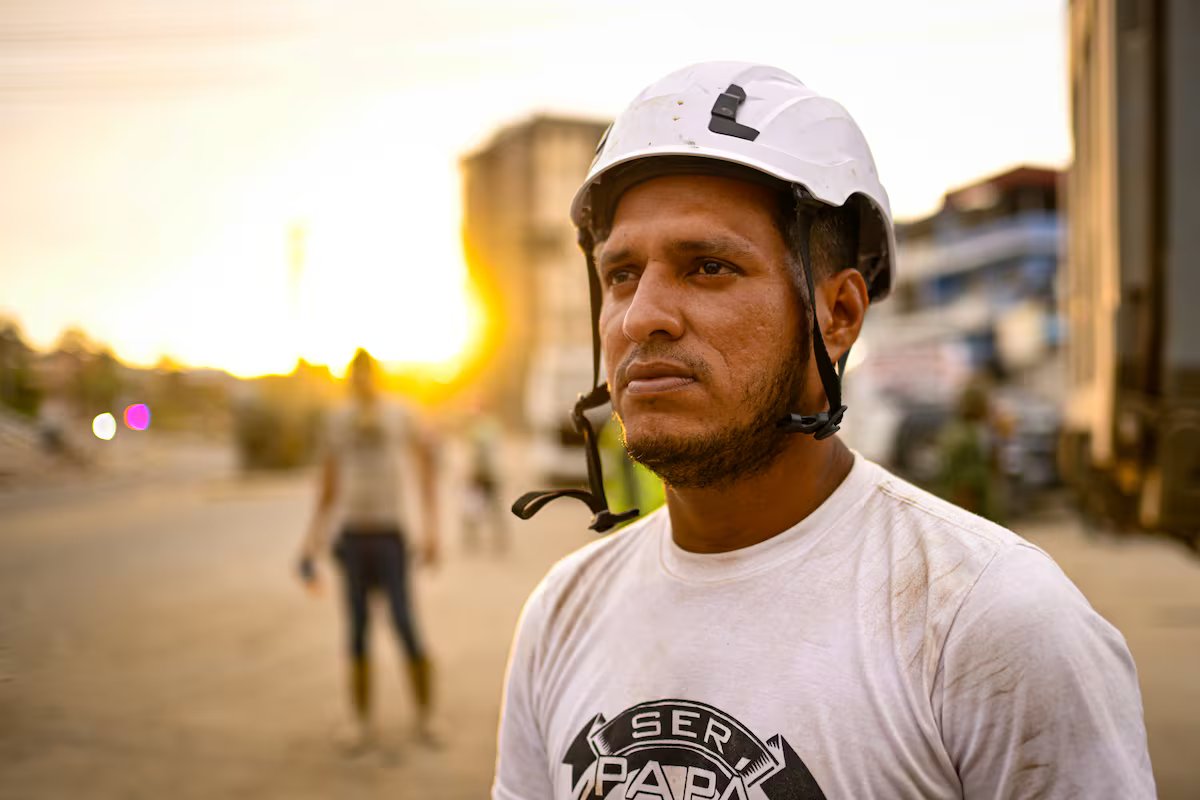
Javier Navarro rests atop a pile of rubber boots. His eyes are red from the dust, the lack of sleep he dulls with one cigarette after another, and the moments when he breaks down in rage and grief, like the day he pleaded with the operators of the heavy machinery to stop pushing ahead with the demolition of collapsed buildings.
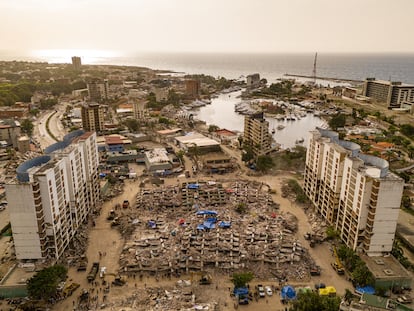
He lost nine relatives in one of the massive Misión Vivienda towers in Caraballeda that came crashing down after the June 24 earthquakes in Venezuela. This week he was expecting to receive his mother’s ashes, the last family member rescuers managed to recover. Four more relatives, however, remain buried beneath the rubble.
The death toll from the 7.2 and 7.5 magnitude earthquakes has surpassed 5,300, according to the latest government figures. Yet judging by the number of people who, a month later, still wait outside the ruins of collapsed buildings, many believe hundreds of victims are still trapped under the debris. Official reports do not specify whether the recovered bodies are those of men, women or children, nor where they lived. The authorities have also stopped speaking about the missing. No one knows how many people are unaccounted for. The death toll rises every day, with little clarity about when, or at what number, it will finally stop.
More than 17,000 people have lost their homes, and interim Venezuelan President Delcy Rodríguez this week handed over the first 240 replacement apartments. At the same time, the leader, who has been awarding medals to rescue dogs and emergency workers while announcing reconstruction plans, is trying to manage the disaster under Washington’s oversight. This is happening in a country that was already living through its own political and institutional earthquake following the U.S. military intervention of January 3.
“I lost my mother, my grandmother, a daughter, a grandson, my sister, my nephew, my stepfather, all the friends we had there.” Javier tries to name them all, but his memory fails him.
He has spent an entire month at the foot of the ruins where he lived with his family for more than a decade. In 2014, he was relocated from the Torre de David, the unfinished financial skyscraper in downtown Caracas that was abandoned after the 1994 Venezuelan banking crisis and occupied by families with nowhere else to live. The building became both a vertical slum and inspired an exhibit at the Venice Biennale. From those ruins, residents were moved to what are now the collapsed OPP towers, named after the Office of Presidential Plans that built them.
For now, Javier has stepped away from the search for his own relatives. He says he did so to protect himself emotionally. “I can look at any dead body, but not mine. I want to remember my family as they were,” he says.
While other volunteers continue searching for his loved ones, he coordinates aid distribution from a tent he erected himself. Through donations, he has obtained masks, gloves, rubber boots, water, scissors, food, hammers, pickaxes, shovels and drills. He also lends out gas cylinders for cutting equipment and portable generators. It is this improvised network that sustains the work of hundreds of volunteers and rescue workers helping recover bodies in La Guaira.
“What do you need to get your family out? A hammer?” Javier asks a man who approaches.
The morning unfolds inside the tent he calls the “logistics center,” where everyone stops by to greet him.
“Don’t give anything to anyone who isn’t dirty,” Javier warns a woman keeping track of supplies in a notebook.
According to several people, as the days pass, newcomers have begun showing up who are not taking part in the rescue effort but are eager to benefit from the donations pouring into La Guaira. At the same time, supplies are starting to run low. The water shortage is already being felt, is the subject of complaints, and threatens to deepen the crisis.
Civilians, firefighters and soldiers all pass through Javier’s tent. They share the same sense of scarcity, lacking the equipment needed to recover bodies from what has become Venezuela’s worst disaster in recent memory. A task that in other countries would be carried out by specialists trained in collapsed-structure rescue has here fallen, almost literally, into the hands of ordinary people.
Javier is 36 years old and has emerged as a leader amid the catastrophe. He organizes teams of men to work in the collapsed buildings, much as he did before June 24, when he made a living renovating and constructing homes in Caracas. Now he coordinates body-recovery efforts at other sites in La Guaira, where families smaller than his own struggle to move massive slabs of concrete.
As he sorts through boot sizes for distribution, he recounts that a client called a few days ago to tell him the recent work he had done at her home suffered no damage from the earthquakes.
“Not a single crack showed up,” he says. “That makes me happy.”
At the OPP towers, each family has dug its own tunnel in search of loved ones. The one opened by the group searching for Navarro’s relatives is about 10 meters deep. It is equipped with fans and a string of lightbulbs illuminating the way. The tunnel reaches the first-floor apartments of a 12-story tower, now buried beneath the full weight of the collapsed structure. People crawl through it until reaching a cavity where they can sit and dig for as long as their lungs allow. Behind a column they must break apart are Javier’s stepfather and other relatives. “It’s the tunnel from hell,” they say.
That’s what everyone calls it, because they say parts of bodies can be seen through the cracks in the collapse.
“I had no idea how to do this. I only have construction experience, but we’ve been there helping others because they’re human beings,” says Eddy Ponce, 35, who arrived a few days ago as a volunteer. “You have to fight the sun, the flies and the rebar. Your life is at risk,” he adds as he picks up a new face mask.
“Now we’re even forensic examiners,” says Juan Carlos Marcano, 40, who also collects tools at Javier’s tent. He is looking for his niece and has not found her yet, but he has recovered 10 bodies for other families. “If you had asked me a month ago if I could do this, I would have said no. The hardest part is the number of children I’ve seen under that rubble,” the informal trader recounts. “All of us who lived through this need psychological help. But I can’t worry about myself, because there are people who are more in need of help, who suffered greater losses. I can’t feel the pain of a mother or of a child who lost their mother. I feel an uncle’s pain. Everyone has their own pain.”
Juan Carlos’s sister is waiting for him to complete the mission of recovering her daughter’s body before leaving La Guaira for good. “There are people who can’t stand being here anymore,” she says.
Despite having no prior experience, Juan Carlos says that around the fallen buildings, everyone works like clockwork: someone brings a shovel, someone swings a hammer or brings coffee so the enormous collective effort keeps going.
Even those who know how to enter collapsed structures feel overwhelmed. María Andrade, 43, a firefighter with nine years of service in the state of Yaracuy, has been working for 15 straight days without relief. Back home, where the earthquake’s epicenter was located and damage was relatively limited, flooding has created a new emergency.
“What’s happening is very hard. I sympathize with all the people of La Guaira,” she says while waiting for boots and a bag of food.
Her colleague Asdrúbal Meléndez comes into Javier’s station to ask for something to fight the flies, which make work, rest and eating almost impossible.
“This is a very intense psychological experience. We are trained, but not for something of this magnitude. There are so many dead,” he says. The rescuer says this week he recovered the bodies of a family of four. “They wanted to remove them intact, but we had to maneuver and had to break one of them,” he laments.
With a specialized crane, he explains, rescuers could lift the concrete slabs one by one and determine whether human remains lay beneath them before clearing the debris. “There’s no point in bringing in crushing machines, because then no one will be able to be identified,” he says.
The worry about what’s to come is constant. Mid-morning, one of the members of Javier’s crew arrives at the tent and reports that they had to leave the tunnels. The vibration from the running machinery feels like another earthquake inside the ruins.
“Don’t even think about demolishing anything, because I’ll chase all those bastards with their machines away,” says Javier. “We don’t want them to dig up our dead. People aren’t going to leave their dead there. Some say they can’t be removed, but we say they can.”
Concern about what’s coming is constant. Midmorning, a member of Javier’s crew arrives at the tent and reports they had to leave the tunnels. The vibration of running machinery is felt like another earthquake inside the ruins. “Don’t even think about demolishing, because I’m going to chase away all those dogs with their machines,” Javier protests. “We don’t want our dead chopped up. People won’t leave their dead there. Some say they can’t be removed, but we say they can,” he says.
One month later, the tension between those searching for bodies and those clearing the collapsed buildings in the epicenter is palpable. In some of the fallen blocks where no one remains, messages reading “Do not demolish” have been put up. Others have posted signs to highlight that the site is “private property,” a preview of the struggle likely to come as survivors fight over the land where their homes once stood.
These days, the background noise in La Guaira isn’t the sound of the sea, but rather that of the engines and blades of the backhoes deployed by the government. While in the early days the streets were clogged with ambulances, rescue vehicles, and thousands of volunteers delivering aid, now the main thoroughfare of this coastal city is mostly filled with trucks hauling debris back and forth.
Sign up for our weekly newsletter to get more English-language news coverage from EL PAÍS USA Edition
