
Want more housing market stories from Lance Lambert’s ResiClub in your inbox? Subscribe to the ResiClub newsletter.
Doug Bauer, CEO of Tri Pointe Homes—America’s 19th largest homebuilder—thinks the phrase “affordability” gets overused.
“It’s a catchy term,” Bauer tells ResiClub. “You pull it up in ChatGPT or Webster’s dictionary, and it’s what one person could afford to pay for that good or service. And everybody’s a little different.” Tri Pointe skews toward move-up buyers, he says, and his argument is that net effective new-build pricing in core homebuilding markets has already come down meaningfully from its 2022 frenzy highs—which means the real obstacle holding back demand right now isn’t affordability at all, he says. Instead, the issue now is confidence, he argues.
“They [buyers] have a confidence problem,” Bauer says. That confidence problem, more than pricing, is what he says has kept new-home demand subdued this year—and it was worsened by a spring spike in oil prices.
“We saw the data up through March, the consumer re-engage,” Bauer continues. “It kind of felt like, hey, 2026 is going to be different.” Then came the Middle East conflict, spiking gas and fertilizer prices, and injecting a fresh round of uncertainty just as buyers were starting to come back. “Everything is in flux.”
But he pushes back hard on the idea that today’s demand softness in the core homebuilding markets is primarily a pricing story.
Net effective new home prices are down more than the sticker suggests
Ask Bauer whether affordability—including price—is still holding back new-home demand, and he doesn’t hedge.
“I disagree 100%,” he tells ResiClub. “Housing prices, the new home prices . . . have come down.” New homebuilders are handing out large incentives, he argues, and “you’ve got to look at the net-net effect of pricing” rather than list prices alone.
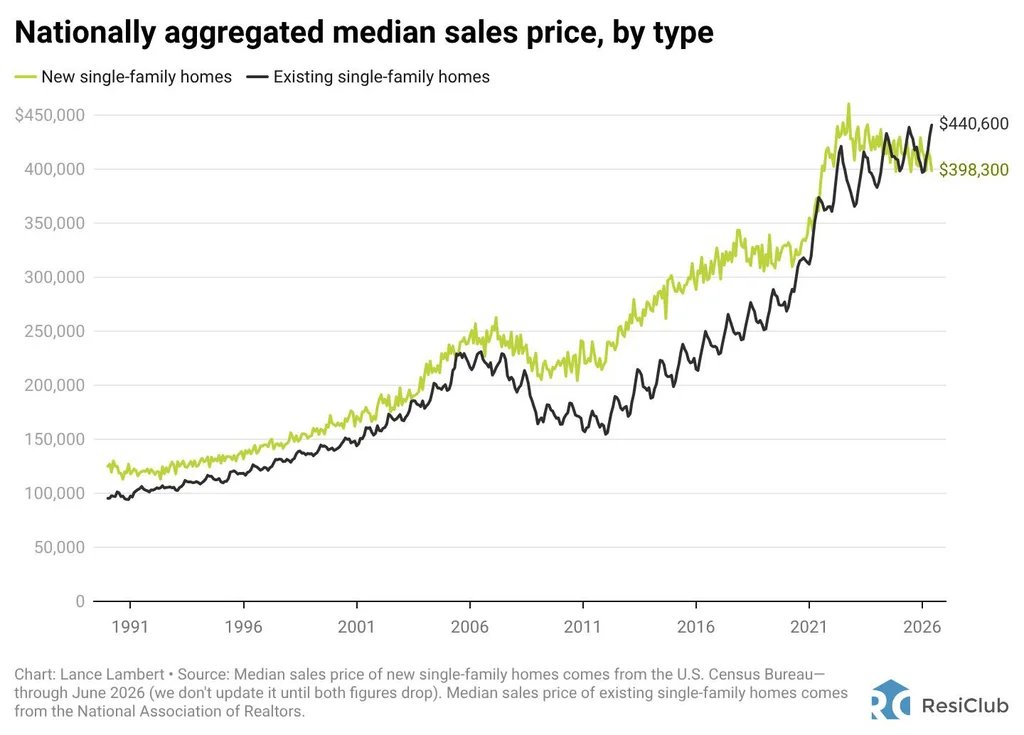
By Bauer’s estimate, pricing in Tri Pointe’s core “A” markets—the higher-end, supply-constrained submarkets the large homebuilder focuses on—is down 5% to 10% on a net effective basis from the peak of the pandemic housing boom. In the “B” and “C” markets, where builders chased volume during the pandemic boom and have since had to write down land, net effective pricing is down considerably more: 15% to 20% from the peak.*
“Now all of a sudden, all the builders that went out for big volume and went to the B and C markets are coming back,” Bauer says, adding many of those same builders are now booking impairments in those submarkets. He declined to name specific submarkets—”I don’t want to throw anybody under the bus”—but suggested buyers and analysts triangulate it themselves: Identify a market’s most desirable “main and main” location, then work outward. “You can use Zillow” to see the pattern play out in the data, he says.
Bauer also pointed to the widening—and in some cases inverted—gap between new and resale pricing as evidence that new-home price discovery has already happened. He cited Lennar’s average sales price net of incentives of $371,000, against a national median resale price of $440,600. “When have you seen new home pricing below the resale price?” he asks.
On incentives specifically, Bauer says that Tri Pointe’s are in the 9% to 9.5% range of the purchase price. Of their net effective home price cuts, an estimated 50% to 60% came in the form of design option discounts and another 20% to 25% as financing-related credits (rate buydowns, mortgage credits), with the remainder going toward other price discounts. He was careful to distinguish Tri Pointe’s approach from larger-volume builders: “We want to protect our margins.”
Bauer also disputed the popular narrative that mortgage rates are the primary lever on housing demand. “Interest rates are a function of how much you can pay for a house—it’s your payment. Interest rates [are] not a demand driver,” he says. “What drives housing is jobs. Consumer confidence [is] the primary driver. I’ve been looking at that for 35 years.”
Tri Pointe CEO’s regional commentary
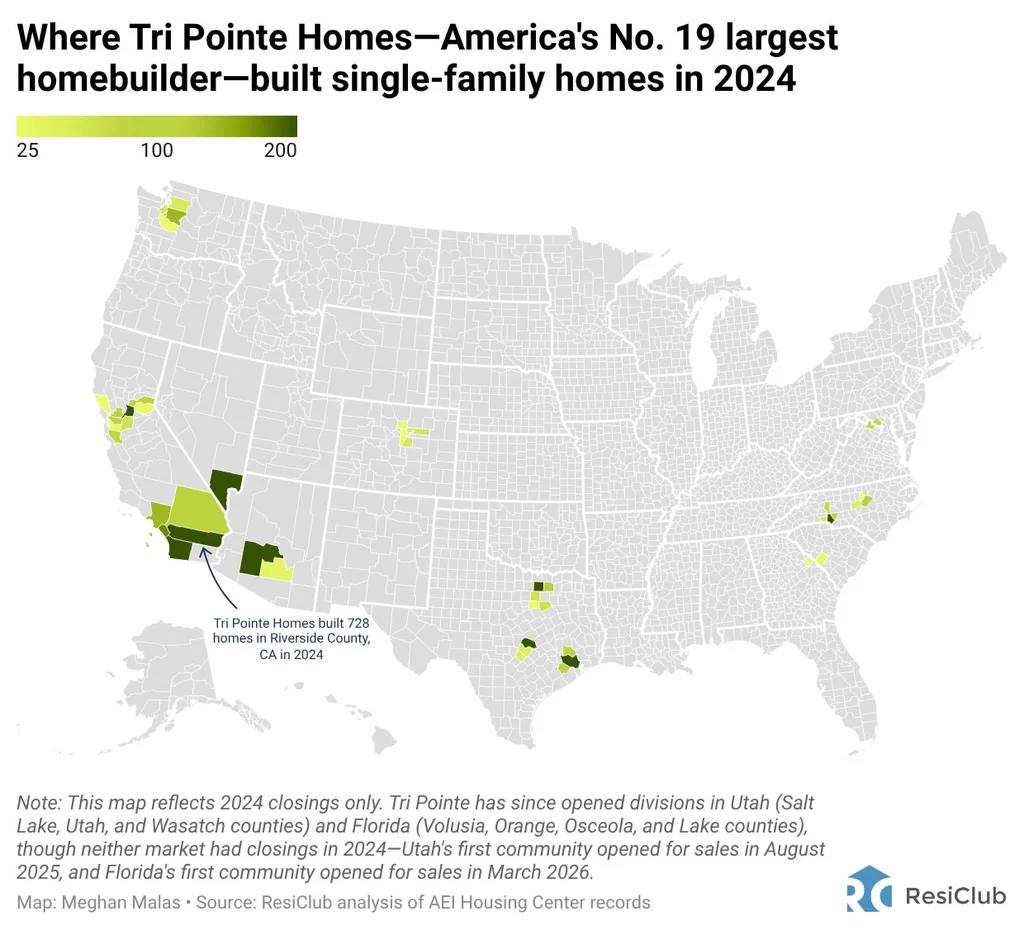
Industry-wide, Bauer tells ResiClub, a “stabilized” absorption pace is roughly three sales per community per month. Tri Pointe is currently running below that, between 2.2 and 2.5.
Relative to its own internal plan, Bauer says Tri Pointe’s best-performing divisions in the second quarter were the Inland Empire, San Diego, Arizona, Colorado, and Utah. Colorado in particular has been a turnaround story: “I’ve never been happy with the Colorado market,” he says, but it’s “bouncing back . . . a little bit of stabilization,” though he stopped short of calling the market fully healed.
Regarding the Austin, Texas, metro area—one of the most-watched markets for its post-pandemic correction—Bauer struck a longer-term bullish tone despite near-term softness. Despite making affordability adjustments in the Austin market, Bauer says Tri Pointe has avoided major impairments there, unlike some other builders, thanks to a strong local division president, and that the company continues to acquire land in core locations, betting on the metro’s tech-driven growth (citing SpaceX and other employers) playing out over a three- to five-year horizon.
“Well, I’ve seen anecdotally a lot of [homebuilder] division presidents lose their jobs [the past few years] because they [were in] B and C markets and they have huge impairments, and frankly, we have one of the best division presidents that has been in the [Austin] market. So we’ve had, knock on wood, no issues,” Bauer tells ResiClub.
He drew a sharper distinction between Texas’s three major metros: “Austin either goes hot or it goes cold, Houston is always steady Eddie, and Dallas is so-so.”
Going private: What the Sumitomo Forestry deal means for Tri Pointe
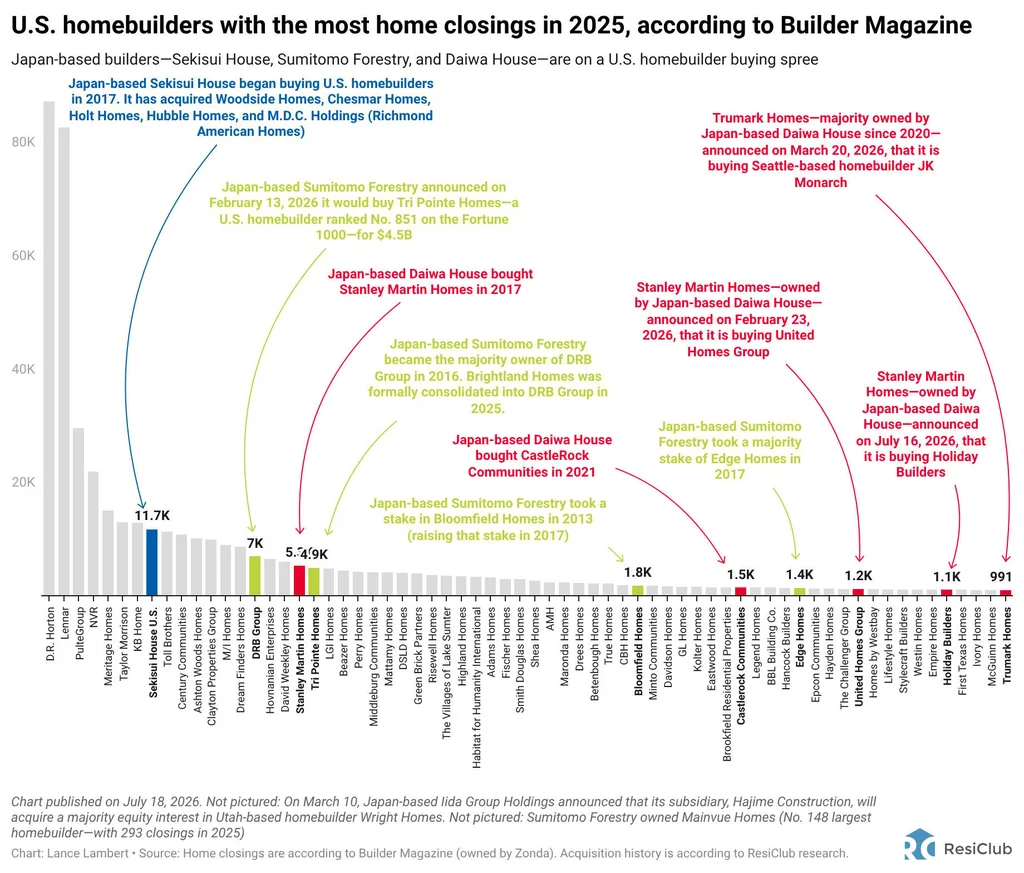
The ResiClub interview with Bauer comes on the heels of Tri Pointe closing its acquisition by Japan-based Sumitomo Forestry—a $4.5 billion, all-cash deal announced in February and closed in May, which took the country’s 19th-largest homebuilder private and folded it into Sumitomo’s growing U.S. homebuilding network alongside DRB Group and Brightland Homes.
Bauer says the deal was two years in the making. “We spent two years getting to know the Sumitomo people . . . the reason we did the deal is because we have shared values and culture. But number two, they think of this business in decades.” He calls that long-duration mindset—as opposed to the quarterly cadence of public markets—”the way homebuilding should be thought of.”
The frustration with public-market scrutiny came through repeatedly during the interview. Homebuilding, Bauer argues, is a fundamentally long-cycle business poorly suited to quarterly reporting: Raw land alone can take three to 10 years to turn into finished lots. “I have to come to the analysts every quarter and tell you how I’m doing,” he says. “The analyst, going, ‘Well, you’re not doing well, Bauer,’ or ‘you’re doing really good.’ . . . I have triple-A properties in Austin or Houston or Seattle, and you’re telling me I’m not doing well.”
Bauer says some of Tri Pointe’s financials will remain public—a requirement tied to its debt—but he personally will no longer sit on earnings calls or manage Wall Street guidance. He framed the acquisition as unlocking growth the public-market structure had constrained: Tri Pointe’s stated goal, he notes, is to grow from roughly 5,000 to 6,000 annual deliveries currently to more than 9,000 by 2030.
“I’ve taken a 50-pound weight off my shoulders,” Bauer says of no longer reporting to public shareholders. “All I focus on is growing this business.”
He also argues that Sumitomo’s structure—six builder brands rolled up under Sumitomo Forestry’s broader housing platform—already makes the combined entity roughly the fifth-largest homebuilder in the country by that measure, even though the individual brands, including Tri Pointe, will continue to operate under their own names and local management teams.
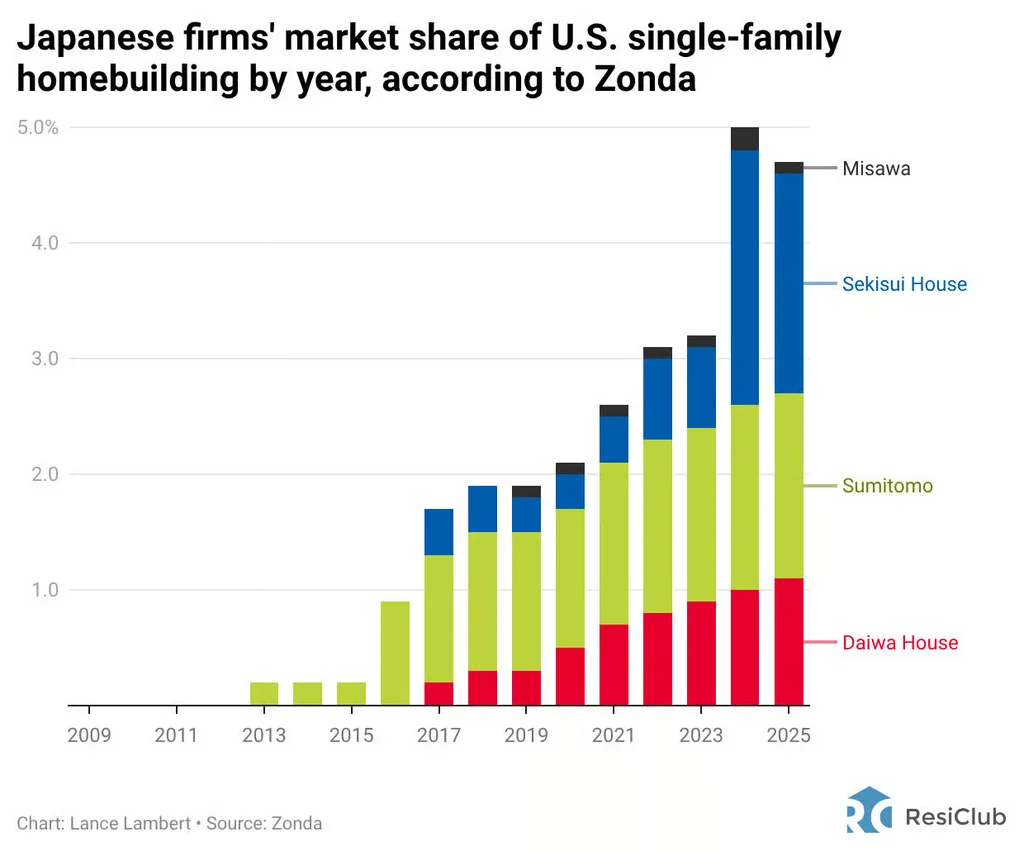
Asked whether he expects more Japanese firms to keep acquiring U.S. builders, Bauer wouldn’t speak for Sumitomo, Daiwa House, or Sekisui House directly, but says he’d bet on it continuing over the next five years: “I would say yes.”
Berkshire Hathaway and the Japanese builders are converging on the same thesis—from different starting points
The Sumitomo deal for Tri Pointe landed a few months before Warren Buffett’s chosen successor, Greg Abel, made his own major bet on site-built homebuilding: Berkshire Hathaway’s agreement to acquire Taylor Morrison, America’s sixth-largest homebuilder. Bauer sees the two moves as validating the same underlying idea, even though the Japanese builders and Berkshire are arriving at it from different directions.
“It made Toshi [Sumitomo Forestry’s CEO] look brilliant,” Bauer says. “Let’s face it—Berkshire Hathaway, like Sumitomo, invests in management teams and thinks in decades, not quarters. That’s the beauty of the deal we have with Sumitomo . . . it’s a great proxy to see Berkshire Hathaway make a similar conclusion.”
Japanese builders are pushed abroad by demographics: a shrinking, aging population at home limits their long-term growth potential, so they’re looking to the U.S. for a more durable population and household growth. Berkshire, by contrast, is pulled in by valuation, Bauer says. “They like to buy into industries and companies that are undervalued,” he says of Berkshire Hathaway. “So there are two dynamics: Japanese [firms] are seeing they want to be part of the growth in U.S. housing because their markets are dropping, and Berkshire Hathaway says, ‘these are undervalued assets.’”
Bauer argues that publicly traded homebuilders are structurally mispriced by Wall Street, pointing to the gap between homebuilder valuations and those of building-products companies. “Why are we trading at sevens, eights, and nines, and they’re trading at mid-teens?” he asks, referring to price-to-earnings multiples. “Wall Street cannot appreciate the amount of [land-cycle] lift—they just think we’re a balance sheet full of real estate assets. When interest rates go up, our stocks go down. When interest rates go down, the stocks go up.”
That mismatch, in his view, is exactly what’s drawing in patient, long-horizon capital from both directions—Japanese strategics and Berkshire alike—and he expects it to keep pulling public homebuilders toward private ownership. “I believe there’s a privatization of homebuilding that’s going to go on in the U.S.,” he says, repeating a thesis he returned to several times in the conversation. “This business is really tough to be in the public arena.”
Underlying all of it, Bauer says, is a demand fundamental he doesn’t think goes away regardless of the macro noise of any given year. “Food, water, and shelter—the most important things in life. It’s never going to go away. AI can’t take it away.”
*A note on today’s story:
Throughout the ResiClub interview article above, Bauer refers to “A,” “B,” and “C” markets. He’s not using formal industry classifications or referring to entire metro areas. Instead, he’s describing submarkets within a region. “A” markets are the “main and main” locations—prime, supply-constrained neighborhoods where Tri Pointe focuses its business. “B” and “C” markets generally refer to increasingly suburban or exurban locations, where many builders expanded during the pandemic housing boom. Bauer argues that those outer-ring markets in core homebuilding markets have experienced the largest net effective price corrections, while prime “A” markets have remained more resilient.
