About 2,014 people in northwestern Ontario remain under evacuation due to wildfires in the region, according to a spokesperson for the province’s minister of Emergency Preparedness and Response.
As of Thursday, 14 communities have been evacuated, five have returned home and one is in the process of returning.
The ministry has held over 100 co-ordination calls with First Nation chiefs, leaders and communities, emergency management partners, municipalities and the federal government since the first Request for Assistance was received on July 14, according to Minister Jill Dunlop.
“The number of evacuees is reported into the Provincial Emergency Operations Centre (PEOC) by community leadership. Evacuation numbers may fluctuate as community leadership confirm the total number of evacuated community members with the ministry,” wrote spokesperson Julia Facca on Wednesday.
Eabametoong First Nation is planning to start sending evacuees home from Niagara Falls as early as Friday, the community posted on Facebook.
Meanwhile, other communities, such as Gull Bay First Nation, are urging those who have not left the community to do so as quickly as possible.
“I would not ask you to leave your home or our land if it were not truly necessary. But for your own safety, and for the safety of our community and our responders, please leave now,” Gull Bay’s Chief Wilfred King wrote in a community notice on Wednesday.
Active fires in the northwest
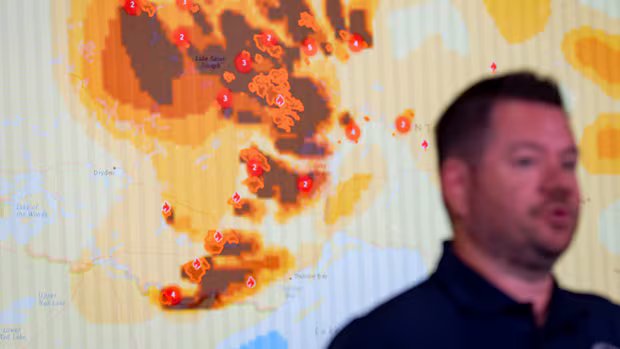
There are 115 active wildfires across northwestern Ontario, according to the latest update from Ontario’s Aviation, Forest Fire and Emergency Services (AFFES) issued on Thursday evening.
Of these, 22 are not under control, six are being held, five are under control and the rest are being observed.
There were also two new fires confirmed in the northwest:
- Red Lake 26 (RED026)is located southwest of Confusion Lake, near Bond Road. The 0.2-hectare fire is being held.
- Kenora 27 (KEN027)is located approximately 3 kilometres west of Highway 525, near Pig Lake. The 2.0-hectare fire is not under control.
The largest wildfire in the region, known as Thunder Bay 36, remains out of control at almost 314,000 hectares. A NOTAM (Notice to Airmen) is also in effect in the area.
Yellow warnings
A yellow heat warning from the Manitoba border, south to the Canada-U.S. border and north to Dryden has moved east toward Jellicoe on Wednesday.
Environment and Climate Change Canada says conditions will continue through Thursday, with daytime highs of 27 to 29 C, humidex values of 30 to 33, and nighttime lows of 13 to 17 C.
Evacuation, implementation orders
Nishnawbe Aski Nation Grand Chief Alvin Fiddler has issued a statement in support of a public inquiry into Ontario’s response to this summer’s wildfire crisis.
Evacuation orders or alerts remain in effect for areas near the following fires:
Those under evacuation orders are required to leave the area, while those under evacuation alerts are urged to prepare to evacuate.
The Ministry of Natural Resources’ Thunder Bay–Ignace District has invoked implementation orders near the following fires:
- Dryden 34 and 35.
- Fort Frances 14.
- Thunder Bay 36, 54 and 56.
Implementation orders limit people’s ability to travel in and around these fires.
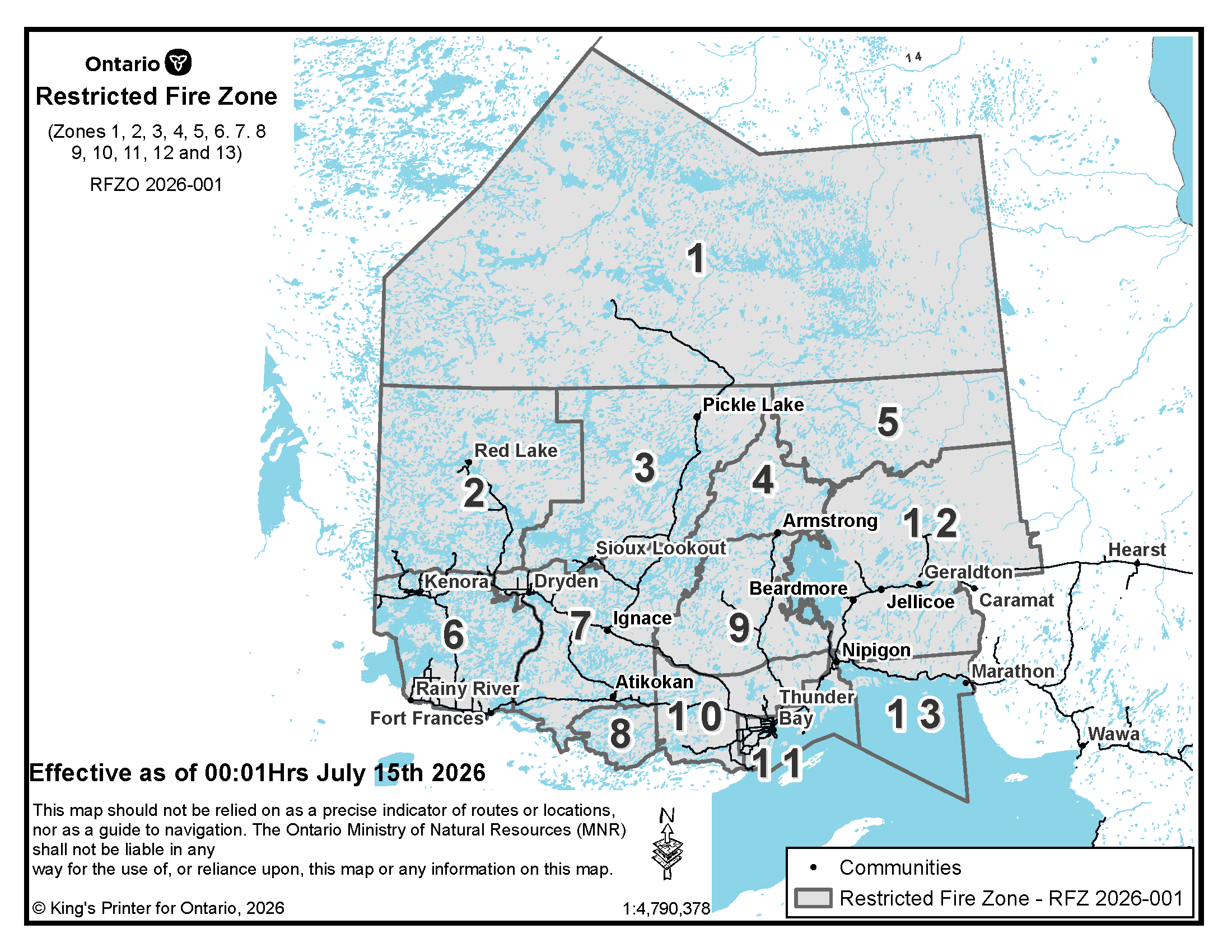
Northwestern Ontario and a small portion of northeastern Ontario remain under a restricted fire zone, which means no open-air burning, including campfires, is allowed.
The forest fire hazard is mostly high across the northwest, with a pocket of extreme hazard in the far north that will affect communities, including, but not limited to, Bearskin Lake First Nation, Kitchenuhmaykoosib Inninuwug and Kingfisher Lake First Nation.
Another high-hazard pocket surrounds Webequie First Nation and another exists in the Kenora district.
Highway closures in effect
According to the province’s interactive highway map, the following roads are closed due to wildfire activity:
- All lanes are closed in both directions on Lac des Mille Lacs Road from Inwood Road to Highway 17.
- Highway 811 is closed, with the exception of local traffic evacuating the area.
- Highway 527 is closed in both directions between Tertiary Highway 811 and Armstrong.
The Ontario Provincial Police (OPP) urge people for their safety and the safety of emergency responders to:
- Stay away from affected areas and refrain from attending wildfire scenes to take photos or videos.
- Remain calm and follow all evacuation orders and emergency instructions issued by local authorities.
- Avoid non-essential travel in affected areas.
- Monitor official sources for the latest information and evacuation updates.
- Remain away from evacuated areas until authorities have advised it is safe to return.
- Help keep roadways clear so emergency personnel can carry out their work safely and effectively.
- If evacuating, bring essential medications, identification, important documents, mobile devices and chargers and any items required to support family members and pets.
Canada Post red delivery service alerts
Mail delivery has been suspended in the following communities due to wildfire activity:
- Cat Lake (evacuation order).
- Gull Bay.
- Armstrong Station (evacuation order).
- Collins (evacuation order).
“Effective July 24, residents and businesses of Aroland (P0T 1B0), Cat Lake (P0V 1J0), Gull Bay (P0T 1P0), Armstrong Station (P0T 1A0) and Collins (P0T 3E0) receive free Mail Forwarding service for up to 12 months. Impacted residents have until Aug. 24 to register for the free service,” Canada Post said.
Five new fires in the northeast
Five fires were confirmed in the northeast, according to the latest update from Ontario’s Aviation, Forest Fire and Emergency Services (AFFES) issued on Thursday evening.
- Sudbury 39 (SUD039)is 0.1 of a hectare and located approximately 4 kilometres east of Fire Star Lake and 8 kilometres north of Lefebvre Road. The fire is not under control.
- Sudbury 40 (SUD040) is 0.6 of a hectare and located approximately 31 kilometres north of Lake Wanapitei and 4 kilometres east of Bowland Lake. The fire is not under control.
- Sudbury 41 (SUD041)is 0.2 of a hectare and located approximately 18 kilometres south of Swallow Lake and 17 kilometres northeast of Bark Lake. The fire is not under control.
- Sudbury 42 (SUD042) is 0.2 of a hectare and located approximately 4 kilometres north of Mozhabong Lake and 6 kilometres east of Alton Lake. The fire is not under control.
- Sudbury 43 (SUD043) is 0.3 of a hectare and located approximately 29 kilometres north of Lake Wanapitei, and along the northeastern shore of Frederick Lake. The fire is not under control.
There are currently 42 active wildfires in the northeast. Of these, five are not under control, two are being held, two are under control and the rest are being observed.
Hazard levels are high, with pockets of extreme hazard near the Greater Sudbury area.
Aid against forest fires
There are 100 contracted aircraft, including seven medium helicopters actively responding during wildfire season, according to the Ministry of Natural Resources.
It can also access up to 80 additional crews through private contracts if needed.
The ministry said it is providing an additional $650 million to purchase six new waterbombers and five new helicopters.
It has also added 170 new permanent fire personnel positions, including crew lead roles, and increased compensation for staff, including firefighters and pilots.
The ministry will conduct an after-action review of its wildfire response to inform improvements in planning and response.
There have also been four Ontario Corps partners and 17 Ontario Corps volunteers sent to help. The province said the following equipment/supplies have been provided:
- 312 air purifiers.
- 84 air filters.
- Five air scrubbers.
- 7,040 N-95 masks.
- 4,676 hygiene kits.
- 80 food hampers.
Air purifiers, air scrubbers and replacement filters, in particular, were sent to five First Nations, allowing them to remain in their communities.
As part of these efforts, Feed Ontario and the Ontario Federation of Indigenous Friendship Centres are also shipping and distributing food to evacuees.
In addition, the Kaministiquia and Upsala fire departments were among some regional fire services to receive wildland fire skids from GlobalMedic.

This year’s wildfire season in northwestern Ontario has shone a light on the challenges facing smaller fire departments, as volunteers do what they can with the limited resources at their disposal. Here’s how GlobalMedic is supporting those on the front lines to help them better protect their communities.
Mexico, Alberta, New Brunswick, Newfoundland, the Yukon, PEI, the Canadian Forest Service and the Canadian Interagency Forest Fire Centre have also offered province-wide assistance.
Thunder Bay transitions to ‘enhanced monitoring’
The City of Thunder Bay moved from active emergency co-ordination to enhanced monitoring.
Residents are encouraged to take steps to reduce wildfire risk around their homes and properties by following FireSmart principles.