
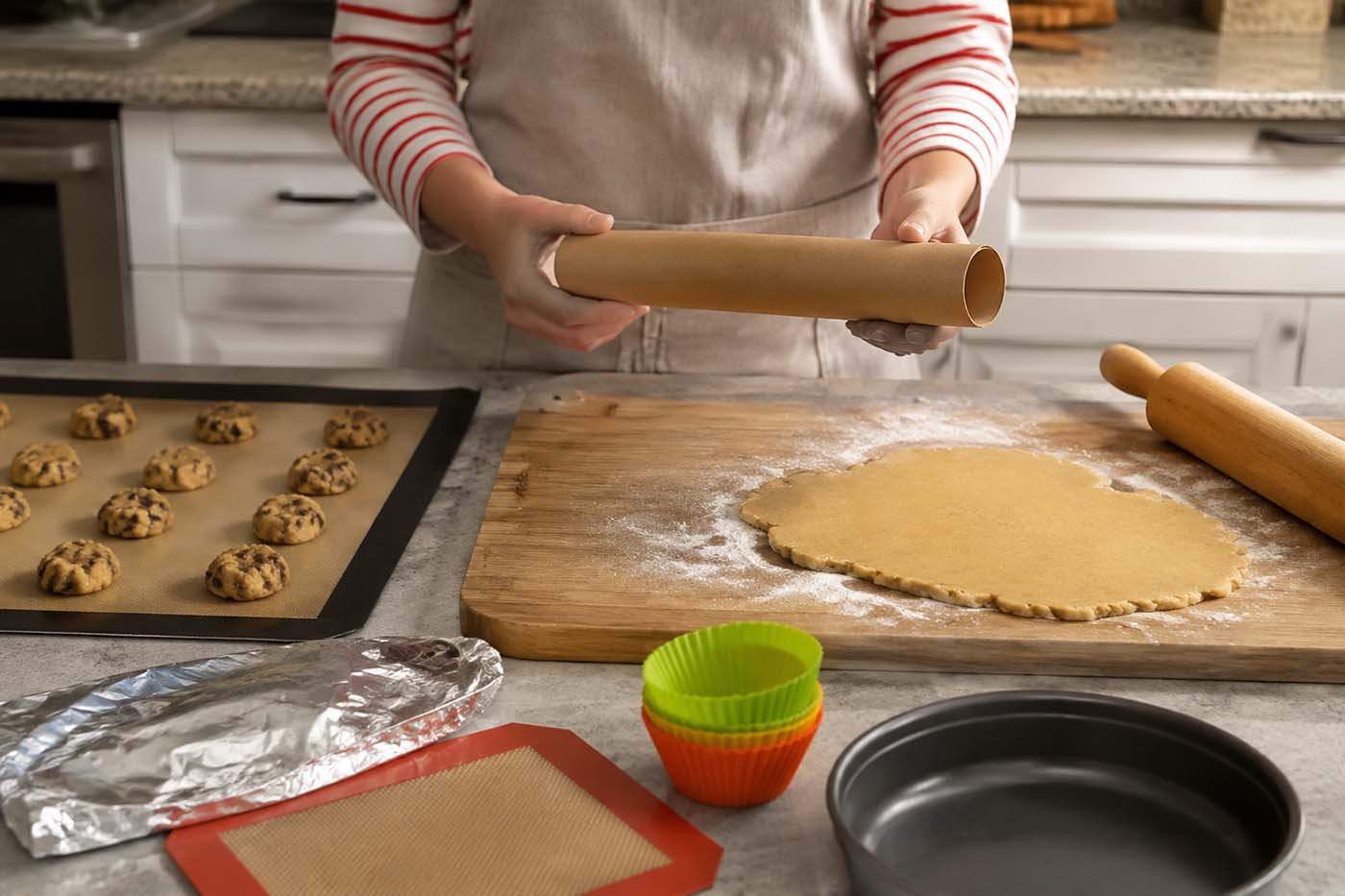
You are ready to slide a tray of cookies into the oven and reach for the parchment paper, only to find the roll is empty. Maybe you are rolling out pie dough on the counter and need something nonstick to work on. Or you just switched to an air fryer and are not sure what liner is actually safe to use in it. Parchment paper handles two very different jobs in a kitchen. It gives food a nonstick surface to bake on in direct oven heat, and it gives you a nonstick surface for tasks that never see the oven at all. Once you know which job you need, the right substitute is usually already in your kitchen.
What Can You Use Instead of Parchment Paper?
The Short Answer: Greased aluminum foil, a silicone baking mat, and a greased pan all work for oven baking. So do nonstick cooking spray, cornmeal or flour dusting, butcher paper, and reusable silicone muffin liners. For steaming or wrapping food, banana leaves or corn husks add flavor the way foil cannot. Wax paper works too, but only for tasks that stay out of the oven entirely, since its wax coating melts and can smoke or catch fire under direct heat. The right choice depends on whether the job involves heat at all.
For related pantry swaps, see our what can I use instead of breadcrumbs, what can I use instead of heavy cream, and what can I use instead of sour cream guides.
📋 Parchment Paper Substitutes: At a Glance
| 🧻 Aluminum foil, greased | 1:1 ratio, best all-purpose oven substitute |
| 🍳 Silicone baking mat | 1:1 ratio, best reusable substitute |
| 🕯️ Wax paper | No heat only, rolling and cold storage |
| 🧈 Greased and floured pan | Best when you have neither on hand |
| 💨 Nonstick cooking spray | Best for quick, light bakes |
| 🌽 Cornmeal or flour dusting | Best for bread and pizza |
| 🥩 Butcher paper | Best for wrapping and smoking meat |
| 🍌 Banana leaves or corn husks | Best for flavor-infused steaming and wrapping |
| 🧁 Silicone muffin liners | Best for cupcakes and muffins |
🔑 Key Takeaways
- Parchment paper does two distinct jobs: lining a pan for direct oven heat, and providing a nonstick surface for tasks that stay cold or at room temperature. The right substitute depends on which job you need.
- Never put wax paper in the oven or under a broiler. Its wax coating melts at a much lower temperature than parchment can handle, and it can smoke or ignite.
- Aluminum foil is the most versatile oven substitute, but it reflects heat rather than absorbing it, so food often browns faster and crisper on the bottom than it would on parchment.
- A silicone baking mat is the closest match to parchment paper’s performance and can be reused for years, though it will not work for steaming food in a wrapped packet the way foil does.
- For air fryers specifically, use only perforated parchment made for that appliance or a properly weighted piece of foil. Loose paper or foil can get pulled into the heating element by the fan.
Understanding What Parchment Paper Actually Does
Before picking a substitute, it helps to know which of the two jobs your parchment paper is doing in the recipe.
🔬 Two Jobs, Two Different Substitutes
Parchment paper starts as wood pulp paper run through a bath of sulfuric acid, which gelatinizes the cellulose fibers and creates a dense, heat-resistant, grease-resistant sheet. Many brands add a thin silicone coating on top of that base paper for extra nonstick performance. Together, that combination holds up to direct oven heat, typically up to around 420 to 450 degrees Fahrenheit depending on the brand. In the oven, that combination lets cookies release cleanly, keeps roasted vegetables from sticking, and makes cleanup fast. This job calls for a substitute with real heat tolerance.Outside the oven, parchment paper just needs to stay nonstick at room temperature, in the fridge, or in the freezer. Think rolling out dough, layering cookies for storage, or lining a tray of no-bake bars. This job has no heat requirement at all. That is exactly why wax paper, coated in actual wax rather than silicone, works perfectly here. But it turns into a fire hazard the moment it goes near an oven.
The Best Parchment Paper Substitutes
1. Aluminum Foil, Greased (Best All-Purpose Oven Substitute)
Lightly greasing a sheet of aluminum foil with oil, butter, or cooking spray makes it a workable stand-in for parchment paper in most baking and roasting tasks. Foil handles heat differently than parchment, though: it reflects heat back toward the food rather than absorbing it, so the bottoms of cookies and roasted vegetables often turn darker and crisper than they would on parchment. Watch your bake a few minutes early the first time you make this swap. Foil is also the better choice for wrapping food into a sealed packet for steaming in the oven, a technique often called en papillote, since parchment can scorch at very high heat while foil handles it easily.
2. Silicone Baking Mat (Best Reusable Substitute)
A silicone baking mat, often sold under the brand name Silpat, is the closest match to parchment paper in actual baking performance. It sits directly on a baking sheet, releases food just as cleanly as parchment, and can be washed and reused for years instead of thrown away after one bake. Most mats are rated safe up to around 480 degrees Fahrenheit, which covers the vast majority of home baking. The one place it falls short is true wrapping, like a foil packet or a parchment pouch for steaming fish. The mat is a flat, fixed sheet rather than a piece you can fold and seal.
3. Wax Paper (Best for No-Heat Tasks Only)
Wax paper looks like parchment paper but works completely differently: it gets its nonstick surface from an actual wax coating rather than silicone, and that wax has a much lower melting point than parchment can tolerate. Never put wax paper in the oven, under a broiler, or anywhere near direct heat, since the wax can melt, smoke, and in some cases ignite. Where it genuinely shines is anywhere heat is not involved. Use it for rolling out pie or cookie dough, or for separating cookie and candy layers in a storage container. It also works well lining a pan for a no-bake dessert that only needs the refrigerator or freezer.
Ratio: 1:1
Note: Never use in the oven or under a broiler. Room temperature and refrigerator or freezer use only.
4. Greased and Floured Pan (Best When You Have Neither)
Bakers coated pans with butter or oil, then dusted them with flour, long before parchment paper existed. This traditional method still works well for cakes, brownies, and quick breads. Tap out the excess flour so only a thin, even coating remains, since too much will leave a pasty residue on the finished bake. This method takes a little more cleanup than a liner, and delicate items like meringues or very sticky bar cookies may still cling to the pan more than they would on parchment or a silicone mat.
Ratio: Thin, even coating of butter or oil, dusted lightly with flour
Note: Tap out excess flour. Not ideal for very sticky or delicate bakes.
5. Nonstick Cooking Spray (Best for Quick, Light Bakes)
A light coat of nonstick cooking spray directly on the pan is the fastest substitute when you need something in the next thirty seconds and do not want to deal with flour or a liner. It works well for muffins, sheet cakes, and most cookies that are not exceptionally sticky. Very sugary or delicate items, such as meringues, macarons, or lace cookies, tend to fare better on parchment or a silicone mat, since a spray alone will not fully prevent them from sticking as the sugar caramelizes.
Ratio: Light, even coat directly on the pan
Note: Not reliable for very sugary or delicate bakes like meringue or macarons.
6. Cornmeal or Flour Dusting (Best for Bread and Pizza)
Bakers dusted pizza stones and bread peels with cornmeal or flour long before parchment paper was common, and the technique still works today. Instead of creating a barrier the way a liner does, the loose granules act like tiny ball bearings. They let a pizza or loaf slide easily off the peel onto a hot stone or into a Dutch oven. Cornmeal also adds a light crunch and a rustic look to the bottom crust that some bakers prefer over a smooth, parchment-baked bottom.
Ratio: Light, even dusting on the peel, stone, or pan
Note: Adds slight texture to the crust. Works best on stones, peels, and Dutch ovens rather than sheet pans.
7. Butcher Paper (Best for Wrapping and Smoking Meat)
Butcher paper, sometimes called peach paper, is an uncoated, food-safe kraft paper that handles a very different job than parchment: wrapping and holding in moisture during long, slow cooks rather than lining a pan for baking. Pitmasters use it to wrap brisket and ribs partway through smoking. It lets some steam escape while helping the meat push through the stall, a temperature plateau in a long smoke. It is not a substitute for parchment in cookies or cakes, but it earns its place in any kitchen that does low and slow barbecue.
Ratio: Use in place of foil for wrapping during smoking, not for baking
Note: Use unbleached, uncoated food-grade butcher paper only. Not a baking sheet liner substitute.
8. Silicone Muffin Liners (Best for Cupcakes and Muffins)
Reusable silicone muffin cups replace both the paper liner and, in many cases, the metal pan itself, giving muffins and cupcakes a nonstick surface that lasts for years instead of getting thrown away after one batch. They hold their shape well enough to sit directly on a baking sheet without a pan underneath, though a metal pan underneath still helps them keep an even shape while baking. Let baked goods cool for a few minutes before popping them out, since silicone releases food most easily once it has cooled slightly.
Ratio: 1:1 in place of paper liners
Note: Set on a metal pan for the most even shape. Let cool slightly before removing baked goods.
9. Banana Leaves or Corn Husks (Best for Flavor-Infused Steaming)
Banana leaves and dried corn husks handle the wrapping and steaming job differently than foil, since they infuse the food with their own subtle flavor and aroma while trapping in moisture. Rinse fresh banana leaves and pass them briefly over a flame or hot pan to make them pliable before wrapping, or soak dried corn husks in warm water for about 30 minutes until soft. Fold and tie the package securely, then steam, grill, or bake it as the recipe directs. Neither option shows up in most kitchens by accident, so plan ahead if you want to try this route, since it usually means a trip to a specialty grocer.
✅ Best for: Tamales, steamed fish, rice packets. A natural fit for anything with a Latin American or Southeast Asian flavor profile.
Ratio: Use in place of foil for wrapping, not for lining a flat baking sheet
Note: Soften before use. Adds flavor that foil cannot. Requires advance planning to source.
Substitute Comparison by Use Case
| Need | Best Substitute | Ratio | Notes |
|---|---|---|---|
| Cookies and pastries | Silicone baking mat | 1:1 | Closest match to parchment’s performance |
| Roasted vegetables and sheet pans | Greased aluminum foil | 1:1 | Browns faster and crisper than parchment |
| Rolling dough or cold storage | Wax paper | 1:1 | Never use in the oven |
| Cakes and quick breads | Greased and floured pan | Thin, even coating | Traditional method, a bit more cleanup |
| Pizza and artisan bread | Cornmeal or flour dusting | Light, even dusting | Adds texture to the crust |
| Smoking meat | Butcher paper | Use in place of foil | Helps push through the stall while venting steam |
| Flavor-infused steaming | Banana leaves or corn husks | Use in place of foil | Adds aroma foil cannot. Plan ahead to source |
| Muffins and cupcakes | Silicone muffin liners | 1:1 | Reusable for years |
Frequently Asked Questions
Can I use wax paper instead of parchment paper in the oven?
No. Wax paper is coated in actual wax, which melts at a much lower temperature than parchment paper’s silicone coating can handle. Putting wax paper in the oven or under a broiler can cause it to melt, smoke, or catch fire. Save wax paper for tasks that never touch heat, like rolling out dough or storing baked goods in the fridge.
Is aluminum foil the same as parchment paper?
No. Aluminum foil can handle very high heat, but it is not naturally nonstick and reflects heat rather than absorbing it, which makes food brown faster and crisper than it would on parchment. Grease foil well before using it in place of parchment, and check your bake a few minutes early the first time you make the swap.
What can I use instead of parchment paper for cookies?
A silicone baking mat is the closest match for cookies, since it releases them just as cleanly as parchment and can be reused for years. Greased aluminum foil also works, though cookie bottoms will likely turn darker and crisper. A light coat of nonstick cooking spray works fine for most cookies, though very sugary or delicate ones like macarons or lace cookies do better on a mat or parchment.
What can I use instead of parchment paper for pizza or bread?
Dusting your pizza stone, peel, or baking sheet with cornmeal or flour is the traditional substitute for pizza and artisan bread. The loose granules let the dough slide easily into place and add a light crunch to the bottom crust. Greased aluminum foil also works for pizza baked on a standard sheet pan, though it will not give the same rustic texture that cornmeal does.
What can I use instead of parchment paper in an air fryer?
Use only parchment liners made specifically for air fryers, since they come pre-perforated to let air circulate around the food. Regular parchment or loose foil can get pulled into the heating element by the fan and pose a fire risk. If you use foil in an air fryer, weigh it down with food, keep it away from the heating coil, and never let it block the basket’s airflow.
Can I just grease the pan instead of using parchment paper?
Yes, for most cakes, brownies, and quick breads. Coat the pan with butter or oil, then dust it lightly with flour and tap out the excess. This traditional method takes a bit more cleanup than a liner, and very sticky or delicate items may still cling to the pan more than they would on parchment or a silicone mat.
What is the difference between parchment paper and wax paper?
Parchment paper is cellulose paper coated in silicone, which lets it withstand direct oven heat while staying nonstick. Wax paper is coated in actual wax, which makes it nonstick at room temperature but unsafe near heat, since the wax melts and can smoke or ignite. The two look similar but are not interchangeable in the oven.
What can I use instead of parchment paper for steaming food?
Aluminum foil is the most convenient substitute for steaming food in a sealed packet, a technique often called en papillote. Fold the foil tightly around the fish, vegetables, or other ingredients so the steam stays trapped inside while it cooks. For added flavor, banana leaves or soaked corn husks work the same way and infuse the food with their own aroma, though they take more advance planning to source. A silicone baking mat cannot be folded for either method, so it is not a good fit for this particular job.
Is butcher paper the same as parchment paper?
No. Butcher paper is an uncoated kraft paper used mainly for wrapping meat during smoking or for lining cutting boards and countertops, and it is not designed to be nonstick or oven-safe the way parchment is. Use butcher paper for wrapping brisket or ribs on the smoker, and stick with parchment, a silicone mat, or greased foil for actual baking.
Can I reuse parchment paper instead of buying a substitute?
Parchment paper can often be reused two or three times for the same type of bake, such as multiple trays of cookies, as long as it is not torn, heavily browned, or coated in raw meat drippings. For a substitute you can reuse indefinitely, a silicone baking mat is the better long-term investment, since it holds up for years of regular baking.
Further Reading
Better Living may earn commissions through affiliate links and may occasionally feature sponsored or partner content. If you make a purchase through our links, we may receive a small commission at no cost to you.
