
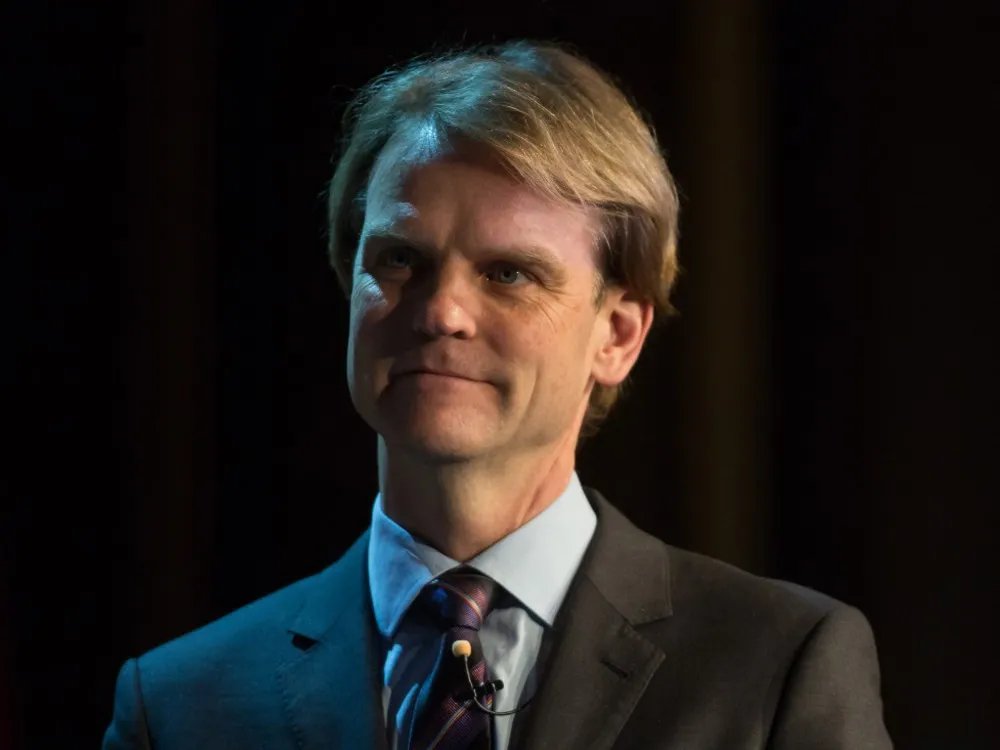
Chris Alexander, a longtime diplomat and former minister of citizenship and immigration for then-Conservative Prime Minister Stephen Harper, announced on July 29 that he intended to run for Mayor of Toronto.
His unexpected and rather late entry into the Toronto mayoral race made absolutely no sense at the time. As the Aug. 21 deadline to either join or withdraw his candidacy approaches, it makes equally no sense why he’s still running — and, more importantly, why he hasn’t dropped out.
A few polls have been conducted since Alexander joined the race. He’s not only sitting in a distant third place in each instance, but the needle for his popular support has barely moved.
Forum Research’s July 29 poll had Toronto mayor Olivia Chow at 47 per cent, followed by Toronto city councillor Brad Bradford at 32 per cent, with Alexander at 11 per cent. Liaison Strategies’s Aug. 4-5 poll had Chow ahead of Bradford 47-40 per cent, with Alexander at 10 per cent. The most recent Liaison Strategies poll of Aug. 14-16 had Chow leading Bradford 49-38 per cent, and Alexander sitting at 11 per cent.
Let’s put aside the fact that Alexander started off in double digits the exact day he made his announcement. It’s a bit hard to believe he was polling higher than Rob Ford and Donald Trump in the early stages of the 2010 Toronto mayoral race and 2016 Republican primaries, respectively. Nevertheless, if we accept the findings of these three polls, his popular support remained stagnant for close to three weeks.
Even worse, Alexander’s small percentage of support has clearly cut into Bradford’s momentum to beat Chow in November. It’s not out of the realm of possibility that Alexander could play spoiler in this campaign and keep the left-wing incumbent mayor firmly ensconced at City Hall.
There was a reason why potential mayoral hopefuls like former Toronto Sun columnist/editor Anthony Furey, former Ontario minister of finance Rod Philips, former Ontario minister of citizenship and multiculturalism Michael Ford (the nephew of Premier Doug Ford), former deputy mayor Ana Bailão, former federal Liberal cabinet minister Marco Mendicino and former Toronto mayor John Tory stayed out of this race. A crowded field of centrist to centre-right candidates in the June 2023 Toronto mayoral by-election had benefited Chow. They weren’t going to let the same thing happen again. Bradford became the consensus candidate to defeat the incumbent mayor, and the others either declined to run or coalesced around his candidacy. If they weren’t pleased with the direction of the city in four years’ time, they could always run against Bradford in 2030.
Alexander was also mentioned as a possible candidate. He told CTV News on July 10 that he was “seriously” considering running for the top job in Toronto. “A number of people and organizations in this city for which I have enormous respect have asked me to, and I don’t take that lightly,” he said, but hadn’t made a decision “yet.”
Most commentators figured he would reach the same logical conclusion that other experienced individuals and politicians already had. Apparently not.
I still have no earthly idea who convinced Alexander that he’s the right person to become Toronto’s next mayor. While he spent 18 years in the Canadian Foreign Service, served as Canadian ambassador to Afghanistan (2003-2005) and had one term as a Conservative MP and cabinet minister (2011-2015), he has no municipal experience. Nothing, nada, zip.
His brief tenure on Parliament Hill had shaky moments, too. He’s been commonly associated with the controversial niqab issue and equally controversial “barbaric cultural practices” hotline. Both of these controversies contributed to the defeat of the Harper Conservatives in 2015. While you can argue that Alexander was simply being a good foot soldier during the election campaign, an experienced politician knows how to wiggle out of difficult situations and negate the potential damage to their political reputations and careers. He was far too inexperienced to accomplish this then — and now.
It should also be pointed out that while Alexander was born and raised in Toronto, he served as a federal MP for Ajax-Pickering. He and his family only moved back to Toronto in 2022. While this obviously doesn’t disqualify him from running for mayor, he’s been out of the loop for many years. A person who runs a major city like Toronto needs to know the ins and outs of municipal politics. He doesn’t.
If Alexander truly cares about the city of Toronto, here’s what he should do.
Alexander should withdraw his mayoral candidacy on Aug. 21 on or before the 2 pm ET deadline. This shouldn’t be viewed as a sign of defeat on his part, but a measure of reality that he can’t win this election and could end up a political spoiler who inadvertently kept Chow in the mayor’s chair. This would be of no personal or political benefit to the 57-year-old Alexander. Instead, he should spend the next four years involved in municipal affairs in some fashion, from volunteer work to joining some high-profile committees. He could then try to launch a legitimate mayoral campaign in 2030, and would have just enough political experience under his belt to accomplish this.
Long story short, Alexander should do the right thing and get out. If not, his political ambitions in any capacity will be wiped out for good.
National Post
