
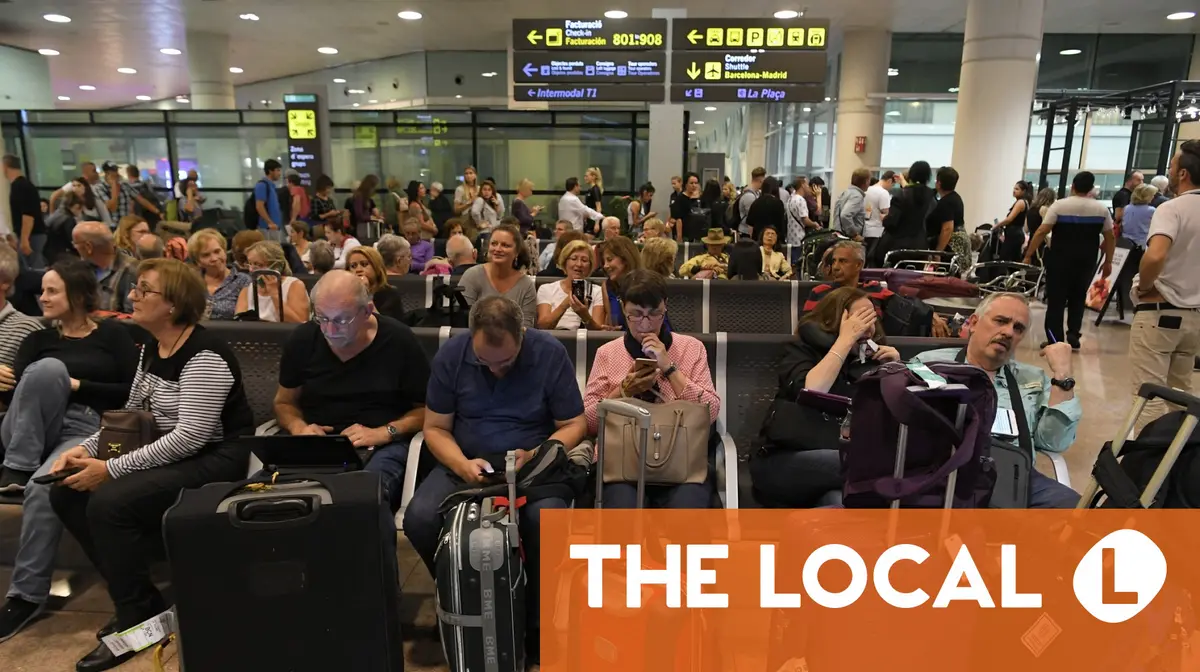
The indefinite strike by ground staff at Barcelona airport enters its third week, with serious disruptions for many but not all passengers travelling via Spain’s second busiest airport.
The stoppage at El Prat Josep Tarradellas Airport by staff at ground handling company Groundforce is now entering its third week.
The strike began on August 4th and since then, there has been no progress in negotiations and no end in sight for the walkout.
According to the CGT union, the stoppage has so far caused more than 6,000 lost bags and the cancellation of 270 flights.
READ ALSO: More baggage chaos and cancelled flights in second week of Barcelona airport strike
Flight compensation company Airhelp has also said that some passengers have waited up to five hours to collect their luggage from the airport.
Flights linking Barcelona with German cities operated by Lufthansa are some of the most affected, along with those linking the Catalan capital with Madrid and Palma de Mallorca, operated by Air Europa.
Flights between Barcelona and Rome, operated by ITA Airways, have also been affected.
Groundforce staff in Barcelona also work with other airlines including Air France, KLM, Qatar Airways, Turkish Airways, United Airways and Finnair, meaning flights with any of these could be affected.
More than 1,100 Groundforce workers are taking part in the strike, who are in charge of checking-in passengers, boarding, ground handling and flight coordination at Terminals T1 and T2.
Spokesperson Esther García denounced Groundforce’s lack of willingness to negotiate and stated that the last meeting between the two sides was on July 24th, a week and a half before the first day of the strike.
Groundforce “doesn’t want to negotiate,” García said, explaining that at the July meeting, the representatives of the ground handling company “got up and left”.
Based on forecasts from the Ministry of Transport and Sustainable Mobility and taking predicted occupancy rates into account, the strike could affect nearly two million passengers.
Groundforce workers at Spain’s second busiest airport, cite poor working conditions, physical fatigue, stress, unpaid overtime and insufficient rest periods as the reasons for holding the strike.
They are demanding a health review and risk prevention for those working outdoors in extreme temperatures, mental health and stress checks due to tensions faced during check-in procedures, as well as more shifts and breaks to achieve a better work-life balance.
The minimum services established by the Ministry of Transport include 80 percent for August and 77 percent for September for connections between Barcelona Airport and non-peninsular territories such as the Balearics and the Canaries.
For international routes and domestic flights where the alternative public transport takes more than five hours, the minimum services will be 58 percent in August and 57 percent in September. Domestic routes with alternative transport of less than five hours only have a guaranteed service of 35 percent during August and 36 percent in September.
If you are due to fly from Barcelona airport soon, airport management company Aena advises that you travel with hand luggage only so that you don’t have to check anything on and potentially have your bags lost or delayed.
They also advise checking with your airline ahead of time to make sure your flight is still scheduled to go ahead and to arrive at the airport earlier than usual so that you have more time in case of long queues or potential issues.
