
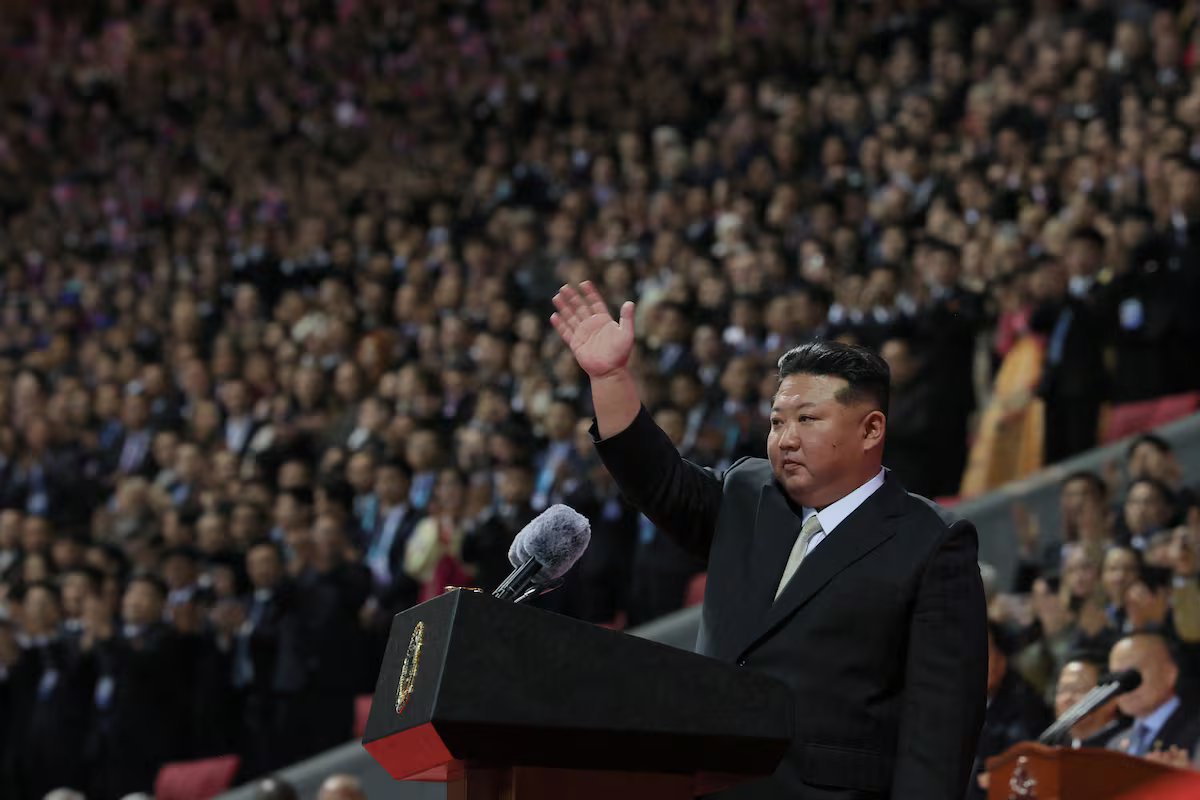
Donald Trump wants to meet with him again. Vladimir Putin needs him to sustain his war in Ukraine. And Xi Jinping chose a visit to Pyongyang as his first, and so far only, foreign trip of 2026. Kim Jong-un, the supreme leader of secretive North Korea, has managed to make the United States, Russia and China compete for his attention. Despite leading a nuclear-armed regime long subjected to international sanctions and presiding over a tiny economy, Kim appears to have found a formula for exerting influence over Washington, Moscow and Beijing: offering each of them something different, and something none wants left in the hands of the others.
“Kim has deliberately sought to increase North Korea’s strategic value to several major powers, rather than return to the kind of dependence and isolation it faced years ago,” Rachel Minyoung Lee, senior researcher in the Korea program at the U.S. think tank Stimson, explains by email.
The outcome is less the result of a grand strategy than of a series of opportunities skillfully exploited. Kim could not have foreseen Russia’s invasion of Ukraine or that ties with Moscow would evolve into a military alliance, Lee notes. But he has proved “adept” at turning the needs of others into strategic leverage, she argues.
The latest opportunity emerged last Monday, just hours before U.S. and South Korean forces began their main joint summer military exercises. Trump unexpectedly ordered the Pentagon to “substantially” reduce U.S. participation, citing the high cost of the drills and his dissatisfaction with Seoul’s level of support during the war with Iran.
Trump justified the decision in a post on Truth Social, where he also emphasized that the exercises make North Korea uncomfortable, despite the fact that, he said, the country had been “unthreatening and respectful” since his return to the White House. The Ulchi Freedom Shield exercises ended on Friday, six days ahead of schedule. There is no precedent for military drills of this scale being cut short at Washington’s request once they have already begun.
For Pyongyang, which sees the exercises as rehearsals for an invasion, the reduction amounts to a concession secured before negotiations have even begun, Ramón Pacheco Pardo, professor of international relations at King’s College London, says by phone.
A pivotal player
Trump is turning his attention back to Pyongyang at a time of mounting domestic pressure and frustration over his inability to achieve the results he had hoped for in the Middle East. The images of his three meetings with Kim between 2018 and 2019, the only meetings ever held between a sitting U.S. president and a North Korean leader, made headlines around the world. Although the process ultimately ended without an agreement, the Republican still portrays it as one of the major achievements of his first term. In recent days, he has highlighted his “great relationship” with Kim and said he is considering another meeting, perhaps in the fall, when he travels to Shenzhen, China, for the Asia-Pacific Economic Cooperation (APEC) leaders’ summit.
Seven years after their last handshake, however, that photo opportunity comes at a higher price. Kim Yo-jong, the North Korean leader’s sister and one of his closest aides, has denied that the two sides are engaged in negotiations, though she has left the door ajar to dialogue if Washington changes its policy toward Pyongyang. The personal relationship between her brother and the U.S. president, she noted, “remains excellent.”
Still, Jenny Town, director of the publication 38 North, stresses in a phone interview that Pyongyang should not be underestimated. “North Korea has options,” Town says, noting that cooperation with Russia is designed to outlast the war and that North Korea has recently expanded ties with other countries at odds with the West. Relations with China, meanwhile, have entered what Chinese and North Korean state media in June described as a “new historic stage.”
Although sanctions continue to weigh on the country and China’s economic support remains indispensable, there is “no longer any urgency” for Pyongyang to sit down and talk with the United States, Town stresses. That gives Kim room to wait, raise his demands and decide when it suits him to turn back toward Washington. “He believes he is a key player in reshaping the world order” and “on equal footing with his partners,” Town says.
The war in Ukraine has made clear that this ambition extends far beyond rhetoric. North Korea has become a crucial supplier for Russia’s war of attrition in a conflict that has now stretched into its fifth year. The U.K.-based Open Source Centre estimates that, since mid-2023, Pyongyang has shipped between eight million and 11 million artillery shells and rockets, while Ukrainian intelligence believes North Korean supplies have at times accounted for nearly half of the ammunition used by Russian artillery on the front lines.
Weapons have been accompanied by manpower. Since 2024, some 15,000 North Korean troops have fought in Russia’s Kursk region. Kyiv estimates that around 8,500 North Korean personnel are currently deployed in Russia, including engineers, sappers and drone operators. “North Korea can now present itself as a country that contributes to the security of another major power,” Lee notes.
It is a significant reversal of roles: a state long treated as a problem to be contained by others is now providing ammunition and troops to a permanent member of the U.N. Security Council. The relationship has continued to deepen since Putin and Kim signed a strategic partnership treaty in 2024 committing the two countries to assist one another in the event of an attack.
China steps up its diplomacy
The exchange has also reduced Pyongyang’s isolation. In return for its military support, North Korea has obtained revenue, oil, economic cooperation, combat experience for its troops and, possibly, military technology transfers. Russia has also helped weaken one of the main instruments of pressure on North Korea: despite U.N. sanctions, it openly imports North Korean weapons and, in 2024, vetoed the renewal of the panel of experts responsible for monitoring those sanctions. The sanctions remain in force, but they have lost their main independent oversight mechanism.
The burgeoning Russia-North Korea partnership has also altered the balance with Beijing. A European diplomat based in the Chinese capital argues that North Korea’s involvement in Ukraine has forced China’s leadership to reassess its calculations. Although China remains by far North Korea’s main economic partner and traditional ally, the existence of a Russian alternative has reduced Beijing’s ability to impose conditions. That added room for maneuver has unsettled Chinese policymakers, who in recent months have accelerated high-level diplomatic engagement with Pyongyang.
Kim returned to China in September 2025 after six years without meeting Xi, and stood alongside the Chinese leader and Putin during the grand military parade in Tiananmen Square marking the 80th anniversary of Japan’s surrender in the Second Sino-Japanese War (1937-1945) and the end of World War II.
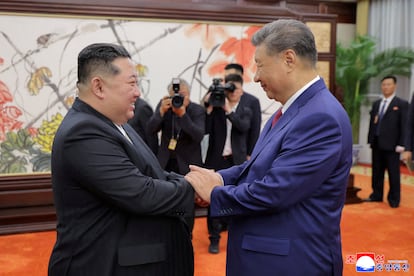
Xi traveled to Pyongyang in June for the first time since 2019, in what remains his only foreign trip this year. For China, keeping North Korea within its orbit means preserving a partner against the U.S. military presence on the Korean Peninsula, preventing instability along its border and ensuring a central role in any crisis that could upset the regional balance. During his visit, Xi reaffirmed a friendship “forged in blood” and a bond of comradeship and mutual trust that, he said, has withstood both the passage of time and a changing international landscape.
The official accounts of the meeting also contained a notable omission. There was no mention of denuclearization, which for years had been one of Beijing’s stated objectives on the Korean Peninsula. Although China has not formally abandoned that goal, it has avoided raising it publicly in the face of an emboldened Kim, who insists that North Korea’s nuclear arsenal is not up for negotiation.
“Kim is trying to make North Korea impossible for the United States to ignore,” Lee says. The researcher argues that Kim’s nuclear arsenal is no longer merely a guarantee of the regime’s survival. It has also become a source of power, autonomy and international status. “He wants to be treated as a normal actor,” Town says, “and to engage with the international community on his own terms.”
And Trump, with his appetite for attention and recognition, may be particularly receptive to that ambition. While previous administrations maintained the complete denuclearization of North Korea as their objective, the U.S. president has gone so far as to refer to the country as a “nuclear power.” That does not amount to formally recognizing North Korea as a nuclear-armed state, his administration still officially calls for denuclearization, but it breaks with the caution of previous governments and raises the possibility that any future negotiations may not begin with demands for the dismantling of Pyongyang’s arsenal.
Pacheco Pardo believes the U.S. president has made it quite clear that his priority is to deal directly with Kim and secure an outcome “he can sell as a victory.”
For now, Kim does not appear to be in any hurry. But a future opening from Washington, and above all any easing of sanctions, would help him continue to diversify North Korea’s international relationships. “North Korea does not want to depend on anyone,” explains Pacheco Pardo.
Having strengthened its ties with Russia and repaired its relationship with China, Pyongyang can afford to wait and assess what it might be able to extract from Trump.
Sign up for our weekly newsletter to get more English-language news coverage from EL PAÍS USA Edition
