
The Supreme Court gave President Trump some leeway Monday to work on plans to have the U.S. Postal Service decide which mailed ballots to deliver, saying it was too early for lower courts to intervene and block him.
In an unsigned order, the justices said the district court meddled in executive branch deliberations, preventing the president from implementing his election integrity agenda.
“The government is likely to prevail on the merits of its argument that the district court lacked jurisdiction to enter the judgment,” the court said.
That does not settle matters, as the case will continue to develop in lower courts, but it does give the president some room to run.
In a March executive order, Mr. Trump directed the Department of Homeland Security to compile lists of eligible voters for each state, excluding noncitizens and others ineligible to vote. He then directed the Postal Service to deliver mailed ballots only to voters who were on the approved lists, seeking to block others from using the mail to cast illegal ballots in the November midterm elections.
The Justice Department has since fought to fend off lower-court rulings as the Postal Service and Department of Homeland Security weigh how to implement the order.
The result has been a sort of chaos, where the government has said it cannot be sued unless and until it comes up with concrete plans — and challengers have said states are already being forced to rethink their vote-by-mail procedures to comply with the president’s vision.
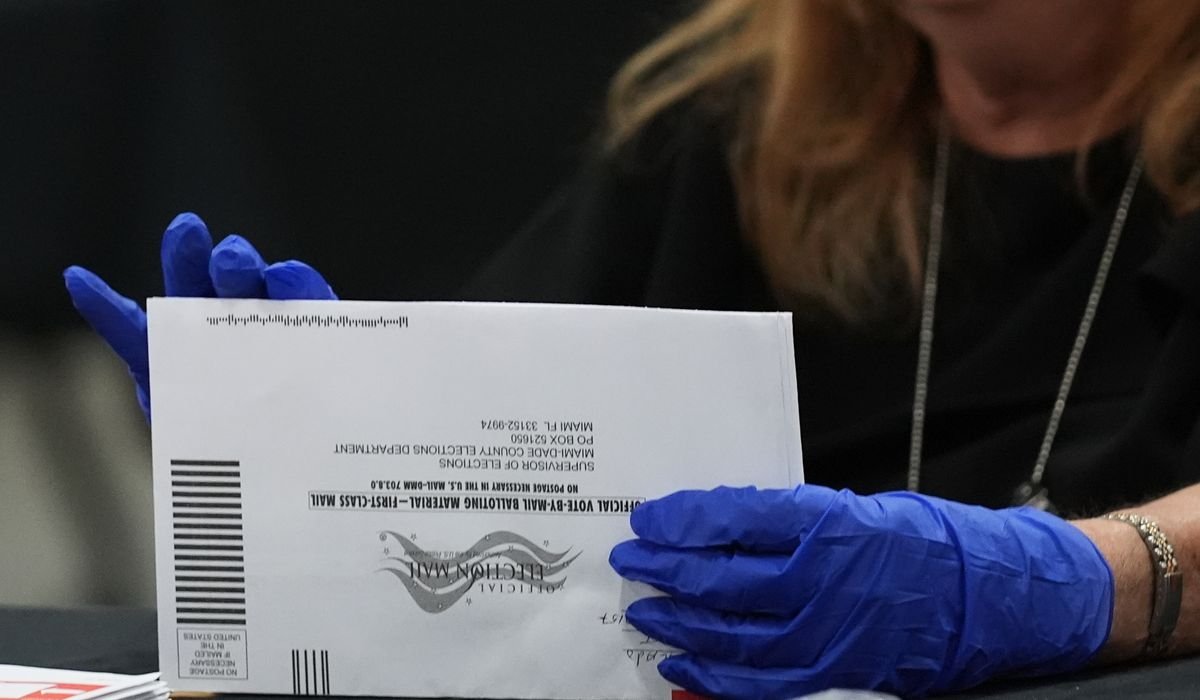
The situation became more complicated in recent days when the Postal Service finalized its mail ballot plans, releasing a rule that requires states to run their ballot envelopes by the Postal Service for approval and to mark outgoing and incoming ballot mail with unique barcodes so they can be tracked.
U.S. District Judge Indira Talwani, whose injunction the Supreme Court dissolved Monday, said she was considering a temporary restraining order to block the Postal Service from publishing — and finalizing — its plans.
In her earlier ruling, Judge Talwani, an Obama appointee to the federal bench in Massachusetts, said Mr. Trump was interfering in states’ ability to run their own elections.
She said roughly half of the states had already obtained ballot envelopes for November’s elections that would fail the Postal Service’s new standards.
That means they are injured even before the Postal Service finalized its rules, she said.
“The executive branch has no authority to regulate elections,” she wrote in her Aug. 11 preliminary injunction.
In a court filing, the Postal Service rejected the claim that it was regulating elections.
“States will retain full autonomy to decide whether (and to what extent) they utilize the U.S. mail as part of their electoral systems and who can use ballot mail to cast a vote,” the agency said. “The rule instead imposes modest data and mail preparation requirements on federal ballot mail envelopes.”
Those requirements are an envelope that meets Postal Service approval, use of an election mail logo so the envelope can be flagged and tracked, and use of unique barcodes generated by the state and written on each mailing.
Postal officials said they have long subjected some types of mail to similar standards.
They made the comparison to cremated human and animal remains, which must be in certain boxes and sent with trackable barcodes, and to replica explosives, which must be brought in person to a post office counter and sent by registered mail.
“Although ballot mail does not present precisely the same operational issues as cremated remains or replica explosives, it is unquestionably sensitive mail that raises unique operational considerations,” the service said.
The comparison drew swift pushback from Marc Elias, a prominent Democratic election lawyer and founder of Democracy Docket.
“Ballots do not raise ’unique operational considerations’ unless you are aiming to limit voting and undermine democracy. Such Orwellian reasoning is dangerous to an already fragile republic battered by years of Trump’s lies,” he wrote Monday.
Election experts said that when the Postal Service finalized its rule Friday, it undercut its argument before the Supreme Court. The Justice Department had said lower court injunctions were premature because there was no final agency action. Now, the final rule means there is.
The high court did not address that issue.
The court’s three Democratic appointees dissented from Monday’s order, saying that states had already begun planning their elections.
“This ruling violates well-established precedents concerning this court’s equitable discretion and needlessly injects chaos and uncertainty into the upcoming midterm elections,” wrote Justice Ketanji Brown Jackson.
The Homeland Security Department has yet to finalize its proposal to come up with lists of eligible voters, but the contours were laid out by Mr. Trump in his executive order in March, pushing the federal government into the election regulation business: Get states to submit lists of voters, then scour those lists trying to spot noncitizens and other ineligible voters.
Mr. Trump has made claims of noncitizen voting.
In a primetime speech on July 16, he claimed more than 300,000 noncitizen names on states’ voter rolls, citing a preliminary Homeland Security Department estimate.
Last week, the Census Bureau released a preliminary analysis claiming to have identified 24,000 noncitizens who cast ballots in the 2020 election. California led the list with 4,300, followed by Texas at 2,500, Florida at 1,800, New York at 1,700 and Arizona at 1,100.
None of those numbers is large enough to have changed the outcomes of that year’s presidential election, but they still drew derision from Trump opponents, who said the Census Bureau data was unusually weak.
They said the bureau broke with its usual protocol by failing to release margins of error or describe potential sources of error. The experts said there were several big potential sources, including the notorious difficulty of matching names and identities to voter lists.
“The whole thing stinks,” wrote Justin Levitt, a professor at Loyola Law School in Los Angeles, who served in the Biden White House as a senior adviser on voting rights.
