
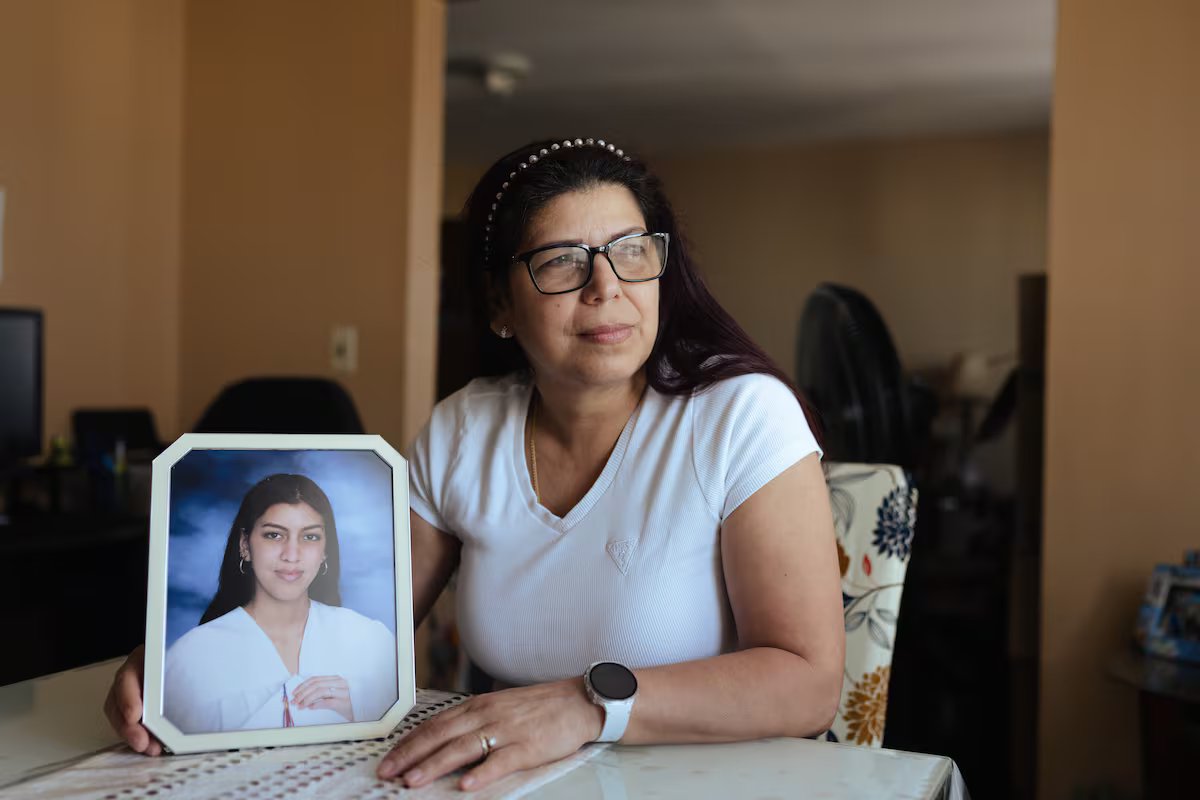
María Eugenia García’s second daughter was born prematurely. Killy Tatiana Yangquen García arrived at seven months, tiny and fragile, entirely dependent on her mother’s protection. She spent her first 20 years clinging to María Eugenia, the two never far from each other. Until Killy Tatiana was arrested in an immigration raid at the bonded warehouse where she was working without papers on a cursed October morning. “Do you understand the care I’ve taken with her and that they ripped her away from me like that? And me not being able to protect her? I haven’t seen her since, only by video call,” the mother sobs from her home in the New Jersey city of Elizabeth, where she has been hiding since her daughter was detained and sent back to Colombia, the country they left more than a decade ago.
Sitting at her kitchen table under the protection of the air conditioning on a hot June afternoon, between sobs and pounding the table when anguish overwhelms her, 53-year-old María Eugenia recounts what EL PAÍS was able to reconstruct over three months and a dozen interviews: how a raid shattered the lives of roughly 50 people and their families.
It was early morning on October 29, 2025. Killy Tatiana was supposed to work remotely, but she was asked to go into the office. María Eugenia was the first to leave the house. She went, as usual, to help care for her sister’s baby. “I arrived, put the little girl to bed and fell asleep too. I didn’t know what was happening behind the door. I slept for an hour, but it was a deep sleep; I don’t understand how that day I was so sleepy,” the mother says.
When she woke up, the first thing she saw was the anguished face of her older daughter. “She says to me: ‘Mom, sit down, do you want herbal tea, water? I don’t have good news. There was a raid at Savino. Immigration came and took Tatiana,’” María Eugenia recalls, vividly remembering one of the worst moments of her life.
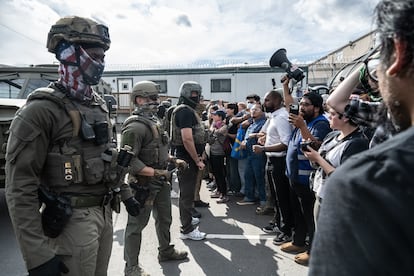
That day, immigration agents stormed the Savino del Bene warehouse, an Italian international shipping company that moves fashion and luxury goods. The facility is located in the Avenel area of Woodbridge, New Jersey, less than an hour’s drive from Manhattan. Witnesses who spoke to this newspaper said more than 50 agents from multiple Department of Homeland Security agencies arrived: Immigration and Customs Enforcement (ICE) and Customs and Border Protection (CBP), among others.
“The operation was large. They came with long guns — the military, the police, and ICE — and surrounded the place. Even a helicopter. They climbed onto the roofs. They wouldn’t let anyone leave. They arrived with wall-scanning devices and with dogs that went through every area, searching for people,” recalls Sandra Suero, whose son, 18-year-old Jhonatan Bello Cabrera, was inside the warehouse during the raid. The Colombian youth managed to call his mother while hiding from agents, and she arrived at the site immediately.
In total, 46 people were arrested — a quarter of the employees present that day — in the operation. According to the pro-immigrant group Movimiento Cosecha, which has advised the families, at least 30 of the workers had pending asylum applications, and many had work permits. That matters little in the Trump era: “An employment authorization card, by itself, does not confer legal status in the United States. Likewise, a pending asylum application, by itself, does not confer legal immigration status on a foreign national,” a Department of Homeland Security spokesperson told this newspaper.
“They asked me if I had a work permit. I showed it to them. I told them I was in the process of getting residency and they checked it on a computer and took the permit away. They asked where my personal things were and then they handcuffed me and took me out,” Jhonatan says.
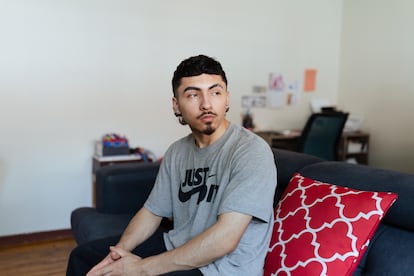
When he was detained, Jhonatan was in the middle of a family petition process to obtain permanent residency through his mother’s husband. His stepfather was a naturalized U.S. citizen and his mother a legal permanent resident. The Colombian national, who had been in the United States for five years at the time, was processed and sent first to an ICE facility in the state, then to Texas, and eventually to Arizona. In total, he spent two months detained until he was released in December after posting a $6,000 bond and being fitted with an ankle monitor.
“You’re supposed to be safe at work. They weren’t committing crimes or anything close to it. Why do they go and take working people away? According to the government, according to the laws, they were supposed to start removing criminal elements, but they didn’t do that,” says his mother, Sandra. “We never thought something like this would happen, especially to a newly graduated kid, still a child, because he’s just starting his life. He had just turned 18 and they arrested him,” she laments. The next hearing in her son’s case is scheduled for November of next year. Jhonatan is trying not to think about what could happen in the months ahead.
Since Donald Trump returned to the White House in January 2025 promising to carry out “the largest deportation in history,” his administration has employed all the tools in its arsenal to pursue, arrest, and expel as many migrants as possible. With daily arrest quotas, massive and indiscriminate raids and canceled humanitarian protections, the Republican administration has launched an unprecedented anti-immigrant crackdown.
Trump’s so-called border czar, Tom Homan, even predicted in May of that year that the country would see more ICE workplace operations than in any previous period of U.S. history. Homan described the strategy as “flooding the area,” for its depth and speed. That’s how dozens of migrants were detained at processing plants and construction sites.
Another front of that offensive has been bonded warehouses like Savino del Bene. Facilities like this were little known until the Trump administration decided to use them in its campaign against immigration. They are places where companies store goods pending payment of import taxes. In return, they are overseen by customs officials who can enter to inspect products when they wish.
Northern New Jersey is full of bonded warehouses because of its proximity to one of the United States’ main seaports. Since last year, federal agents have conducted raids at at least five such facilities in the state. In total, more than 200 people have been detained, local activists say.
“A kind of legal fiction”
Advocates for migrant workers in these warehouses have repeatedly questioned the legality of the arrests. For Lauren Wilfong of the National Day Laborer Organizing Network (NDLON), there is no doubt these arrests “violate the U.S. Constitution, federal civil rights law, and the human rights of members of our community.”
In March, NDLON, along with other pro-immigrant organizations in New Jersey, filed a request under the Freedom of Information Act with the Department of Homeland Security, ICE, and CBP seeking records on these raids to prove their illegality. The government never responded, so the organization filed a lawsuit on August 11 to force it to release the documents.
Una redada del ICE en Edison, Nueva Jersey, en julio de 2025.
“These bonded warehouses work just like any other warehouse, but there’s this sort of legal fiction that exists,” Wilfong explains by phone. “Because they hold goods that have not been processed yet for importing, it does give the Customs and Border Protection Agency certain rights as far as inspecting the products and things like that. But these are rights regarding the goods that are held there, not the workers at those facilities,” she says. “In a site like that, the Constitution actually requires that law enforcement have a warrant in order to demand entry, and they don’t have warrants.”
The Department of Homeland Security maintains it does not need a warrant to carry out these inspections and operations. “A bonded warehouse is within CBP search authority and a search may be conducted at any time, without a warrant, to include both people and things,” it said in a statement.
Asked by EL PAÍS whether the company responsible for the warehouse, Savino del Bene, faced penalties for employing undocumented people, a department spokesperson responded in general terms, saying that “as part of compliance reviews, CBP validates the employee lists provided” by each bonded warehouse. Any noncompliance results in “immediate corrective action requirements” and can lead to “loss of warehouse designation, and referral to the authorities.” It was unclear whether Savino del Bene faced any such consequences. The company did not respond to a request for comment.
Months in detention, different outcomes
The number of days each person spent in custody following the raid, and what happened afterward.
Source: Reconstructed by EL PAÍS based on interviews. Approximate durations. · Graph: J. Figueroa / EL PAÍS
As this becomes one of the many legal battles the Trump administration faces over its immigration policy, Wilfong stresses that “the scale of the harm” in this case “goes well beyond the people arrested” in the raids and affects “everyone in those warehouses and then, of course, all their families as well.”
María Eugenia García last saw her daughter Killy Tatiana at a detention center in New Jersey before she was moved around the country and sent to Colombia. “My life is incomplete without her,” the mother laments. Separated from her daughter for the first time, she says she has had to learn to dry her tears, “breathe, go on, and endure.” But for how long? she asks. “I have had a lot of strength from God. It’s the only thing that has given me the courage not to die before seeing her. Because I couldn’t have done it alone,” she says.
Hope of voluntary departure
Killy Tatiana answers the video call from Bogotá, where she has lived since leaving the United States in February with a voluntary departure granted by an immigration judge after nearly four months in detention. “When they grabbed me, it was hard for me because I said, ‘My God!’ It was something we were aware could happen. I had thought several times about quitting my job, but I never said anything. So if I had quit, I wouldn’t have been there,” she says.
Killy Tatiana came to the U.S. with her family when she was 10. She turned 21 last May and celebrated — if that word can be used — by video call with her family in New Jersey. In Bogotá, some relatives took her in, but for her, Colombia is a country she doesn’t know anymore, no longer hers after so much time away. “I stay locked up. I get bored because my life, my social circle, is my mom, my sister, my niece and my husband. It’s a big shock for me to leave them and be here locked up with no one,” she says, trying to hold back tears.
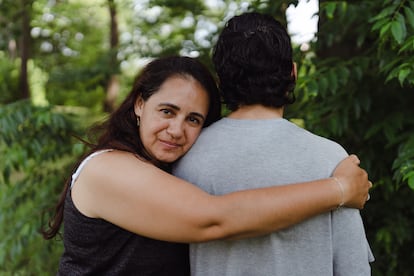
Her mother and husband are aware of the blow returning to Colombia has proven to be, and they suffer along with her. “It’s hard because you’re sending someone [away] whose whole life is here. I understand that there are laws. The law must be respected, but we were also making an effort to legalize her. It’s inexplicable. Because you feel empty, helpless knowing nothing can be done,” says Yardanis Payero, her husband of two years, who lives with María Eugenia in New Jersey.
María Eugenia’s family entered the country on visas and, like so many immigrant families, stayed after their permissions expired. They were undocumented for 10 years, until Killy Tatiana was detained. “We thought we didn’t need papers because back then you could live without papers. We never rushed it,” she explains.
However, mother and daughter acknowledge they began to realize they would need to regularize their status in some way when Trump secured his return to power in 2024. “Once detentions started, we knew we were at risk. We knew both she and I were vulnerable to being picked up at any moment. We always thought about what we would do if it happened. And we would say: ‘If they pick me up, I’ll sign and leave immediately,’” María Eugenia says.
Transferred across the country
The journey of four detainees from the Avenel (New Jersey) detention center through the ICE detention system
Source: Reconstructed by EL PAÍS based on interviews. Approximate locations at the state level. · Graph: J. Figueroa / EL PAÍS
That was the plan, and it played out to the letter. But it was heartbreaking. It’s easier to speak hypothetically than to live through it. María Eugenia came to believe that because Killy Tatiana had spent half her life in the United States and had no criminal record, there was a possibility she could stay in the country after her arrest: “We had our hopes, but the judge denied bond. And they told her she would be deported, and with that there was no chance of returning. So they told her it was better to sign the voluntary departure.”
Under U.S. law, a voluntary departure is a mechanism that allows a person to avoid an order of deportation by agreeing to leave the country on their own. It is useful for those who have a legal route to return to the U.S., such as a family reunification petition, because it removes the usual five- to 10-year bar on reentry associated with deportations.
In Killy Tatiana’s case, her hope is that her husband, who is applying for citizenship, will be able to bring her back once that process is complete. However, that could take years.
“Here are the bitches”
In the months that the Savino del Bene warehouse workers were held in detention, their relatives and loved ones in New Jersey never stopped fighting for their release, even after authorities transferred them to facilities in Texas, Ohio and Michigan. A group of 10 women detained together in the October raid were sent to Michigan — a state on the Canadian border. There, at the North Lake Correctional Facility, almost four hours from Michigan’s main airport and in the middle of a forest, the women endured the worst months of the Upper Midwest’s freezing winter.
They arrived in Michigan after first passing through the infamous ICE facility in Newark, on the outskirts of New York, called Delaney Hall, where hundreds of detainees have protested the awful conditions: rotten food and restricted visits. The transfer from New Jersey was days of hell, during which they were offered little food or water, the women told this newspaper. They were first taken to the “iceboxes” of Texas, as the southern border detention facilities are known for their freezing temperatures. From there, they went to Ohio and spent a few days in a county jail. Upon arrival, they all recall being forced to undress in front of a female officer and shower while she watched. When they finally reached the Michigan facility, they had suffered taunts and humiliations that were hard to forget.
“When the immigration officer was handing us over to the county sheriff in Ohio, he said: ‘Here are the bitches,’” recalls Sofía, one of the detained women. “In Michigan they didn’t turn on the heat. Every day we had nosebleeds from the cold. We slept together until we warmed up. We stuffed sanitary pads into the vents. The food was bad. You’d find pieces of bone, teeth, bread with mold. Horrible,” says another detainee.
To cope, the women forged a friendship that has endured long after their release. For the last of them to regain her freedom, an Ecuadorian immigrant who was ultimately deported, detention lasted seven months.
Sofía, a 27-year-old Dominican woman who prefers to keep her real name private, is remembered as the person who made everyone laugh, who looked for “the bright side” even in the darkest moments of her detention. She was deported to the Dominican Republic on January 27 of this year, 91 days after she was arrested at the warehouse, where she had been working without papers. Although she had overstayed the visa she used to enter five years earlier and was undocumented, she never thought she could be picked up while working. Her mother, however, had a premonition.
On the day of the raid, her 51-year-old mother was traveling from Puerto Rico, where she lives, to New Jersey to surprise her with a visit. “But before I arrived, I was surprised to find out that my daughter had already been arrested. Although I had told her on several occasions to stop working, she has always been very independent. She likes to be on her own,” says her mother, still in disbelief — and who also asks that her identity be protected — during a joint video call with EL PAÍS.
Both are now separated by the Mona Channel, the stretch of water between the Dominican Republic and Puerto Rico, with no idea when they might see each other again. Sofía cannot enter Puerto Rico because it is a U.S. territory and, after being deported, she is barred from returning to the United States for several years. Her mother, though a permanent resident with the right to travel, doesn’t have enough money to do so often and has been able to visit only once.
“Being close and far away has its pros and cons. It’s as if you had someone right next to you whom you want to visit, but you can’t whenever you want,” laments the mother, though she hasn’t lost hope that somehow she’ll be able to get her daughter out of the country they emigrated from due to a lack of economic opportunities. Sofía, for her part, maintains that she doesn’t want to return to the United States permanently: “I feel — I don’t know if it’s shame — about going back to that country after what they did to me.”
Free but terrified
On a living-room wall at Daniela’s house hangs a kind of altar that reminds her of the time she spent detained. Or rather, what kept her sane during the more than two months she was locked up after the Avenel raid: faith. During the weeks the group of women spent in Michigan, Daniela (an assumed name) found God. She was baptized inside the detention center and still proudly shows her baptism certificate.
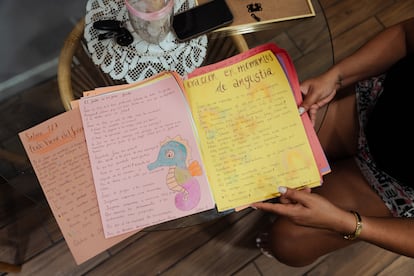
To get through the days, Daniela studied the Bible. She began copying verses and prayers onto colored poster board whenever the detention center guards were kind enough to lend her a pencil sharpener. She wrote letters to her two children that she never mailed but kept in a book. Today, in her basement apartment in Elizabeth, some of those writings cover one wall of her living room.
Daniela, 45, came to New Jersey 10 years ago. She took her two children and fled Colombia, where she had been threatened with death. In the United States, she sought asylum and received a Social Security number and work authorization. “That’s when I started working. I started doing taxes. I always did everything right. From the start my lawyer told me: ‘Never ask for help here in the country, never.’ And that’s what I did. I never asked for anything here. I always worked; I learned to do everything — lay floors, construction pads, paint, everything. I raised my children,” she says.
They waited years for their asylum appointment. Finally, they got a slot last August. Daniela went with her children and her lawyer for the interview. In the middle of it, the official “stood up, left, and ICE arrived.” “Six agents came in. They pushed my son against the wall, put chains on him and took him away,” she recalls, still shocked.
Her eldest son, 24 and married to a U.S. citizen, spent 100 days in detention. During that time, Daniela was also picked up in the warehouse raid. Her younger son, 19, was left alone; he had to drop out of school and start working to support himself.

“It was very hard, but I say God has a purpose because we both came out free. It’s a blessing,” the mother says. When her son was released from detention, she was still being held. By the time her turn finally came, after posting a $10,000 bond, her son drove 27 hours to pick her up in Michigan on January 10. They had spent the first Christmas of their lives apart.
Back home, however, the torment has not ended. “When I got out, I shut myself in for a month. I gained 29 pounds from anxiety. I kept the windows closed; I didn’t even go to the door. I kept watch, afraid they might knock. It was a horrible unease,” Daniela explains. “Reintegrating into society is hard. It has been very difficult for me.” It hasn’t helped that people have continued to be arrested in her neighborhood. The day before meeting EL PAÍS at her home, she says a migrant was detained around the corner.
She knows little about the status of her asylum petition. She says she was given several court dates that were canceled: “When I check the app, it says this case is pending.” “About two months ago I got a call from an asylum office telling me I had to go with an ID to pick up a paper. And I said: ‘No, my dear, I’m not going.’” She knows the risk of leaving her house perfectly well, so she prefers to leave it in God’s hands.
Credits
Photographs: Corrie Aune
Raid video: Cosecha Nueva Jersey (NGO)
Graphs: Javier Figueroa
Sign up for our weekly newsletter to get more English-language news coverage from EL PAÍS USA Edition
