
Listen to this article
Estimated 3 minutes
The audio version of this article is generated by AI-based technology. Mispronunciations can occur. We are working with our partners to continually review and improve the results.
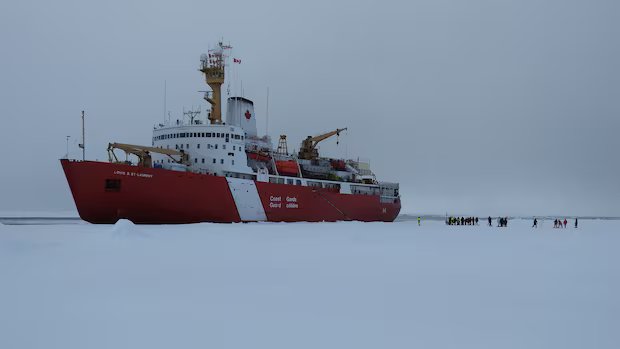
The Canadian Coast Guard’s largest and most powerful icebreaker successfully visited the North Pole this month as part of an effort to resolve disputed claims in the Arctic.
The CCGS Louis S. St-Laurent, accompanied by the Swedish icebreaker Oden, reached the North Pole on August 16.
The polar mission is being carried out in order to map the floor of the Arctic Ocean with special sensors which researchers say will help better define Canada’s claim on a portion also claimed by Russia and Denmark via its autonomous territory Greenland.
Front Burner28:55What does it take to defend Canada’s Arctic?
This marks the sixth trip the ship has made to the pole, an area which few humans have ever visited.
For Capt. Byron Briggs, this was his first time on the top of the world.
“It actually was even more of an adrenaline rush than I thought it was going to be after we successfully managed to get to the pole and play with the ship enough to actually get the GPS to tell us we were at 90 North,” Briggs said, referring to the pole’s latitude.
“It was a pretty special moment for me, certainly. And based on the cheers from everybody else on the bridge with me, it was a pretty big moment for all of us.”
Briggs said they managed to rendezvous with Santa Claus when they reached the North Pole.
On the ice, crew members played a friendly game of hockey.

The ship has a crew of 77 in total, including 47 core crew, a doctor and nurse, a helicopter flight crew and a science team of 22.
In 2019 and 2022, Canada fulfilled its obligation under the United Nations Convention on the Law of the Sea (UNCLOS), and submitted data outlining the country’s claims on the sea floor.
Kai Boggild, a scientist with the Geological Survey of Canada, is leading the research operation collecting that data.
“[This data] demonstrates where we believe these points are,” Boggild said.
Information collected on this mission is intended to back those claims up, in particular around the Lomonosov Ridge, an underwater ridge which splits the Arctic Ocean into two basins.
Boggild noted that the importance of the trip goes beyond geopolitics and will provide critical scientific data.
“There are a lot of really fundamental questions about how we understand how the Arctic formed,” Boggild said.
“So collecting these data for UNCLOS also allows us to learn a lot more about basically the natural history of the Arctic Ocean and, and how that’s evolved over, over millions of years.”

In a statement issued by the Department of National Defence, David McGuinty, minister of defence, said the ship’s mission serves multiple purposes, including asserting Canadian sovereignty in the region.
“The arrival of CCGS Louis S. St-Laurent at the North Pole is an important milestone that reflects Canada’s enduring commitment to the Arctic,” McGuinty said. “This mission advances scientific knowledge, strengthens our presence in the North, and reinforces Canada’s sovereignty and security.”
The Louis S. St-Laurent’s crew left home port in St. John’s, Newfoundland, on July 8 and is expected to return in early November.
