
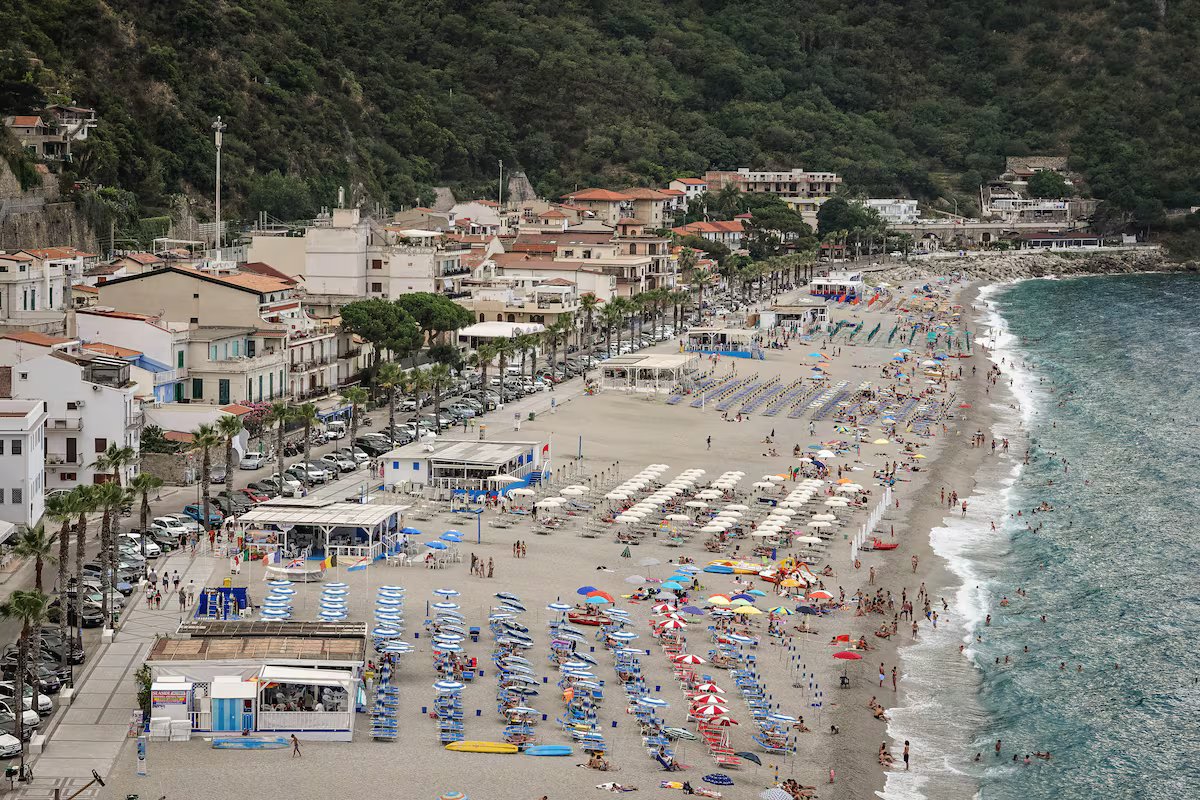
Italy has nearly 4,900 miles of coastline, but enjoying it is not always free. While elsewhere, going to the beach means looking for a space on the sand, in Italy the experience is often quite different. Finding a space to plant an umbrella without paying is a challenge. Along stretches of the coast, access to the sea is managed by private companies through public concessions, which have transformed the beaches into a multimillion-dollar business. The result is an endless forest of perfectly aligned umbrellas, accompanied by their respective sun loungers, waiting to be rented for prices that can exceed €35 ($40) a day.
This deeply rooted model, plagued by irregularities, faces a reform that has been postponed for years despite pressure from Brussels. Managed by private concessionaires, paid beaches have spread at pace. According to the Italian environmental association Legambiente, they already occupy more than 42% of the country’s coastline. The Ministry of Infrastructure puts the figure at 33%, a difference that is explained by the criteria used for the calculation: the government factors in the entire Italian coastline and not just the areas suitable for bathing.
For decades, companies that are almost always family-owned — concessions are usually inherited — have paid relatively low royalties to the state for exploiting public spaces, while prices for users have increased exponentially. The concessionaires manage services such as toilets, showers, changing rooms, parking, as well as the rental of umbrellas and sun loungers. They also control the beach bars and cafeterias and are in charge of life guards and rescue operations. Meanwhile, public areas are often neglected, dirty, and devoid of public services.
This is a sensitive issue that divides public opinion in Italy. For some, the paid beaches guarantee order, cleanliness, and comfort; for others, they represent the privatization of a public asset that should be accessible to all. The main criticism of the system is the enormous difference between what the concessionaires pay to exploit the beaches and the profits they garner. The state collects between €80m and €100m ($92 million-$116 million) a year from concessions, while the sector, which lacks transparency, earns more than €2 billion ($2.3 billion) annually, according to different estimates. The Italian Court of Auditors itself has warned that the royalties paid by entrepreneurs are not usually proportional to the income they obtain.
One of the most controversial aspects of the Italian model is that concessions have been automatically renewed. Without open tenders or effective competition and without controls or transparency, the same operators have maintained the exploitation of large stretches of the public coastline for generations, consolidating a system that few other European countries have espoused.
A move in the right direction
Brussels has been calling for change for years. The European Commission considers that Italy is in breach of the 2009 Bolkestein directive, which requires free competition regarding this type of concession. After decades of postponements and confrontations, Giorgia Meloni’s government has addressed the issue. The approved reform stipulates that by September 30, 2027, all the estimated 12,000 paid beaches will go out to public tender. The concessions will have a limited duration of between five and 20 years, and there will be economic compensation for the current holders for any investments they have made.
The prospect of opening up the market has, however, triggered concern among many in the sector who fear that the tenders will favor large tourism groups or investment funds capable of displacing the family businesses that have traditionally dominated the Italian coast.
Sign up for our weekly newsletter to get more English-language news coverage from EL PAÍS USA Edition
