
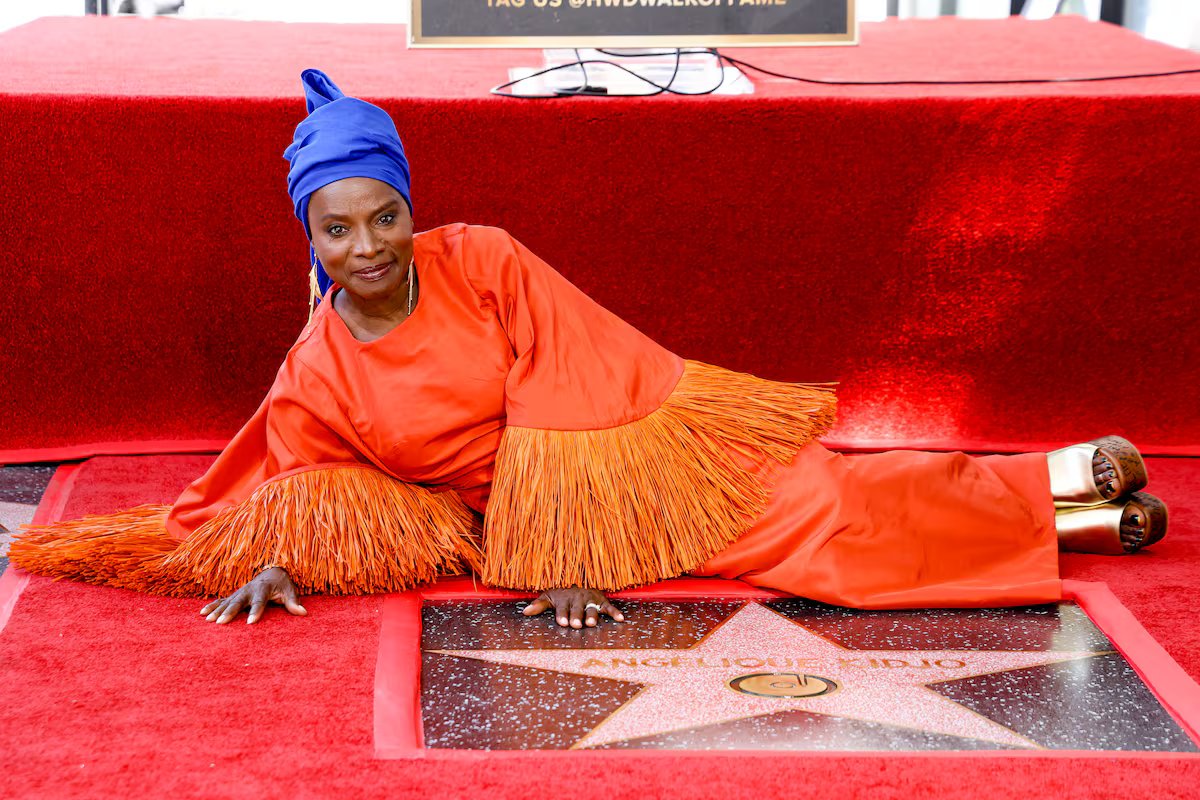
When Angélique Kidjo knelt on the Hollywood Walk of Fame this past August 18 to unveil her star, the scene felt like a historical moment of redress. Cameras, onlookers and admirers crowded around her. Just a few feet away, dozens of tourists were likely still searching for the names of Marilyn Monroe, Michael Jackson, Frank Sinatra, or Stevie Wonder, which are embedded in the world’s most famous sidewalk.
From now on, among those more than 2,800 stars, there’s also one that belongs to a woman born in Ouidah, a small coastal city in Benin. It’s one of the major ports where, for centuries, hundreds of thousands of enslaved Africans were sent to the Americas.
Kidjo has become the first Black African artist to receive this honor. Until now, the only names of people born in Africa on the Walk of Fame were those of two white South Africans: actress Charlize Theron and actor Basil Rathbone.
This is an event that far transcends the realm of music, even though it might just seem like yet another award for an artist who is accustomed to honors. Five Grammy Awards, the Polar Music Prize (considered to be the “Nobel Prize of Music”), various honorary doctorates, recognition from the United Nations, Amnesty International and some of the world’s most prestigious cultural institutions all attest to an extraordinary career. However, the Hollywood star has a different significance. It not only distinguishes Angélique Kidjo, but also highlights how long it has taken one of the most influential cultural industries on the planet to recognize someone like her. More than 70 years after the creation of the Walk of Fame, Hollywood has finally added a Black African artist to one of its most universal symbols… a space that, for decades, has celebrated global talent, while barely glancing at the African continent.
Perhaps that’s why the debate shouldn’t focus on whether Kidjo deserves a star, but rather on why Hollywood has taken so long to recognize her (and so many other African artists).
For much of the 20th century, Africa was presented to the world through a collection of images repeated ad nauseam, shaping the image of a continent which is still held by many Westerners. It was the land of Tarzan and white explorers; of grand safaris and endless sunsets; of the spectacular savannas from Out of Africa (1985); of televised famines in the Sahel region or Ethiopia; of humanitarian aid campaigns; of South African apartheid; or of coups and civil wars. Later came images of child soldiers, epidemics and precarious boats crammed with migrants seeking a better life outside their countries. Even when the continent appeared in connection with admirable stories — such as the struggles for independence, or the end of the racist South African regime — it was almost always through the lens of politics or conflict.
Hollywood played a decisive role in constructing this image. Africa was the stage where others lived out adventures, or found personal redemption. Africans rarely occupied the center of the narrative. They were extras, victims, or secondary characters.
Music wasn’t immune to this perspective, either. In the late 1980s, when major record labels coined the term “world music,” they did so with the intention of facilitating the marketing of music from Asia, Latin America, and Africa. The term helped give visibility to many artists, but it also created an invisible boundary. While rock, jazz, and pop were considered universal genres, African music was confined to a separate, almost anthropological, category… as if it belonged more to the realm of folklore than to that of contemporary creation. The label suggested that there was “normal” music — Western music — and “other” music, that of the rest of the world.
Regardless, Africa is at the genesis of much of contemporary popular music. Many of the rhythms that shaped jazz, blues, soul, funk and even rock have deep African roots. Enslaved people who crossed the Atlantic carried with them rhythmic patterns, singing styles and ways of understanding music, which survived the horrors of slavery and ended up transforming 20th-century popular culture. And yet, while African influence permeated Western music, African artists continued to face enormous difficulties when it came to being recognized as protagonists of that same history.
Before Angélique Kidjo, Miriam Makeba had brought the fight against apartheid to international stages. The Senegalese composer Youssou N’Dour and Malian singer Salif Keita demonstrated that African music could transcend borders. But it was Kidjo who finally broke down the barrier that had restricted African artists to the narrow confines of “world music.”
When she began her career, however, that was the reality she encountered. She was born in 1960, in Ouidah, a city where the memory of slavery coexists with a rich cultural tradition and a wide mix of different faiths. The daughter of a musician and a theater director, she grew up surrounded by stages, rehearsals and songs. From a young age, she understood that music could be a space of freedom… and she also discovered that freedom had its limits.
In 1974, following the establishment of Mathieu Kérékou’s Marxist-Leninist regime, censorship and political control intensified in Benin. Many artists and intellectuals were persecuted or had their freedom of expression restricted. It was in this context that Angélique Kidjo left her country and settled in Paris, in the early 1980s. This exile proved decisive.
Many African musicians living in Europe accepted the role assigned to them by the market: that of simply being guardians of an exotic tradition, one destined for a minority audience. But Kidjo chose a different path.
She demonstrated this from her very first hits. Songs like Batonga (1992), Agolo (1994), Wombo Lombo (1996) and Adouma (1993) — in which she embraced Benin’s rhythms and African languages — began to be played on radio stations and at festivals in Europe and the United States. Later, she released albums like Djin Djin (2007), which she recorded with artists such as Alicia Keys, Peter Gabriel, Carlos Santana, and Joss Stone; Eve (2014), dedicated to African women; and Remain in Light (2018), a masterful reinterpretation of the classic by Talking Heads. These collections cemented her place among the great figures of the international musical scene.
Kidjo never wanted to be the African singer that Europeans expected. Rather, she simply wanted to be a great artist. That’s why she fearlessly blended the rhythms of Benin with the funk of James Brown, jazz, salsa, rock, Brazilian music and pop. She sang in Fon, Yoruba, French and English. She collaborated with numerous international artists and, in recent years, with many African artists, such as Burna Boy, Mr Eazi, Davido and Yemi Alade, all musicians of Nigerian origin; Salif Keita; Fally Ipupa, the Congolese “King of Rumba”; and the Tanzanian recording artist Diamond Platnumz.
All of this represented a major cultural revolution. For years, many artists on the continent felt pressured to adapt their sounds to Western tastes, in order to achieve wider distribution. But Kidjo did the exact opposite: the more international her career became, the more her roots started to show. With this artistic approach, she finally broke down the barriers that, for decades, had confined the African continent’s creative output to the label of “world music.”
It was no longer a matter of asking permission to join global culture. Rather, it was about participating in it, on equal footing.
Kidjo’s greatest success hasn’t been in making African music more accessible to the West, but in convincing the West that this music has always been part of the world’s cultural conversation. Hers has been a quiet, yet extraordinarily effective way of combating stereotypes. Not through speeches, but through songs. And this transformation hasn’t just been aesthetic: it has also changed the way that the global public perceives Africa.
Angélique Kidjo isn’t just a singer. From a very early age, she understood that international recognition — beyond releasing albums or filling concert halls — gave her a platform she could use. And she transformed it into a megaphone to advocate for a different vision of Africa and to denounce the inequalities that continue to shape the lives of millions of people on the continent.
As a goodwill ambassador for UNICEF and other UN agencies, she has visited schools, hospitals, and rural communities to promote education, especially for girls. In 2006, she founded the Batonga Foundation, which has facilitated access to education and vocational training for thousands of teenagers and young adults in several African countries.
Kidjo has raised her voice in favor of gender equality, denounced gender-based violence, defended democracy against authoritarianism and championed the need to protect African cultural heritage. She’s convinced that the continent’s future also depends on its ability to value and preserve its own cultural wealth. In her speeches and interviews, she insists that Africa doesn’t need to be saved: instead, it needs to be listened to. It doesn’t require pity, but respect and opportunities to develop the enormous potential of its people.
This coherence between artistic creation and social commitment explains why Kidjo occupies a unique place within contemporary African culture. She has never understood music as mere entertainment. Every one of her concerts, artistic collaborations and public appearances is part of the same project: to demonstrate that Africa cannot continue to be defined solely by its conflicts or its deprivations, but also by its creativity, its capacity for innovation, and the strength of its societies.
When Angélique Kidjo began singing in Paris, the challenge was to convince the world that African music deserved to be heard. Today, that battle has been won. Burna Boy fills stadiums, Tems sings with Beyoncé, Tyla tops the charts and African rhythms set the pulse of popular music. The star installed on the Hollywood Walk of Fame is, in reality, the recognition of a journey that began a long time ago in Ouidah and ended up changing not only the story of a singer, but also the way that the world listens to Africa.
Sign up for our weekly newsletter to get more English-language news coverage from EL PAÍS USA Edition
