
The Narsarsuaq Museum no longer has set opening hours. Since the airport closed in the spring, few visitors come to this remote settlement in southern Greenland. However, if someone asks for Ole Guldager’s house and goes to ask him to open it, he is happy to oblige. The museum occupies one of the barracks of the former military base, a long wooden building painted red with a brick chimney. Beside the entrance sits the radial engine of a World War II aircraft, corroded by decades of exposure to the elements. Behind the building stretches the airstrip that U.S. soldiers built in record time. Today, however, that same country appears not as an ally from the past but as a growing threat to the island’s sovereignty and natural resources, especially in places like Narsarsuaq, one of three bases the United States would seek to reopen.
When Guldager turns on the lights, uniforms, rifles and carbines, field telephones, a metal stretcher from the old hospital, slot machines and letters confiscated by censors that described extreme isolation and never reached their destination emerge from the gloom. The rooms reconstruct the daily life of the thousands of U.S. servicemen, pilots, and nurses who passed through the former base. Among the hundreds of photographs are several of Marlene Dietrich, taken in 1944. For a few hours, the actress brought a bit of Hollywood glitz to that inhospitable corner of fjords and mountains to lift the troops’ spirits.
Guldager arrived in Narsarsuaq as a child. He was born in Denmark, but his father worked at the civil airport into which the former military installation was converted after the Americans left in the late 1950s. A historian and archaeologist — and one of the island’s few beekeepers — he has devoted much of his 58 years to researching the place where he grew up and chose to stay.
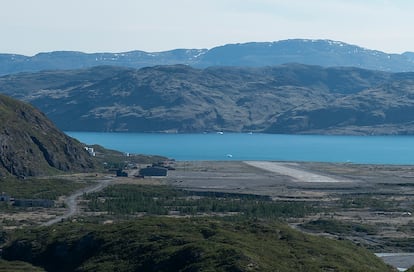
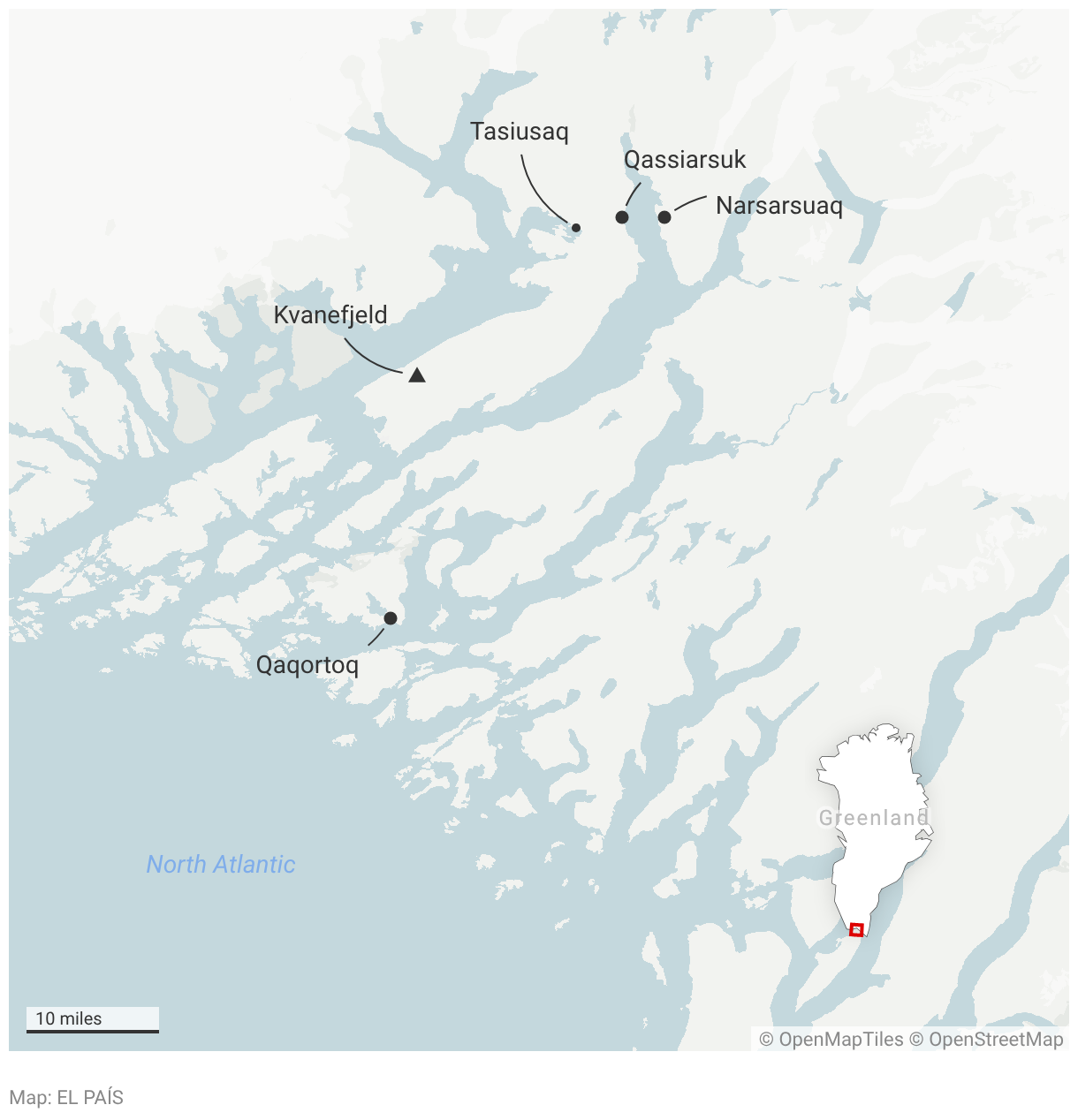
The last plane landed in April. The airport was closed because another one opened in Qaqortoq, the regional capital, where about 3,000 people live, and it made no sense to maintain two for such a small population. But the reality is that since then Narsarsuaq has been emptying out. Guldager estimates that of the 150 residents it had, about 40 remain. Everything revolved around the airport, which for more than six decades was the main gateway to the island’s south, handling thousands of passengers each summer. Now there are weeks when barely a dozen visitors arrive. The hotel, one of Greenland’s largest, closed its doors the same day the airfield shut down.
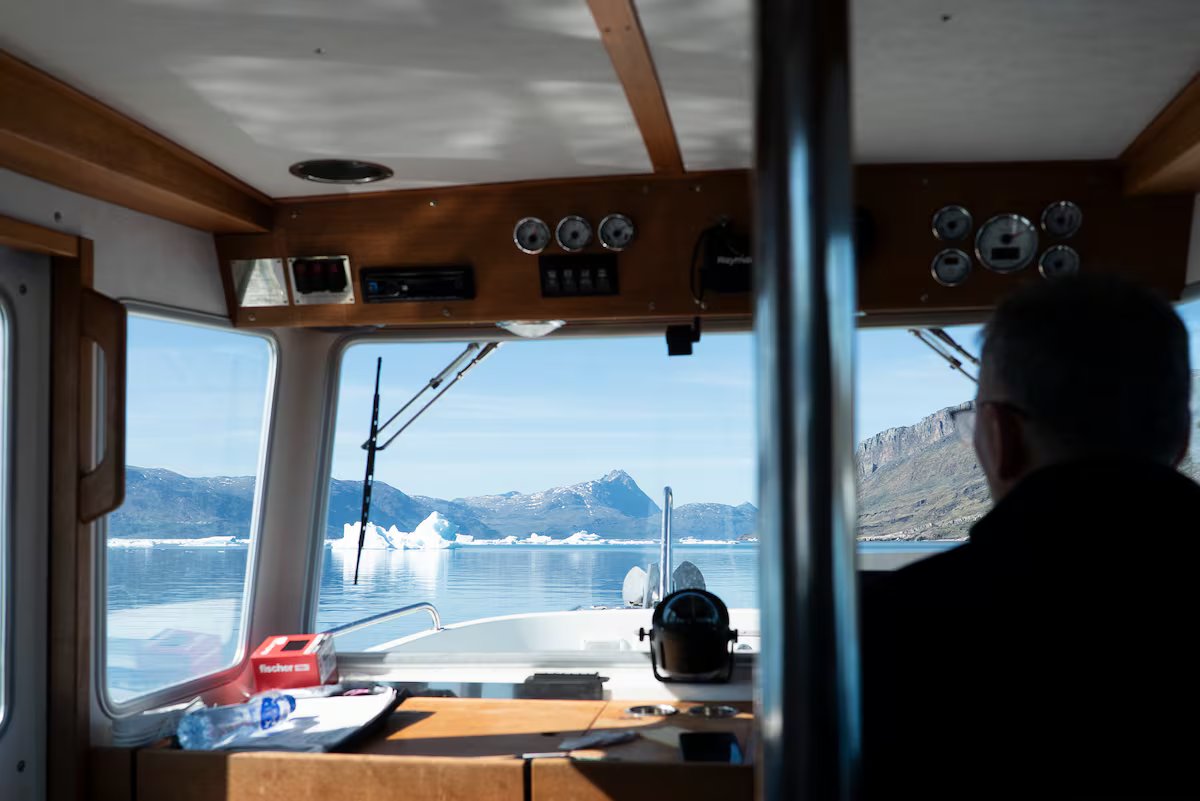
Among those who do not plan to leave is Storch Lund. The grandson of Henrik Lund — the poet who wrote the lyrics to Greenland’s anthem — he grew up on a farm across the fjord and moved to this shore as a teenager to work as a mechanic’s apprentice. He went on to run the airport for more than two decades, and also ran a café and a souvenir shop that closed a few months ago. He also started a company to transport tourists to other settlements. Today, only one of his boats still operates with low demand; the other two remain moored. At 69, he finds it hard to accept that “nothing happens in Narsarsuaq anymore.”
It is into that void that the United States now reappears.
As the village withers, the shadow of Donald Trump lengthens over it. The U.S. president, who tried to buy Greenland from Denmark during his first term, threatened earlier this year to take control of the island “the easy way or the hard way.” Tensions eased after several European allies deployed troops to the Arctic territory in support of Danish sovereignty, and the crisis moved onto a diplomatic track. For seven months representatives of Denmark and Greenland have been negotiating behind the scenes in Washington with the Trump administration over the terms of an expansion of the world’s leading military power on the planet’s largest island, home to just 56,000 people.
In those talks, the United States demands sovereignty over the territory occupied by any future U.S. military installations on the island — a status similar to that of British bases in Cyprus — a demand Danish and Greenlandic representatives are unwilling to accept.
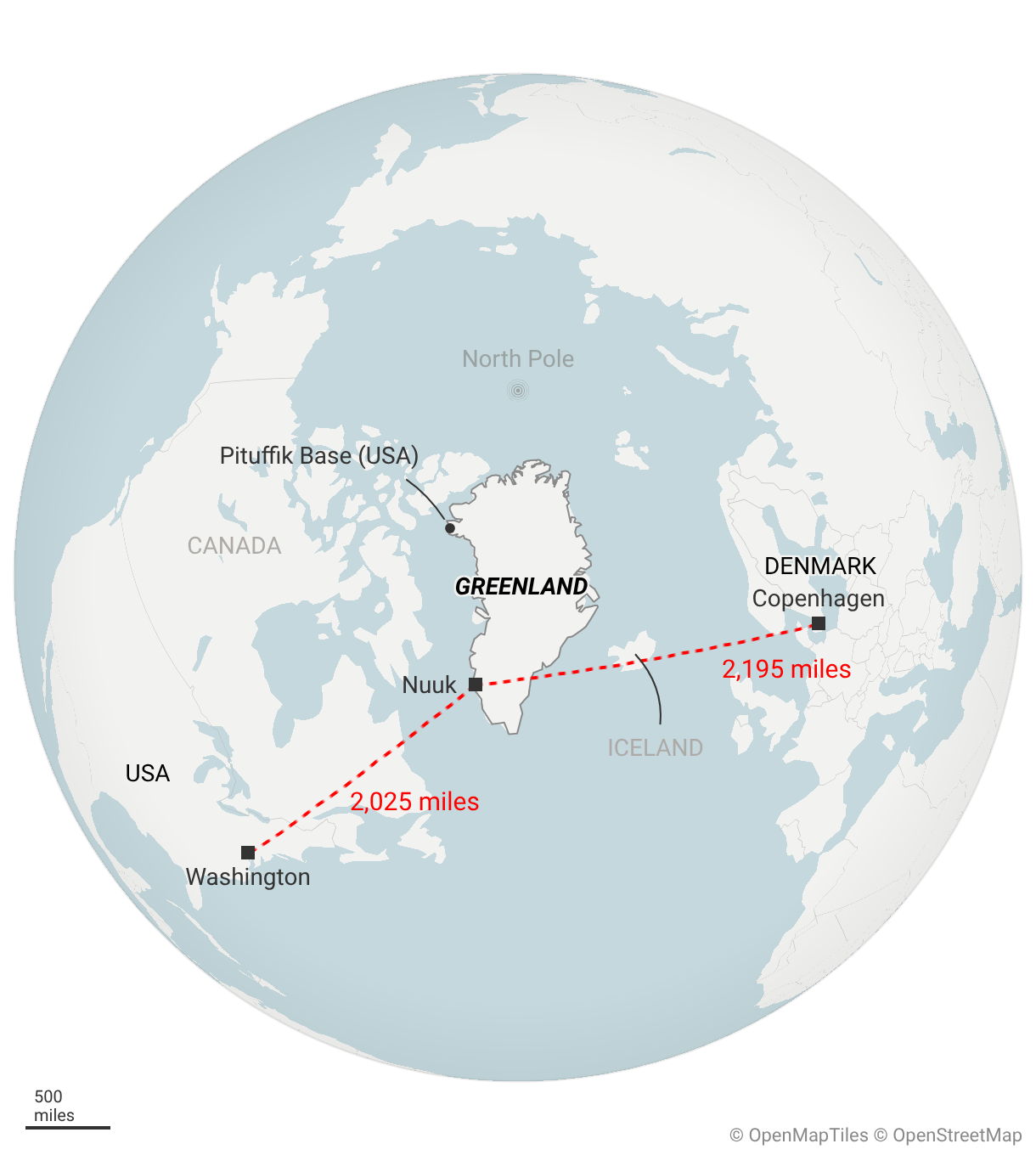
Washington’s strategy rests on the bilateral defense agreement signed with Copenhagen in 1951, a treaty that allows, upon request, an expanded U.S. military presence in this territory of the Kingdom of Denmark. General Gregory Guillot, head of U.S. Northern Command, informed the Senate in March of the intention to establish three new “defense zones” in Greenland to strengthen surveillance of Russian nuclear submarines and counter China’s growing influence in the Arctic.
In May, four weeks after Narsarsuaq’s international airport was downgraded to a heliport, U.S. Marine Corps personnel and representatives of the U.S. Embassy in Denmark arrived to inspect the airstrip, the deep-water port, and other facilities at the former base.
Guldager fears that the return of U.S. troops will eventually evict the residents who still hold on in Narsarsuaq. “We are going to lose our homes and have to leave the place where we have lived and worked all our lives,” he laments. Author of a book about the dozens of military installations the United States built in Greenland during the Nazi occupation of Denmark, Guldager recalls that during the 1953 expansion of the Pituffik base —the only one Washington still maintains on the island, in the northwest — dozens of Inuit families were forcibly relocated 80 miles from their homes.
“The Americans built everything, but this is my home,” Guldager emphasizes. With nostalgia he recalls how in just three years that uninhabited plain became a town with roads, workshops, mess halls, a hospital, a cinema, a basketball court and a gym. In the dying days of World War II about 4,000 people lived there, more than in any other Greenlandic settlement at the time.
Code-named Blue West One, the Narsarsuaq base was part of a chain of stops crucial for ferrying military aircraft from America to the fronts in Europe and North Africa. More than 10,000 aircraft refueled or were repaired there during the conflict.
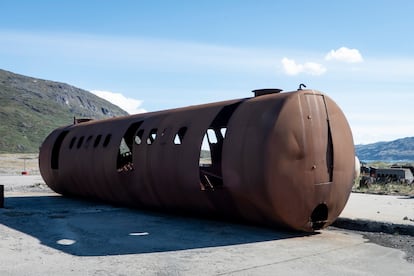
The United States abandoned the base in 1958, leaving a deep environmental footprint; a toxic legacy for a population whose identity depends on balance with its surroundings. The coastal landscape was strewn with rubble, scrap metal, pipes, batteries and thousands of rusty drums. A few miles away, the old military hospital, which had capacity for 250 beds, burned down in the 1970s. No one removed the asbestos panels, and small white fragments of this toxic material lie scattered across the valley. Residents fear the strong winds will continue to carry dangerous particles toward the village, although today they are more worried about Donald Trump.
The consequences of the airport’s closure and the specter of a U.S. return are also felt across the fjord. Although less than two miles apart, Qassiarsuk and Narsarsuaq belong to different worlds. Even though crossing that stretch of water takes barely 15 minutes, ice buildup, strong winds, or dense fog can cut communication between the two shores for days. Qassiarsuk stands on the remains of the farm where Erik the Red settled at the end of the 10th century after being exiled from Iceland. There he named the territory Groenland (green land, in Old Norse) and laid the foundations for Viking colonization.
Far from the classic frozen image, Qassiarsuk dazzles in summer amid hills of intense green dotted with houses painted bright red, yellow, and blue. Although the village has barely 50 inhabitants, it is one of Greenland’s main livestock centers. This activity, like agriculture, is concentrated almost exclusively in the strip of the island south of the Arctic Circle.
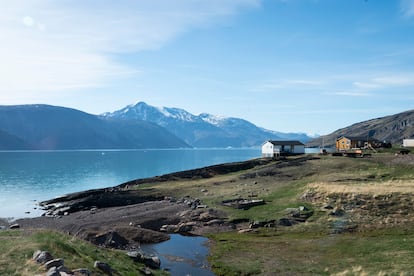
A five-mile path leads to Tasiusaq, where a single family keeps the farm and the guesthouse running. There, Aviaja Lennert and her son’s fiancée bustle in the kitchen to prepare dinner for a pair of German guests who are about to arrive with their backpacks after more than two hours walking from Qassiarsuk. Getting around the island requires patience: without roads connecting settlements, transport depends on boats and helicopters, and when water is not involved short trips are made in a buggy, by snowmobile, or on foot. To replenish energy after the walk, the hosts have prepared a menu that includes homemade bread, fish soup and roasted lamb with local potatoes and wild herbs they gathered themselves. For dessert, rhubarb compote.
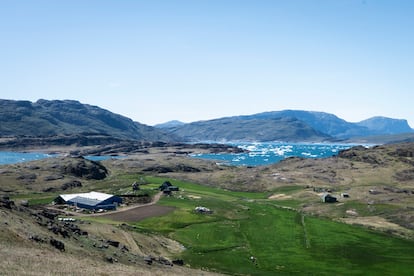
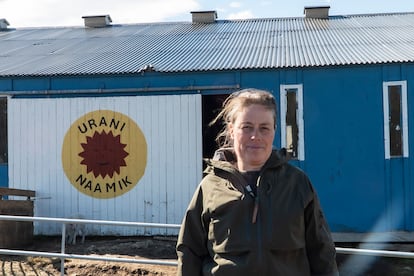
Lennert divides her time between tending the farm’s 600 sheep, looking after travelers, and teaching the few children at Qassiarsuk’s school. Despite her efforts to diversify income, the family faces a precarious period after the airport’s closure. This summer they have received far fewer guests than in previous years. Now another concern has resurfaced that Lennert thought had been banished: mining, a latent threat capable of ruining the natural resources on which their livelihood depends.
Her farm is near Kvanefjeld, a deposit that holds one of the world’s largest reserves of rare earths and uranium. Lennert thought that threat had passed five years ago when she tearfully celebrated the electoral victory of Inuit Ataqatigiit, the ecologist party that had promised to ban uranium extraction to curb Kvanefjeld’s exploitation. She was one of the most active voices in the Urani Naamik (No to uranium) movement, whose cheerful orange sun remains painted on the side of her barn. “It is very important for us to have healthy nature from which we can obtain our food,” she argues to explain her firm opposition to extractive projects that could contaminate the area. Today she worries about Trump — whom she refers to as “the unnameable” — both for his interest in controlling the island and for his desire for the immense wealth of its natural resources.
While Kvanefjeld remains blocked, Washington’s gaze has turned to another vast rare earth deposit a few miles away. Tanbreez hosts reserves practically free of uranium, so its exploitation is not legally prohibited. Aware of its strategic value, U.S. diplomacy maneuvered to prevent the project from falling into Chinese hands and facilitated its transfer to the New York firm Critical Metals. The operation has the firm backing of the Trump administration, which mobilized the state export-credit agency to inject up to $120 million, amid reports of investor interest linked to the magnate’s circle —including his son Donald Trump Jr. — in the mine’s development.
The U.S. president insists on keeping up the pressure. Although he toned down his threats from February onward, at the NATO summit held in July in Ankara he reiterated that the vast island “should be controlled by the United States and not by Denmark.” In early August, Trump posted an image on social media showing a giant figure of the president looming menacingly over a settlement in the Arctic territory, accompanied by a terse message: “Hello, Greenland.”
Last week that extractive voracity ran up against the island’s regulatory wall. The Greenland government ordered the postponement of a controversial oil exploration project in the territory’s east led by Greenland Energy, a Texas-based firm linked to Trump’s circle. The company, which had moved the necessary equipment, intended to start drilling without the required permits, prompting a “serious warning” from local authorities.
EU seeks to strengthen its influence
Faced with Washington’s advances, the European Union is trying to stake out ground and strengthen its influence in the Danish autonomous territory. Barry Andrews, an Irish MEP and the European Parliament’s rapporteur for relations with Greenland, calls for a common front and warns against the White House’s ambitions. “We must make it clear to the Trump administration, again and again, that Greenland’s sovereignty must be respected; we cannot trust the United States anymore,” he stresses by email. Andrews is pushing to double European investment in the island to €500 million in the next budget framework.
Along the same lines, Danish MEP Christel Schaldemose, a vice president of the European Parliament, advocates “investing more and creating better development opportunities.” The social democrat stresses by phone that the EU should be the island’s preferred partner, while always respecting that decisions about resource extraction and the future of mining rest exclusively with Greenlanders.
That right to decide is what led the southern community to mobilize en masse against the Kvanefjeld mega-project when, five years ago, they felt their way of life threatened. In that civic resistance Inga Gísladóttir played an active role, an unusually multifaceted professional — social worker, IT specialist and air traffic controller — who also travels the world as a narrator of Norse mythology. Born in Iceland, Inga has just completed 15 years in Greenland and has returned from three months in Qaqortoq training controllers for the new airport.
Her stance on the geopolitical scramble for the island’s resources is categorical: “Just because this is a vast, sparsely populated land does not mean anyone can come and take it over; it belongs to those who want to preserve it.” In a matter of days she will leave Narsarsuaq, unsure where she will go next. After returning from a walk to see for the last time the glacier that looms a few miles from the village, Gísladóttir brushes away mosquitoes as she evokes the deep Inuit connection to the land: “Here the relationship with nature is not extractive; it is not seen as something to profit from, but as a heritage we must enjoy and preserve for future generations.”
Sign up for our weekly newsletter to get more English-language news coverage from EL PAÍS USA Edition
