
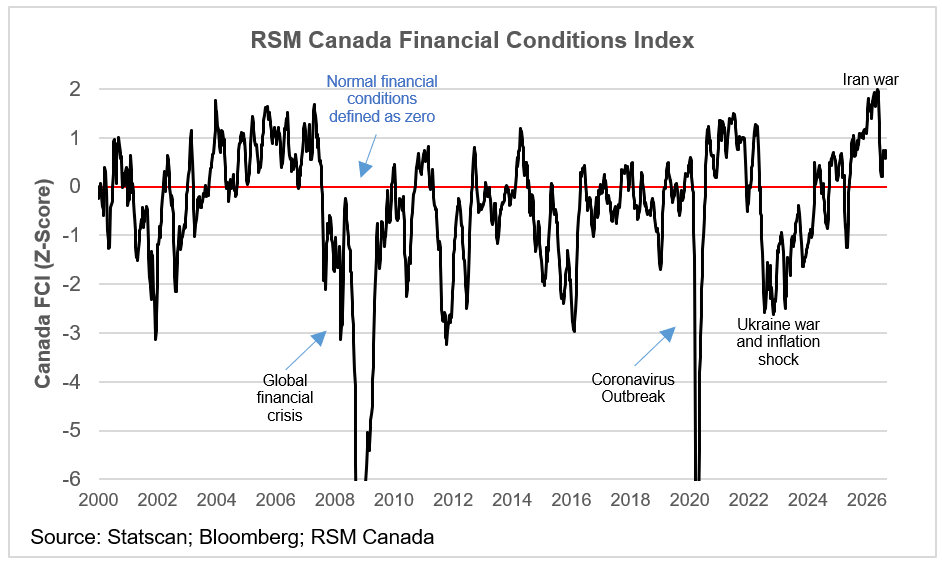
The RSM Canada Financial Conditions Index remains modestly accommodative, despite the energy shock and the growing unease over U.S.-Canada relations.
The index is a composite look at the risk priced into three financial markets—money, bond and equity markets—as well as performance of the commodity market.
Financial conditions directly affect the willingness to borrow and to lend, and they play an important role in Canada’s economic growth and the value of the Canadian dollar.
Get RSM’s Market Minute commentary every morning. Subscribe now.
Index values for each of the markets are calculated as Z-scores (standard deviations), with index values above zero indicating financial accommodation (less risk), while index values below zero suggest more risk and an investment climate less conducive to growth.
At present, our index is 0.7 standard deviations above zero.
Response to uncertainty
That financial conditions have been decelerating is a testament to the uncertainty facing investors.
That financial markets remain modestly accommodative despite the disruption of U.S. tariffs and the energy shock is probably testament to confidence in the response of the monetary and political authorities to external events and to Canada’s position as an energy provider.
That the index hasn’t sunk below zero is because of the resilience of the equity market amid external turmoil.

Rising oil prices are a plus for Canada’s nominal gross domestic product. And while Canada’s inflation has increased to 3 per cent, which is the top of the Bank of Canada’s policy target, inflation has more or less weathered the worst of the energy shock, with localized gains in the energy sector.

Monetary policy
The forward markets are anticipating that the Bank of Canada will tighten monetary policy in response to what will most likely be the sustained effects of the energy shock and the trade war on inflation. The market is hedging those bets, implying no policy hikes until the Bank of Canada’s January meeting.

The bond market
The bond market agrees with that sentiment, with 2-year bond yields at 2.75 per cent pricing in two 25 basis-point rate hikes.
The increase in inflation and the likelihood of rate hikes reduce the real return for investors holding the bonds until maturity while increasing the attractiveness for long-term borrowers who get to repay the loans in deflated Canadian dollars if inflation is sustained.

Long-term bond yields are increasing throughout the major economies. Ten-year yields in both the U.S. and Canada are trading at the top of their recent ranges, threatening breakthroughs with each unfortunate policy move.

The equity market
The performance of Canada’s equity market might have more to do with speculation than with economic growth. But there is no denying the attractiveness of its returns during the post-pandemic recovery.
As in the U.S., Canada’s equity market has propped up overall financial conditions.

