
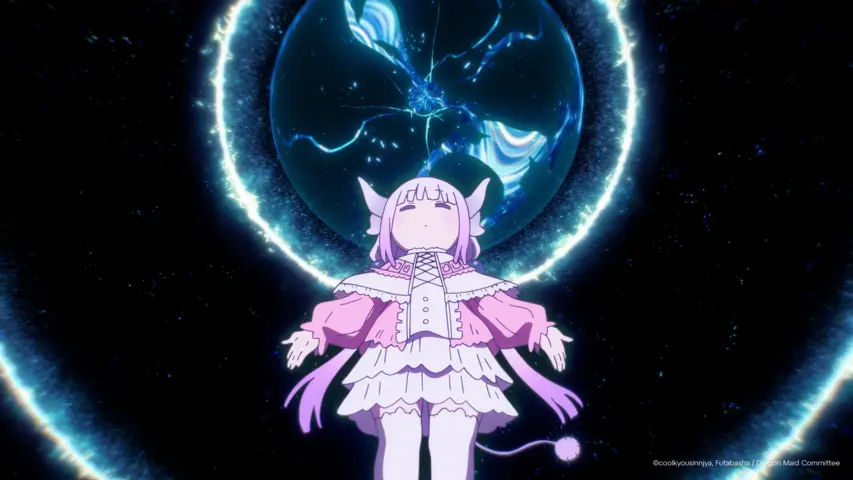
Kyoto Animation has long been considered the gold standard for emotional storytelling. While many of their works originate from light novels, visual novels, or manga, the studio brings these stories to life with a level of elegance and vibrancy that few others can match. Every frame carries its unmistakable craftsmanship.
This signature quality is evident in their latest feature film, Miss Kobayashi’s Dragon Maid: A Lonely Dragon Wants to Be Loved, a continuation of the beloved series. Although its character designs differ from the more grounded style seen in other Kyoto Animation productions, featuring exaggerated proportions that stand out visually, the film remains a striking and heartfelt experience at its core.
Picking up where season two left off, we follow Kobayashi (Mutsumi Tamura) and an assortment of dragons who have taken on human forms while living in the human world. There is Tohru (Yūki Kuwahara), who serves as Kobayashi’s maid, and Kanna (Maria Naganawa), a young dragon attending school and forming friendships with other children around her perceived age. This harmony is threatened when Kanna’s negligent father (Fumihiko Tachiki) returns, demanding that she come back to the dragon world to create a dragon orb to replace the one she previously destroyed in preparation for an upcoming conflict.
Even though this is an anime, and there is no physical connection between the actors, the characters still share an evident chemistry. Within a few seconds, whether the audience has seen the show or not (though I would say the series is required viewing, non‑fans shouldn’t feel too lost), we believe this group of unique misfits is a familiar and cohesive unit. Mutsumi Tamura is wonderful as the titular Kobayashi, and Maria Naganawa is otherworldly as Kanna, delivering a layered and heartfelt performance that anchors the film
With a subtitle like A Lonely Dragon Wants to Be Loved, it’s reasonable to assume that loneliness and love reside at the core of the film’s message. From the very beginning, and throughout the entire film this theme is evident. While Kobayashi insists, she isn’t Kanna’s adoptive parent (and more a friend), she clearly fills a parental role, something Kanna has never truly had. This becomes especially clear in a nightmare Kanna has, where she clings to her father’s back, feeling his warmth, only to eventually fall off and be caught in her arms. While now as an adult I do no longer dream or long for parental warmth and love, but it is something that while should be mutual, even though the harsh reality is that it often isn’t.
For Kanna, the closest experience she has ever had to real love is what she found in the human world with the likes of Kobayashi and with Riko, but does that truly matter? For many people who experience loneliness, love could fill every aspect of their life, and yet they still feel alone, still searching for the affection of one person. For Kanna, that person is her father: she longs to be praised by him, to be wanted by him. She wants to hug him and be with him, even though those feelings are not reciprocated. It’s this tenderness and emotional longing that grounds Miss Kobayashi’s Dragon Maid: A Lonely Dragon Wants to Be Loved.
Despite taking place in a world where dragons and humans coexist, it’s the underlying humanity that brings the film to life. Kobayashi believes, and instils in the dragons, the idea that both humans and dragons are capable of change, and that only in death do our views become fixed, as we can no longer grow or evolve. This belief is challenged when Azad, a mage with ulterior motives, enters the story. Consumed by hatred after a dragon killed his sister, he wants every dragon to die and believes that the world will only become a better place once they are eradicated.
Especially in 2026, when unity and camaraderie can feel like things of the past and people’s ideologies have become so intertwined with their identity. it’s refreshing to be reminded that openness to change and understanding different perspectives is what truly makes the world better. Bitterness and entrenched hostility only cause more harm, leading to a world that is a husk of its former self: a place where acceptance and love go to die.
While 2026 is a grim reality, one thing that remains undeniably bright is the animation produced by Kyoto Animation. Miss Kobayashi’s Dragon Maid: A Lonely Dragon Wants to Be Loved continues to demonstrate why Kyoto Animation is one of the best anime studios working today. Every frame of this film is brimming with colour and vibrancy; more than once, I found myself wondering if HDR had switched on, because the colours are eye-squintingly bright and remarkably dynamic. There’s movement and zestfulness in every shot, and a fluidity to it all that’s hard to replicate on a TV‑series budget.
What was shocking was how great the action animation was. While Kyoto Animation has tapped into action before, it isn’t something they’re known for; their most famous works are shows and films like The Melancholy of Haruhi Suzumiya and A Silent Voice. The action in A Lonely Dragon Wants to Be Loved is gripping. Even though much of it takes place in wide-open, barren locales, there’s an intensity and beauty to it that stands apart from most action anime. It melds the dynamism you’d expect from shōnen action with the emotional texture and visual elegance we love about Kyoto Animation.
Miss Kobayashi’s Dragon Maid: A Lonely Dragon Wants to Be Loved is a delightfully heartfelt and moving continuation of the Miss Kobayashi’s Dragon Maid series. It prominently showcases why Kyoto Animation remains one of the greatest anime studios working today, bringing their signature stunning animation and heartfelt storytelling to the big screen once again. This film should not be missed.
★★★★
In UK Cinemas from 4 March 2026 / Mutsumi Tamura, Maria Naganawa, Yūki Kuwahara, Fumihiko Tachiki, Yūki Takada / Dir: Tatsuya Ishihara / Crunchyroll, Sony Pictures / 15
Related
Discover more from
Subscribe to get the latest posts sent to your email.
