
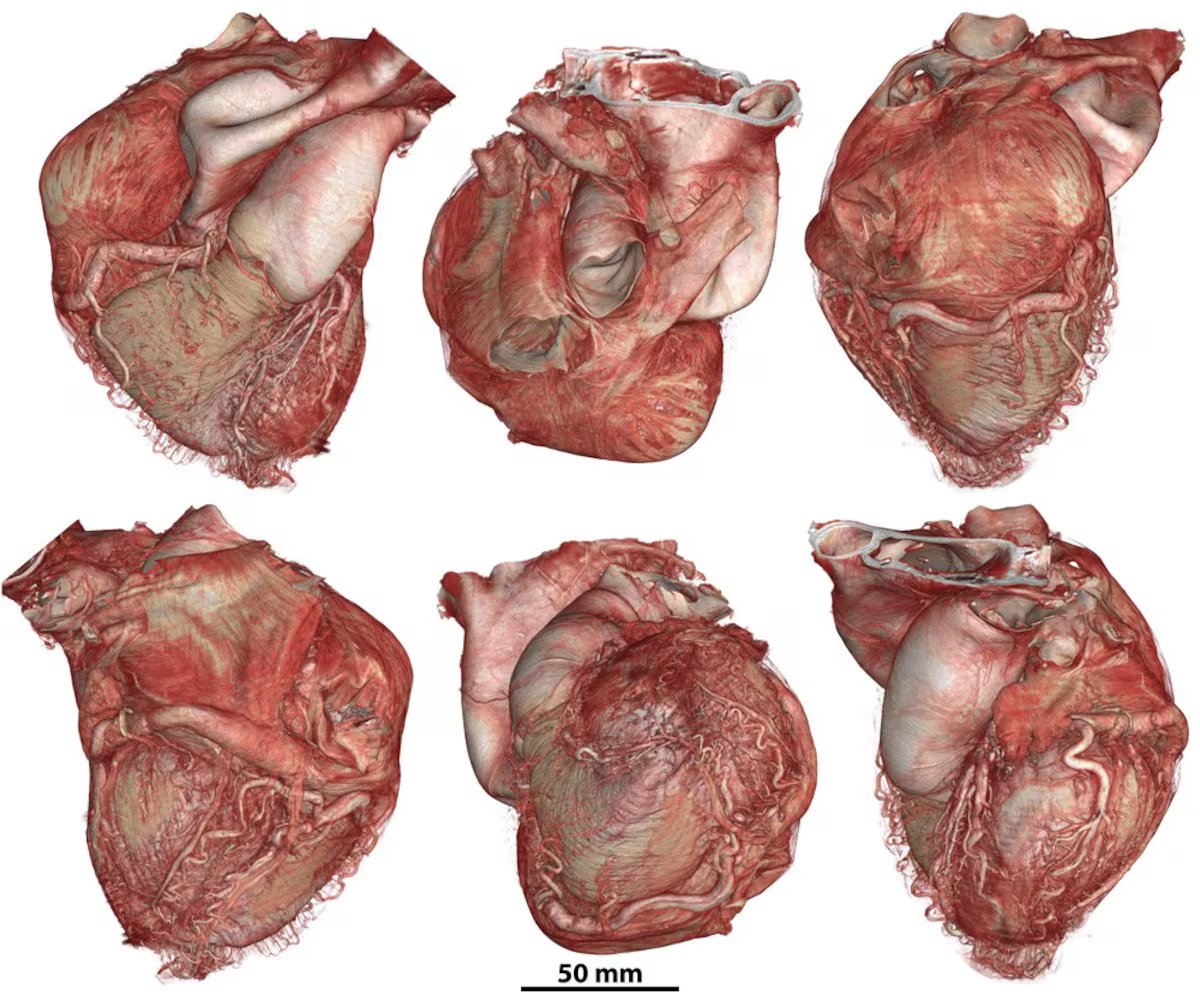
After five years of research and several failed attempts, an international team led by doctors and scientists from University College London published the Human Organ Atlas on Wednesday. The project, a kind of Google Earth of the body, promises to revolutionize biomedical research and the study of diseases, such as hypertension, diabetes, cancer and COVID-19, by linking multisystem failures, anatomical variations and patterns associated with complex pathologies in organs of the same patient.
The platform’s 3D images were generated with unprecedented detail using organs from deceased donors. This was made possible by an extremely powerful X‑ray technique known as HiP‑CT, which can produce full‑organ reconstructions and reach cellular‑level resolution without cutting or damaging the tissue. “This multiscale capability makes this atlas a unique resource, capable of connecting macroscopic anatomy with 3D histological details,” say the researchers, who published their work in the journal Science Advances.
To get to this point, the group of experts refined a beta version that was launched in 2021, during one of the most difficult moments of the pandemic. “We’ve been incorporating more features and adding more data to the portal so that the atlas is what it is today,” explains mechanical engineer Claire Walsh, from University College London, one of the project’s main driving forces, via video call. The researcher recalls that some of the initial information shared in the atlas about patients who died from COVID-19 led to publications revealing previously unseen microscopic vascular lesions. That and other discoveries became the foundation for building something bigger.
The specialist explains that one of the biggest challenges for the team — made up of more than 20 researchers — was scanning entire organs and making large amounts of data accessible. Each dataset can reach hundreds of gigabytes or even more than a terabyte. The largest so far, corresponding to a human brain, is 14 terabytes. “To store these images in the cloud and allow for interactive viewing, we needed a huge infrastructure. And we’ve invested a great deal of time in this over the last few years, to make this data truly interactive,” Walsh says.
The atlas is a fully open repository of anatomical data that allows researchers, educators, and the general public to access its content online. It also provides software tools and training resources to make the platform easier to use. Other features include search tools, image and video galleries, browser viewing, and download options. Dr. Walsh the potential influence of such a collection on biomedical research, for example. “With clinical imaging, you can only see relatively large metastases. And with histology, with sections, it’s like looking for a needle in a haystack. With HiP-CT, you can perform high-resolution scans and detect possible micrometastases, and then scan that area in even greater detail,” she explains.
Walsh lists another example: the study’s findings on chronic obstructive pulmonary disease (COPD). “For a long time, it was thought to be exclusively pulmonary, but people with COPD are much more prone to cardiovascular problems; there is clearly a multisystemic component. The same is true for diabetes, hypertension, and other multisystemic diseases,” she says.
The atlas has also revealed unexpected details in kidneys. “In the kidney, we discovered that the glomeruli are not all at the end of the vascular network, as was previously believed, but are distributed in a completely different way,” says Walsh.
The project was developed at the European Synchrotron Radiation Facility in Grenoble, France, and brings together researchers, engineers, physicians, and infrastructure specialists within the Human Organ Atlas Hub, a consortium of nine institutions across Europe and the United States. It has so far compiled data from 25 donors, with samples sourced from more than a dozen European biobanks, such as the Hannover Unified Biobank and the French Alps Anatomy Laboratory. The available results include 3D data on 56 organs of 11 different types, including the brain, heart, kidney, liver, lung, uterus, and prostate.
Despite the progress represented by the creation of a platform like this, one of the atlas’s main challenges is the limited diversity of organs by sex and age, since most of the available models so far come from male donors with an average age of 73. However, as Dr. Walsh notes, this impression can be misleading. “Although those that have been published are mostly male, they represent only about 30% of the consortium’s data. The rest are in the process of being prepared for publication, and there the proportion is not so skewed. We have more female donors, but this first collection is heavily influenced by COVID-19 cases, in which men had worse outcomes, so there were more male donations,” she says.
Regarding the age of donors, Walsh points out that the predominance of people over 60 is understandable: “Younger people are usually destined for transplants, so the atlas will always be more oriented towards older ages.” She links this distribution to a broader reality in global health: “Aging is one of the greatest contemporary socioeconomic challenges, since age-related diseases are now one of the main global burdens on public health,” says Walsh.
Open science
The Human Organ Atlas stands out not only for the quality of its images but also for its commitment to the FAIR (Findable, Accessible, Interoperable, and Reusable) principles. From the outset, the team embraced what is known as open science. “We wanted this data to be accessible to everyone and to build an open and shared scientific infrastructure on a global scale,” says Paul Tafforeau, a scientist at the Grenoble Synchrotron and creator of the platform.
All data is available under a Creative Commons Attribution 4.0 license, which allows for its reuse as long as the source is cited. “The Human Organ Atlas demonstrates what teamwork in science can achieve at its best,” says Walsh.
The team aims to broaden the repository with more organs, greater donor diversity, and new analytical tools, while fostering an open, connected community that supports research, education, and the development of artificial intelligence. “In the future, we hope to develop the technique to obtain images of whole human bodies with a resolution 10 to 20 times greater than what is currently available,” say the researchers.
This resource will continue to transform science and medical education in the coming years. “This data could transform the way anatomy is studied and understood,” says Walsh.
Sign up for our weekly newsletter to get more English-language news coverage from EL PAÍS USA Edition
