
Confession: I’ve never listened to an audiobook. (Unless you count snippets of Stephen Fry’s calming Harry Potter narration.) Not for a lack of interest, necessarily, but rather just that I generally put whatever passive listening time I have towards music or podcasts. But that might finally change after spending a day hearing a lot about audiobooks.
Last week, Amazon hosted me and other international media at an event in Berlin to launch its inaugural creative industries impact report. In it, the e-commerce giant outlined how divisions like Prime Video, Amazon Music and Audible are making a splash in both local and global markets. I wrote a full breakdown of that report, including its Canadian findings, but for this story, I wanted to focus on Audible. A big part of that other piece was about Prime Video, something I’m much more familiar with as a regular streaming service reporter. On the flip side, my Audible and audiobook discoveries were much more pronounced, and so I figured I’d dive into those a bit here.
First and foremost, I didn’t realize just how many Canadian originals there are on the Audible front. (While I’ve seen ads for these sorts of titles all the time, I never paid much attention.) During the event, Amazon specifically shouted out Mistletoe Murders, which was written by Winnipeg-born Ken Cuperus and features Canadian voice talent like Vancouver’s Cobie Smulders (How I Met Your Mother), Toronto’s Raymond Ablack (Ginny & Georgia) and Vancouver’s Anna Cathcart (To All The Boys series). But a quick search of Audible’s Canadian site shows the likes of Alanis (featuring the eponymous Ottawa-born Jagged Little Pill singer), Sidney Crosby: The Rookie Year (starring the titular Haligonian hockey player) and Oracle (Vancouver’s Joshua Jackson of Dawson’s Creek fame).
Knowing the sheer volume of titles made the next part of the event all the more fascinating: a behind-the-scenes tour of Audible’s Berlin office. Notably, the German location is one of four full-service Audible outfits alongside those in Newark, London and Paris. (In countries like Canada, Australia, Japan, Italy and India, Amazon works with third-party studios.) This tour was particularly interesting because it highlighted just how much work goes into producing Audible titles.
First off, Amazon has to find, select and negotiate with its production partners, a process which can no doubt take some time. From there, the parties begin the casting process, which looks for talent based on age, gender, vocal range, distinction, experience and availability. On top of that, the pre-production process involves booking and contracting others, like artistic directors, engineers, sound designers, composers and proof listeners (those who do a final check on a recorded title).
Once all of that’s done, production can begin. When it comes to the main recording process, a number of elements are key: performance consistency, pacing, pronunciation and a case-by-case determination on whether the narrator must maintain 100 per cent script accuracy or some creative freedom is permitted.
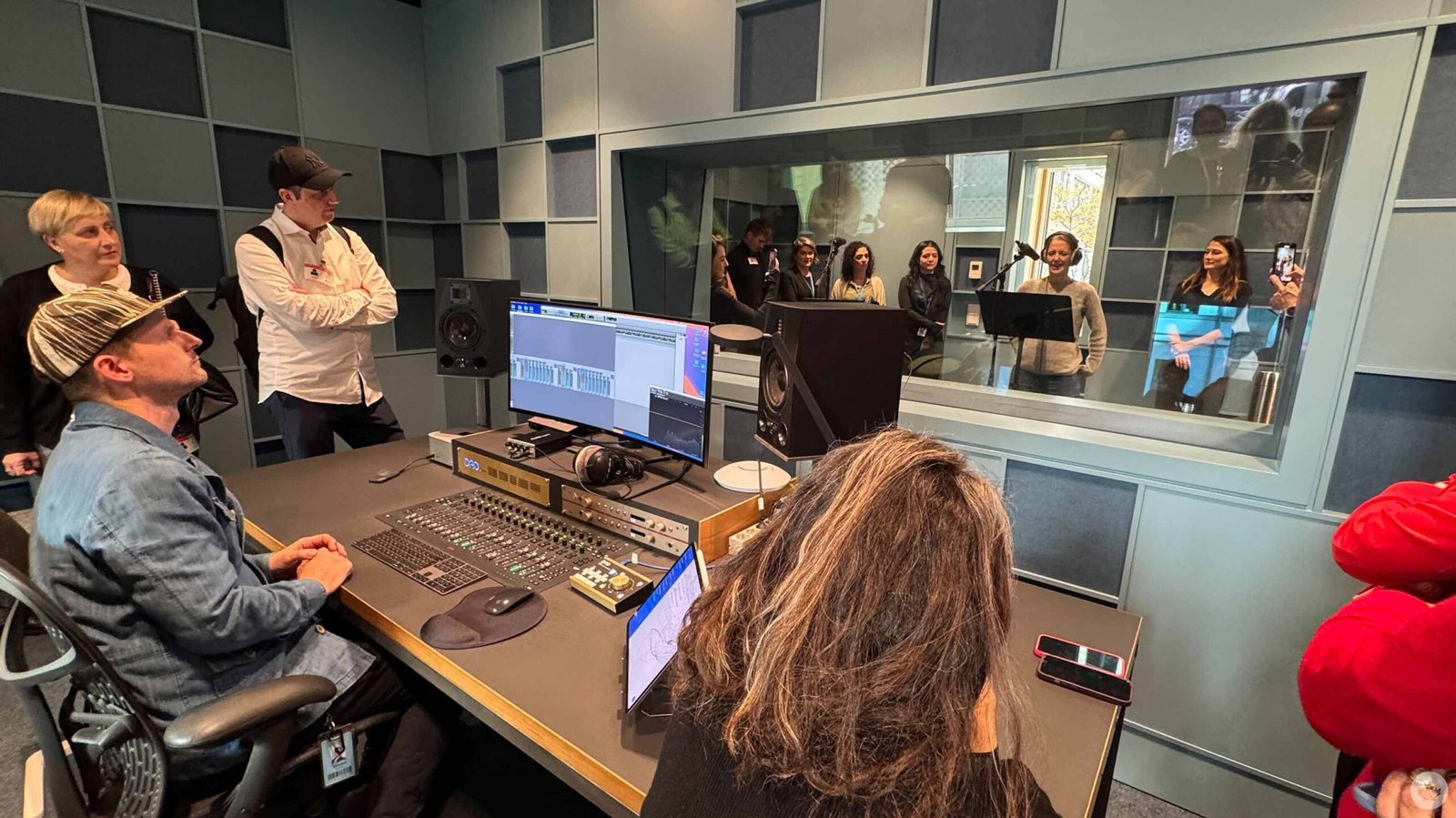
For this part of the tour, we were welcomed into a recording booth, and I sat on the side of the sound engineer. On the other side, actress Karoline Mask von Oppen, had her setup with which she would record. For the purposes of the demo, she sampled a section from Stephen King’s Pet Sematary. All the while, she gave some interesting insight. First off, she says she’ll normally record for about three-and-a-half to four hours total, as anything more can cause vocal strain. In those sessions, she’ll generally go through 8,200 words per hour.
Something else that many might not consider (that I only recently learned from a video game actor podcast) is that the actors have to be very conscious about what they’re consuming prior to a session. For instance, fruits and lean proteins can be good to prepare, while dairy, caffeine and sugar should be avoided because they can create a buildup of mucus or phlegm or dehydrate vocal chords. (von Oppen says water and tea are her go-to.)
For some extra fun, a few other media took part in a practice run, and, understandably, flubbed many lines. (That’s not a knock against them, though, as it’s only human to mess up, especially without experience. Indeed, we even heard both von Oppen and a recording of an unnamed actor going through many different takes, whether it was because they flubbed a word or just went for a different intonation. It definitely lets you better appreciate the calm and collected narration you’ll eventually hear in the final product. (I’ll also add that between visiting Audible Berlin and a similar recording studio at Ubisoft Montreal, it can get bloody hot in those rooms!)

All the while, I marvelled at just how technologically complex the actual sound rigs are. As someone who is not at all an audiophile and has historically used cheap $30 to $40 wireless headphones I got on Amazon, I have to appreciate just how much goes into the tech of it all. Something I also never really considered that von Oppen brought up is just how much of an open dialogue the actor must have with the sound engineer. Since I’m mostly into games and films, I tend to have this idea of large teams collaborating on a project. But on an Audible, it’s just the two people on either side of the glass. Therefore, there has to be a strong collaboration and sense of trust between the two when it comes to catching any mistakes and figuring out where to go for a different take on a given line or scene.
After all of that’s done, the editing process begins, with a particular focus on editing (cleanup and pacing), sound design (sound effects, AKA foley, music, overall mix) and quality control (listening through the entire title, filing an error log and making any necessary fixes and pickups).
All in all, it’s a pretty intensive process for what’s ostensibly just an audio experience. I definitely took a lot of that for granted, and now that I know more about how the sausage is made, I’m definitely much more interested in listening to an audiobook and other spoken word content. Now, what to pick?
