
I would like to say that Nicolás Maduro is the only one who has aged. He has more gray in his hair than when he first stood in his prisoner’s suit before the Southern District of New York’s federal court almost three months ago, having been forcibly transported there by a U.S. military operation and accused of crimes related to drug trafficking, weapons possession and corruption. He puts on his reading glasses to examine documents and take notes at the second hearing, which focused on whether the U.S. should allow him to use Venezuelan funds to pay for his private defense.
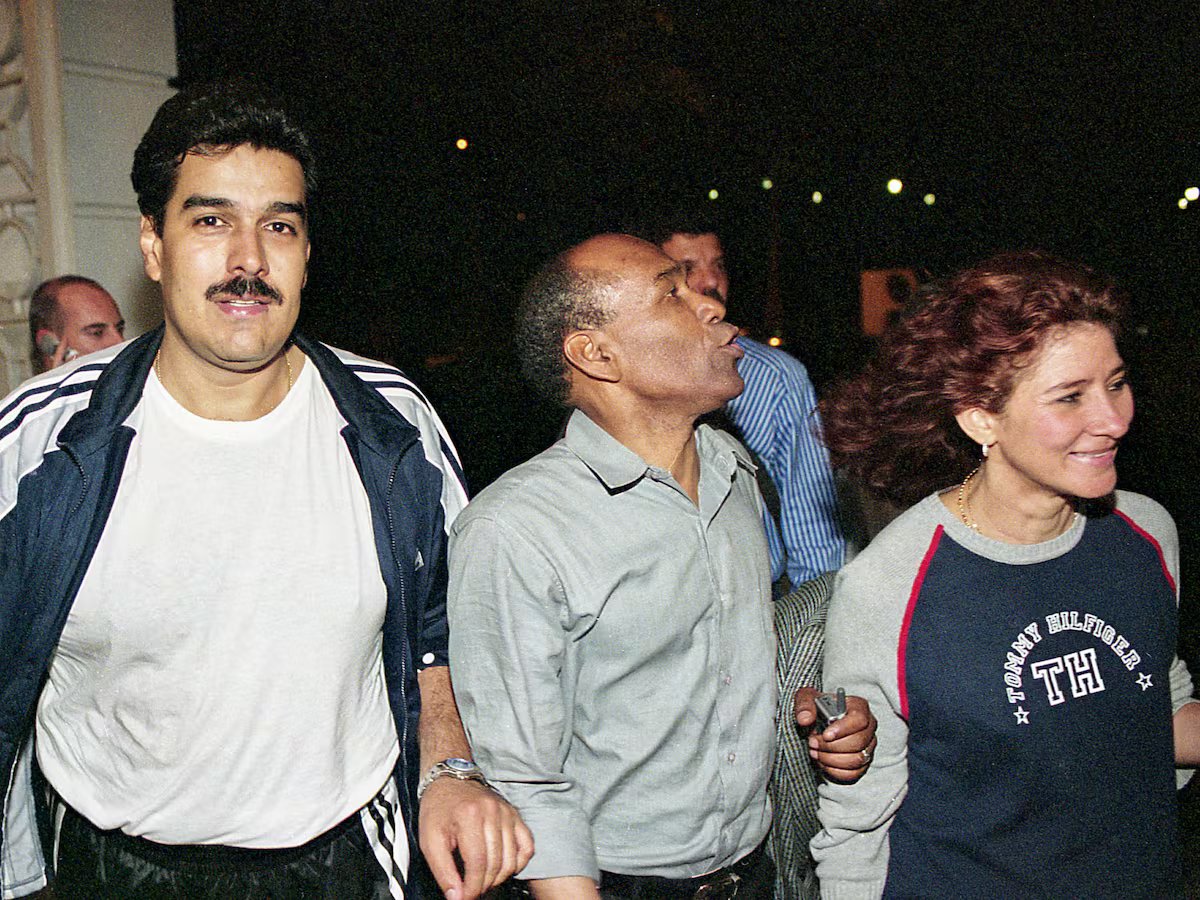
It has been more than 25 years since we first met, a quarter of a century since his party started to govern my country, Venezuela, together with the military. I was 23 when I met Nicolás Maduro and Cilia Flores. Both were members of the National Constituent Assembly that was established in Venezuela in 1999 while I was working as a political reporter for the Venezuelan press. Seeing them again in person during the hearing on March 26 in Manhattan, now that I am almost 50, I was struck by the mixture of disbelief, loss and bitterness that has been building for a long time.
Over the years, I have witnessed the rise and fall of the couple, who carved a niche for themselves in Hugo Chávez’s inner circle, inheriting the presidency after his death and turning the screws of Chavismo further at the expense of Venezuelans’ freedom while plundering the nation’s oil wealth. Their dynasty lasted thanks to repression until January 3 this year when they were seized by the U.S., with Maduro replaced by his vice president, Delcy Rodríguez, under the tutelage of the U.S. Although the country is still governed by the same regime, Maduro’s fall has offered hope for political change, especially to Venezuelans in the diaspora who have suffered persecution and exile and who turned up to see him in court.
Some of the Venezuelans seeking asylum—who traveled from various cities across the United States and managed to enter the courtroom—see this process as their first chance to experience a measure of justice. Since taking office in 2013, Maduro has intensified his crackdown on dissent. “A spark that ignites, a spark that goes out,” he even ordered the armed groups defending the government—the “colectivos”—as well as the Battle Units and Community Councils, which maintain a complex system of denunciations and social control that even today can send dissidents to prison on the flimsiest of pretexts: for protesting, for posting a tweet against the regime. The Bolivarian National Intelligence Service (SEBIN) and the General Directorate of Military Counterintelligence (DGCIM) also set about investigating and arresting hundreds of civilians and military personnel accused of being rebels.
A mission of the Human Rights Council and the United Nations has investigated and documented human rights violations committed by the state since 2014. In the U.S., the Treasury Department’s Office of Foreign Assets Control (OFAC) has also issued a series of sanctions against Maduro together with dozens of officials and entities aligned with the government. These measures have led to restrictions on the Venezuelan oil sector, freezing assets and blocking transactions with U.S. entities. And although Maduro is not charged with human rights offenses, César Coello, a young activist from an opposition party who sought asylum in the U.S. in 2019, is optimistic: “I hope to see something new in Venezuela. In three months, things have happened that have not happened in more than 20 years. This is surreal, we are witnessing living history.”
Maduro and Flores’ influence within the Chávez regime was built gradually through obedience. Both were part of the political movement started by Hugo Chávez, a military officer who had attempted two coups d’état and who, after a brief stint in prison, was voted in as president in 1998. The couple met while visiting Chávez in prison, according to Nicolás Maduro in an interview he gave me in November 2003 for the Venezuelan newspaper El Mundo. “Cilia was a professional, a housewife who had never been involved in politics, and a lawyer for Chávez and several prisoners (…) We met in the process and got closer. We have a deep relationship and a clear identity,” said Maduro, who was a deputy by then and president of the ruling party’s National Assembly.
At that time, Flores was also a lawmaker. She and Maduro presented themselves as an affable couple who talked to journalists and shared details of their personal and spiritual lives with a certain candor. They said they had met in politics and while following Sathya Sai Baba, whom they visited a couple of times in India. “Things that should not be talked about much,” Maduro said during the same interview, while showing a medallion etched with the guru’s face that he wore around his neck on a gold chain, along with a crucifix. The pair became speakers of the Venezuelan Parliament and promoted the transfer of legislative powers to President Chávez, which helped Chávez build the legal framework of the regime through the approval of dozens of laws giving him control of the economy among other public powers in the midst of an unprecedented oil bonanza.
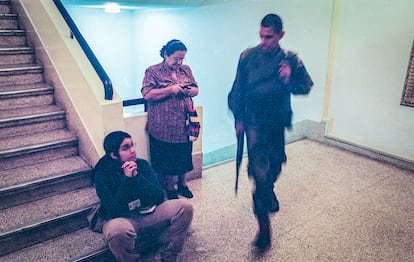
Maduro then resigned from parliament to join the executive cabinet, first as foreign minister and then as vice president, and became an almost untouchable political figure. “Look where Nicolás, the bus driver, is headed. He was a bus driver, and how they make fun of him,” said Chávez, who had just been declared president for a fourth term in October 2012. Maduro was one of the president’s most trusted men. During that last election campaign, Maduro occasionally drove the vehicle in which Chávez, already ill with cancer, toured the country. He was one of the few figures who accompanied him during his hospitalizations in Havana. And when the end was imminent, the founder of Chavismo named him his successor during a message broadcast on all radio and television stations.
Nicolás Maduro was declared president of Venezuela in the April 2013 elections, with a 1.49% advantage over the only opposition candidate, Henrique Capriles. He formed a cabinet full of officers from the Armed Forces and, despite being a civilian, began to wear camouflage jackets and field uniforms himself.
The last time I was able to work in Caracas as a reporter was between April and May 2017. Chávez had been dead four years, but the state-run Venezolana de Televisión station was still broadcasting the old editions of the program Aló, Presidente – clips of speeches in which Hugo Chávez asked for revolutionary loyalty to overcome difficult times. Inflation that year was 438% and there were swarms of people in the streets rummaging through the garbage in search of food. At that point, the protests of the previous month had resulted in 29 deaths and more than 1,200 injured.
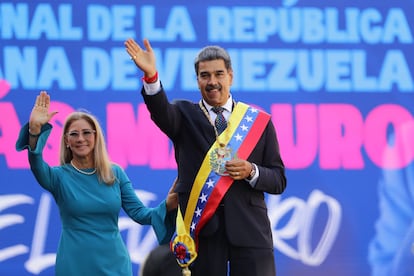
On May 1 of that year, Nicolás Maduro convened another National Constituent Assembly (Decree 2830), and dissolved Parliament again where the opposition had held a majority since 2015. The aim was to rewrite the 1999 Constitution to incorporate the Communal State and popular power structures. The state became more and more involved in operations such as the distribution of food and gasoline in the midst of fierce shortages. Maduro also continued with the policy of seizing assets that Chávez had initiated, but now not only of large companies but also of small enterprises: “Company stopped, company expropriated.”
Even before assuming the presidency, Maduro flagged up more than a dozen alleged conspiracies to overthrow him. He provided no concrete evidence, but was convinced the military would be on his side, “knee to the ground,” to defend him. Like Chávez, he led the military parades every year, showing off his investment in arms, tanks and anti-aircraft batteries bought from Russia, which in theory were to be used in the event of a foreign invasion. They were not, however, resorted to on January 3 when the U.S. launched their operation to take Maduro and his wife into custody. According to the U.S. Attorney Office’s indictment with which President Donald Trump justified his intervention, Nicolás Maduro has used these weapons to threaten U.S. security and manage foreign policy in Latin America.
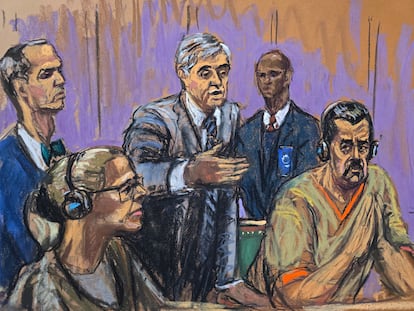
“This is a case that is beyond the normal,” said 92-year-old judge Alvin Hellerstein, during the hour-long hearing that discussed the blocking of Venezuelan funds as a result of OFAC sanctions. It is these sanctions that prevent the current regime of Delcy Rodríguez from paying for the private lawyers chosen by Maduro and Flores. The Prosecutor’s Office alleges that the circumstances in which the sanctions were issued persist in Venezuela, but the judge considers that now that Maduro and Flores have been locked up in the U.S. for almost three months “the Venezuelan government is no longer implicated in the kinds of atrocities we’re talking about now. We corrected that.” This is despite the fact that arrests and reprisals against dissidents who dare to celebrate the U.S. intervention continue, and that almost none of the exiled Venezuelans attending the hearing are clear how they might return to their country without suffering consequences.
With Rodríguez at the helm in Venezuela, OFAC has granted licenses that have allowed the country to generate revenues of up to $18 billion from oil sales at prices that will be under U.S. control. Maduro’s lawyers believe that money could pay for Maduro and Flores’ legal fees for a judicial process that could take years. This idea enrages the Venezuelan exiles in the courtroom who are hoping for reparation for damages unlikely to be considered in an eventual trial against Maduro and his wife. “How long are they going to put their hand in our pockets! The money they have is stolen and it is also ours. They have no right to spend more of the country’s money. We have to keep applying pressure,” rails one Venezuelan at the end of the session surrounded by a small group of demonstrators who have gathered in front of the courthouse to follow the process.
But there are also those who say, “Sometimes we have to be thankful and content with what God is giving us, even though they deserve more [punishment].” Meanwhile, helicopters fly over the courthouse and a motorcade of armored cars escorts the defendants back to their cells at the Metropolitan Detention Center in Brooklyn, where they will remain until they appear before the judge again.
Sign up for our weekly newsletter to get more English-language news coverage from EL PAÍS USA Edition
