
Listen to this article
Estimated 6 minutes
The audio version of this article is generated by AI-based technology. Mispronunciations can occur. We are working with our partners to continually review and improve the results.
The once debt-free Alberta government projects three consecutive years of red ink and increased borrowing to fund critical public services.
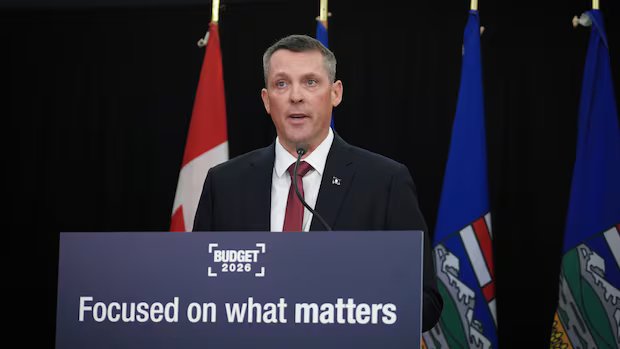
Finance Minister Nate Horner says his United Conservative government must break some of its own fiscal restraint laws to weather an increase in population that came without an economic boom.
The province is projecting a $9.4-billion deficit for the upcoming fiscal year, which Horner described as “a tough pill to swallow” in a news conference Thursday afternoon.
But moving away from the yo-yo of provincial revenue that rises and falls along with oil and gas resource royalties would require Albertans to reconsider their aversion to taxes, Horner suggested.
“If Albertans want to give up some of that tax advantage to get off the roller-coaster, that’s a conversation we can have,” he told reporters.
The province predicts the average price of benchmark West Texas Intermediate oil to be $60.50 US per barrel.
Horner tabled an $83.9-billion proposed 2026-27 budget in the Alberta legislature on Thursday afternoon, which is about a five per cent increase in spending from the current year.
Officials estimate revenue to be $74.6 billion, which is slightly lower than what the province hopes to collect this year.
Following four years of surpluses, allowing the province to pay off some of its debt and bolster investments in the Heritage Savings Trust Fund, Alberta is slated to run a deficit in the 2025-26 fiscal year. The province must grapple with a debt load slated to hit $109 billion by March of 2027 and potentially $138 billion by 2029.
Horner said he is confident the Heritage fund will reach its $250-billion goal by 2050, even without contributions for three years.

The UCP has tabled its proposed budget which sees more money allocated for health care and education, but an increase in some taxes has critics saying the budget will cost Albertan’s more than they can gain.
Anticipating criticism from both those with a distaste for debt and those who want to see more spending, Horner said the government is left with few expenses left available to cut.
He said he doesn’t have a mandate from Albertans for broad tax increases, nor will he directly seek one, but hopes families talk about the challenge around their kitchen tables.
The UCP government has adopted legislation to control its spending, requiring mostly balanced budgets, no more than three years of deficit budgets, and limits on any deficits.
The 2026-27 proposed budget is poised to break the law in at least two ways, officials said.
Horner said that bothers him more than anyone else.
“The consequences are political,” he said. “We created these rules, and I’m breaking them.”
Premier Danielle Smith dropped some budget clues earlier this week, committing to increasing the health and education budgets to help catch up with growing needs.
Although Alberta’s population growth is forecast to slow down, Horner said the province has substantial catch-up work to build enough schools, hospitals and health facilities for the province of five million people.
Government has ‘entirely wrong priorities,’ Opposition says
In the wake of a fall teachers strike and lockout prompted by the overwhelming demands on educators in crowded schools, the province proposes about a seven per cent increase in kindergarten to Grade 12 education spending next year.
Health spending is slated to rise nearly six per cent, in an effort to expand capacity for surgeries, bolster addiction treatment and recovery, and begin what the government calls “compassionate intervention” services, where an expert panel can force an adult into addictions treatment.
But Horner said other ministries had to make sacrifices to protect health and education.
He said it was important to the premier to restore to 100 per cent the grants in lieu of taxes that the province pays to municipalities instead of paying property taxes on provincial buildings within their boundaries.
However, overall funding to municipalities will decrease by one per cent even as civic leaders plead for money to maintain and replace aging infrastructure and fund social supports.
Alberta Municipalities issued a statement saying Albertans’ property taxes will rise as a result of the government’s proposed budget. The statement said it’s “misleading” for the province to claim taxes aren’t rising.
The organization urged the government to start a conversation about how to raise the revenue required to prevent crumbling roads and broken water mains.
Alberta NDP Leader Naheed Nenshi questioned Horner’s comments that the government has eliminated unnecessary expenses and is improving health and education services.

He pointed to a failed attempt to privatize lab-testing services, creating more health system bureaucracy, and downtown arena infrastructure deals as examples of waste.
Nenshi said the government’s planned cuts and fees hurt some of the most vulnerable Albertans.
Budget documents say residents in continuing care homes will see a two per cent fee increase to daily charges. Apprenticeship and trade exam and certification fees are all being hiked to $150. Immigrants applying for the provincial stream will pay a new $135 fee.
People who receive income support benefits but are able to work will be removed from that program after six months, which is expected to save the province $44 million next year. Seniors will also have to receive lower incomes to qualify for the Alberta seniors benefit or grant programs.
Nenshi said Smith’s government is racking up debt while pulling in far more lucrative resource royalties than former NDP premier Rachel Notley had at her disposal. He said he believes Smith is no fiscal conservative.
“Your UCP government has spent so much money to deliver so little. And that’s not because of immigrants,” Nenshi said, referring to the premier saying too many newcomers put unsustainable pressure on public services. “. . . It’s because of their choices. They have entirely the wrong priorities.”
