
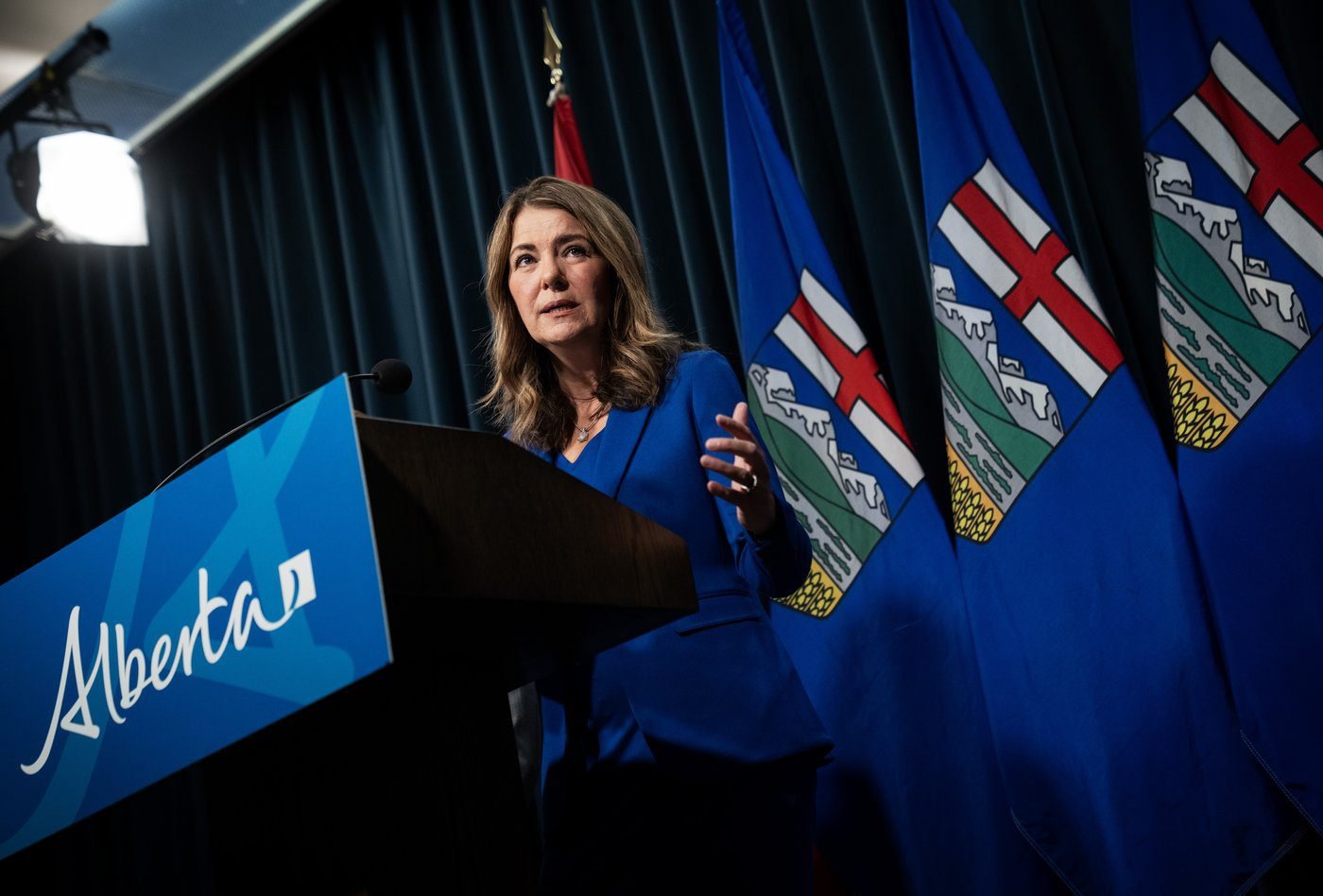
Alberta Premier Danielle Smith says the war in Iran underscores the need for a new pipeline connecting her province’s oil reserves to the West Coast.
The threat of shipping disruptions has seen global oil prices jump since American-Israeli attacks on Iran over the weekend.
Smith says any disruption in the Strait of Hormuz, a key oil choke point at the mouth of the Persian Gulf, only underscores the need for a new pipeline that could bring her province’s pivotal export to Pacific shipping lanes.
She made the comments Monday at an unrelated news conference in Lethbridge.
Smith said if the uncertainty continues, it only demonstrates that the world and Canada’s trading partners need to have a stable source of supply.
“We want the conflict to end quickly with minimal loss of life. I think that’s what we should all be hoping for, and we’re watching with interest about what our friends and allies are going to need,” she said.
The United Conservative premier added that the planned expansion of the existing Trans Mountain pipeline, which carries Alberta bitumen to the West Coast, offers a “clear line of sight” for Asian partners.
“We’re here to help. But part of the way in which we can help is, of course, with expansions to the West Coast pipelines.”
The conflict could also affect Smith’s political fortunes, as the price of oil tends to make or break Alberta’s budget.
Last week, Smith’s government projected a $9.4-billion deficit for the coming year based predominantly on slagging oil prices.
Depending on how much market volatility is to come with one month left in the province’s current fiscal year, Smith said what was expected to be a $4.1-billion deficit “might be somewhat less than that.”
Late last year, Smith signed an agreement with Prime Minister Mark Carney that paved the way for a potential Indigenous co-owned pipeline and the clawback of environmental policies standing in the way.
The deal aims for Alberta and Ottawa to agree on an industrial carbon price by April 1 and sets a July 1 deadline for a pipeline proposal to be submitted to Ottawa’s major projects office.
The province’s latest projections put West Texas Intermediate – the North American benchmark oil price — at an average of US$60.50 a barrel in the upcoming fiscal year.
Alberta Finance Minister Nate Horner said Monday morning the government aims to forecast conservatively rather than overestimate future oil prices, but he’s been watching the “dramatic increase” to between $70 and US$74 per barrel since the markets opened.
“The markets are pricing the risk right now. If the (Strait of Hormuz) remains closed for a long time, you’ll see that reflected in the price. But as the risk dissipates, it will quickly become a supply and demand calculation again,” Horner said.
Alberta’s government now estimates that every $1 drop in the WTI price carves out about $680 million from the province’s bottom line.
Smith’s latest comments echo what she said following the American capture of Venezuelan President Nicolás Maduro in early January.
At the time, U.S. President Donald Trump stated his plan to ramp up oil production in the South American country, while Smith said such instability bolstered the argument for a new export pipeline to British Columbia.
Keith Stewart at Greenpeace Canada said in a statement to The Canadian Press that war might provide windfall profits for oil companies and exporters in the short term.
“But we would be fools to ignore how oil and gas importers are accelerating investments in domestic wind and solar power so they aren’t held hostage to the brutal geopolitics of fossil fuel dependence.”
This report by The Canadian Press was first published March 2, 2026.
— with files from Lauren Krugel in Calgary
Lisa Johnson, The Canadian Press
