
To this day, about 200 tribes have remained unconnected from the world community. Most of them are found in the Amazon Basin, in Brazil. Statistics like this are entirely drawn from aerial footage and oral evidence, primarily based on UN estimates, and little do they say about the lived reality of the Indigenous peoples.
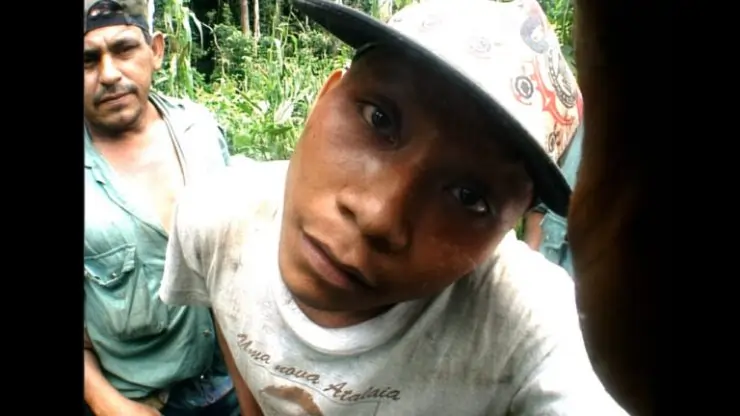
Amazomania brings forward one of the most iconic moments of the first contact between the Korubo tribe and Brazilian officials (who represented FUNAI, which stands for the National Indigenous People Foundation of Brazil). The expedition was led by the explorer Sydney Possuelo, and it was mainly recorded by Erling Soderstrom. Working with the original footage (much of which was unseen) and the participation of Korubo members, the Swedish filmmaker Nathan Grossman revisits the encounter across three key moments in time (1996, 2006, 2023), attempting to recalibrate perspectives and rewrite one of the histories of tribal appeasement.
From the rationalised lens of 2026, and in times when many nations place efforts towards colonial reparations, resurfacing that first Western step in the land of the Korubo resembles a farce. The tapes present the exchanges of gestures and clothes, while they reveal the pride (concealed in humbling smiles) in the faces of the crew. The exceptional (for the times) care and consideration in the words of the leader, Possuelo, however progressive, bring little gravity to the uncanny footage. Things escalate in embarrassment when Soderstrom, with all good intentions, wishes to revisit the tribe in the company of Grossman, who captures with his camera what Soderstrom did not notice through his own lens in 1996: the Korubo might sustain a way of life that appears alien to our perception, rooted in and nurtured by an entirely different culture, but seeds of capitalism had found their way in. Like a monster nurtured in the wild, Soderstrom is confronted with his own culture.
In his sophomore documentary, following I Am Greta (2020), Nathan Grossman renders a mature, self-deprecating account of the exotifying eye. He does so well with the synthesising of it all, and complements the sequences with carefully planted playful image tricks, suggesting (rather than asserting) an interplay between roles: the observer and the observed are here re-evaluated. And while he does not take a stance, he creates space for the tribe to claim the rights to their image.
Even with its moments of embarrassment, Amazomania is as exciting as it is consequential. It does not offer resolution to the tensions between human communities, nor to the impossibility of cultural uniformity, but it brings into view the shared predicaments of inhabiting the Earth under growing ecological pressure. As such, it restores the need for a form of coexistence that accounts for both sides.
★★★★
Amazomania had its world premiere at the 2026 Copenhagen Documentary Film Festival, where it screened in the Main Competition, FIPRESCI Critics’ Award, and Audience Award sections.
Amazomania, 93’ / Dir: Nathan Grossman / Cinematographers: Erling Söderström, Diego Lajst, Nathan Grossman / Editors: Jordana Berg, Nathan Grossman/ Producer: Cecilia Nessen / Sweden, Denmark, France
Related
Discover more from
Subscribe to get the latest posts sent to your email.
