
White Coat Black Art26:30He was approved for MAID — but died waiting in a Catholic hospital
It’s September, and Stacey Hume is next to her dad’s hospital bed in the palliative ward of Edmonton’s Grey Nuns Community Hospital. She, along with her mom and sister, are told by staff that they need to make a choice about her dad.
Either contend with him possibly dying at a red light, alone in the ambulance, or remain in the hospital, where “it could be three, four or five more days of him hanging on like this,” recalled Hume.
Her dad, William Hume, was dying. He had been diagnosed with late-stage gastroesophageal cancer just a few months earlier. William wanted MAID, and was assessed and approved soon after he was diagnosed.
But the procedure is prohibited at Grey Nuns, where William was admitted, as it was the only Edmonton hospital with an ER bed available. The hospital is operated by Covenant Health — a publicly funded, Catholic health-care provider in Alberta — which does not allow MAID to be administered at any of its sites. William would have to be transferred to another facility.
Faith-based health-care providers are allowed to have policies prohibiting MAID. That means patients who want an assisted death, like Hume, need to be transferred to another facility that allows the procedure, in what are called forced transfers.
In the end, the family didn’t make the decision for him. He passed away in hospital that afternoon of Sept. 5, six hours before his 6:30 p.m. appointment for MAID. He was 79.
“My dad would be horrified to find out that he went to a faith-based place and his final wishes were dictated by a religion that he didn’t even believe in,” Stacey told Dr. Brian Goldman, host of CBC’s White Coat, Black Art.
William Hume’s journey
William’s terminal cancer diagnosis came as a surprise both to him and his family.
“I think my dad honestly thought he was going to live until he was 100,” Stacey said.
Staying physically fit and healthy was important to William, according to his daughters. He loved to golf, sometimes golfing twice a day.

After coming home from Palm Springs, Calif., in April, William noticed a tickle in his throat when he swallowed.
They didn’t think much of it at the time, Stacey says. He was sent for a barium swallow test, an endoscopy, and a PET scan.
While camping, Stacey would be the one to read the test results online. Her dad had Stage 4 esophageal cancer.
She packed up the car and drove back to Edmonton to tell him the news.
“It was devastating.”
Within days of finding out his diagnosis, William told his family he wanted MAID.
“There was no doubt in my dad’s mind that this is what he wanted.”
His last few days
William’s health deteriorated on Sept. 2, and he had to be transported to hospital via ambulance.
Stacey’s mother was told by paramedics that only one ER bed was available in all of Edmonton at the time, and it was at the Grey Nuns.
“We didn’t have a choice. If we wanted dad to get care, we had to go to a Catholic hospital,” said Stacey.

In the palliative ward, staff told Stacey and her family that they had to arrange William’s transfer with the province’s MAID Care Coordination Service.
“That came as shock No. 1 for us, that really they washed their hands of it and said, ‘The rest is up to you if you want MAID.”
Stacey’s sister, Carolyn Gunderson, called in the morning of Sept. 3. She was told he would have to get a forced transfer to receive MAID.
They were later told by a staff member with the Care Coordination Service the earliest time it could be administered was on Friday, three days after he was admitted.

Part of the reason is that Dr. Andrea Letourneau, who was scheduled to administer MAID to William Hume, was only available in the evenings. The critical care specialist and certified MAID provider had been working 10-hour days that week in an intensive care unit at another Edmonton hospital. She was also told transport was difficult to arrange.
“As a practitioner, I do my best to try to be available for these patients at short notice,” Letourneau said.
Stacey says shock No. 2 came from one nurse at the hospital who said the family needed to have faith and that it was in God’s hands.
“My mom was completely taken aback and said, ‘What if I don’t believe in God?’ And the nurse said, ‘Oh, you don’t believe in God?’”
Their dad was not a religious person.
“Never at any part did we expect religion to become a part of dad’s death.”

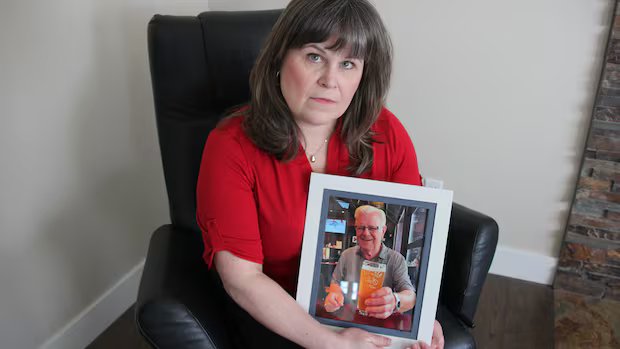
Stacey Hume’s dad knew he was dying and wanted medical assistance in dying (MAID). After he was admitted to an Edmonton hospital run by a Catholic health-care provider, his family says he didn’t get the death he wanted.
When asked for an interview, a spokesperson with Covenant Health referred comment to Alberta Health Services (AHS).
In an emailed statement, AHS said it couldn’t comment on specific patient details due to privacy issues.
The statement confirmed a staff member from the MAID Care Coordination Service was “supporting the patient and the family to see the patient’s wishes fulfilled prior to their passing.”
The statement also extended its sympathies to the family.
Forced transfers
When forced transfers need to occur, there can be a lot of logistics to arrange, says Letourneau. She says a certified MAID provider, a nurse, a facility that allows assisted deaths, and transport all need to be arranged.
Letourneau often tells patients, when possible, to provide several days’ notice, as MAID was not set up to be an “emergent procedure.”
“It was set up so that we can have time to try to organize these things. Unfortunately, that’s not how life works, and that’s not how medicine works.”

In 2024, 349 people had to transfer due to a facility’s policy, according to Health Canada’s annual report on MAID. That represents about two per cent of the 16,499 people who received MAID that year.
A court challenge to whether faith-based organizations in B.C. can continue to prohibit MAID in their facilities is currently underway in B.C. Supreme Court. Physicians say if this case goes to the Supreme Court of Canada, there could be ramifications for other provinces.
Forcing people who want MAID to move facilities is a “system-generated harm,” says Dr. Stefanie Green, a certified MAID provider in Victoria, B.C.
She says many Canadians would be shocked to know that an institution’s religious policy can dictate a legally viable, covered medical service.
“I think when two patients in the same city with the same illness can have very different end-of-life experiences depending on who owns the building that they’re in, that feels like a problem.”
Faith-based facilities
Alberta and Manitoba saw the highest proportion of people forced to transfer due to a facility’s policy in 2023 and 2024, according to Health Canada’s data.
Since MAID was legalized in 2016, Green says there has been “a softening” of these kinds of policies as more people understand the harms that can happen with these transfers.
She points to Quebec, where a provincial law was introduced in 2023 requiring all palliative care homes to allow medically assisted deaths to happen onsite.
“I do think we’ve seen that change. That’s a positive sign, but I think certainly when it comes to faith-based institutions, there’s a certain ideological value-based policy that’s in place that’s not likely to change,” she said.
Stacey, who has an appeal pending related to her lawsuit against AHS in an unrelated matter, has not filed a formal complaint against AHS or Covenant Health.
Her family is still dealing with the loss of a father and husband.
“Dad was adamant from the very beginning: MAID was what he wanted. MAID is not what my dad got.”
