
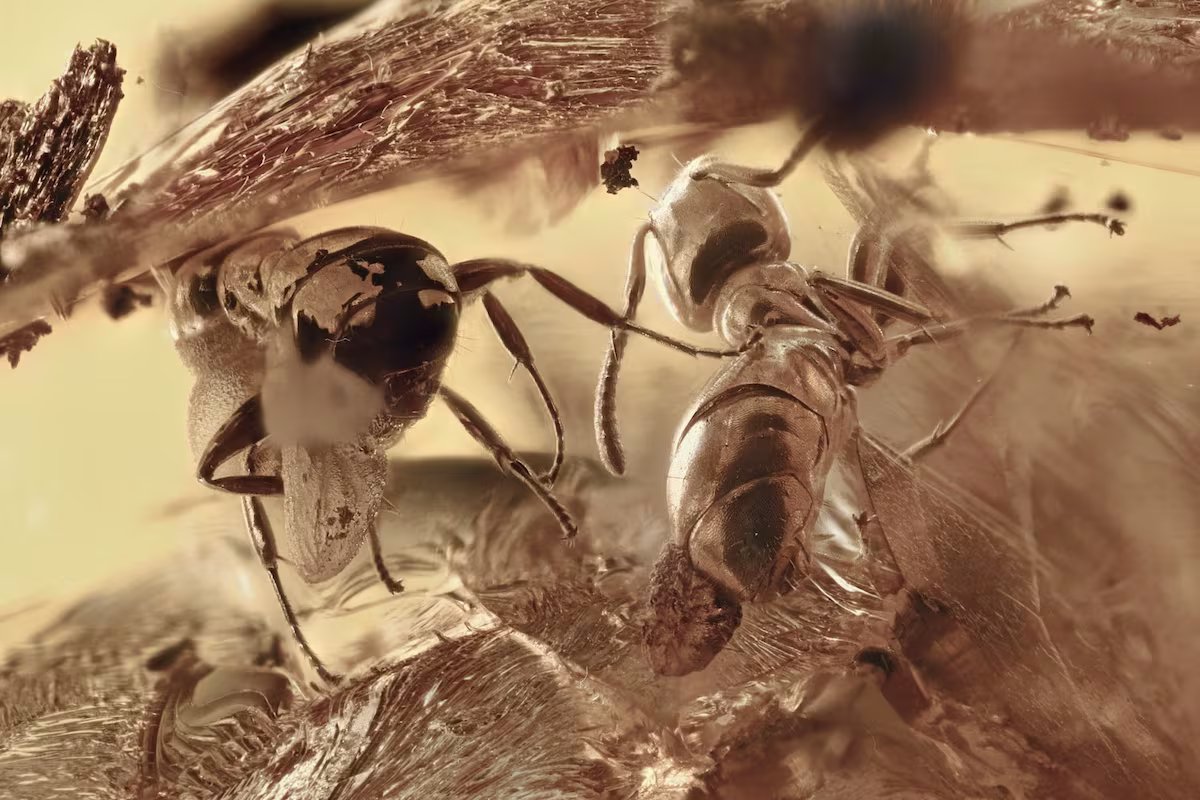
Although there are many amber stones containing a single creature, there are fewer that include two or more, as is the case with a pair of mosquitoes trapped in amber 130 million years ago which tell us that, back then, males also sucked blood. Even more extraordinary is when several organisms can be seen interacting, either eating the other, acting as a parasite, or cooperating. The new edition of the scientific journal Frontiers in Ecology and Evolution examines not one, but six of these stones in which scenes of life millions of years ago have been frozen in time.
Amber is an organic stone that began as a vegetable resin. Many trees, such as conifers, produce it to heal their wounds, such as tears in their trunks and branches. As its pours down the trunk, it drags with it twigs, leaves and even flowers. The largest flower, for example, has been trapped in one of these stones for 38 million years. Small living beings are also trapped by this sticky substance. In 2020, a dinosaur no bigger than a hummingbird was found in one of these honey-colored traps. Usually, it is smaller beings such as arthropods, snails, worms. When the substance falls into a water tank or is buried, a polymerization process begins that turns it into copal, an aromatic substance, that is more translucent, and that over hundreds of thousands of years ends up mineralizing completely.
“It is used not only in art and jewelry, but also for the study of fossil ecosystems thanks to the organisms trapped during the formation of amber that can last a million years,” explains José de la Fuente, a research professor at the Spanish National Research Council (CSIC)’s Institute for Research in Game Resources and co-author of the study. “The multiple beings contained in amber represent the coexistence between different organisms with the possible interaction between them,” he adds.
Because of their 3D preservation, details that conventional fossils – the animals and plants turned to stone – cannot preserve, can be seen and paleontologists can not only define the species but also try to rebuild the relationship they maintained.
The so-called case 2 is a good example of an ecological relationship that still exists. It is a Burmite – that is, Burmese or Myanmar amber that is among the oldest, with some pieces going back more than 100 million years. It is also the one that has proved the most exciting. A study led by the paleontologist of the Geological and Mining Institute of Spain (IGME), Enrique Peñalver, discovered a few years ago that dinosaurs already had ticks 99 million years ago. And the tick was attached to a feather of the dinosaur on which it fed. It is one of the examples of interaction, in this case parasitic, preserved in amber.
The biological relationship examined in case 2 from the new study is called myrmecomorphic or myrmecomorphic, an evolutionary strategy in which a creature impersonates or mimics ants. In this case, a spider appears in the amber that would have mimicked an ant (myrmex, in Greek).
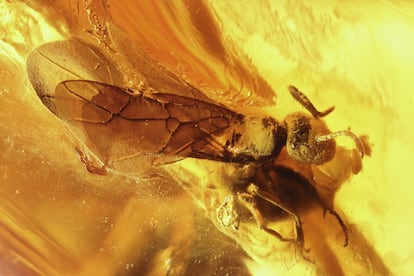
“The spider mixes with the ants in an empathetic way, introduces itself and becomes an ecological ally,” explains de la Fuente. It is a kind of collaboration: “Both attract or capture food that serves both. In this case, it could also happen that the waste of one serves as possible food for the other.” In de la Fuente’s collection, there is also an amber stone that he considers unique; inside there are ants from groups that have long since become extinct, a mosquito, a snail, a milliped, plant remains and moss. Some species of ants have a mutually beneficial relationship with moss. It provides shelter for them and their offspring, while the fungus it contains serves as a food source for the bryophyte.
The six time capsules analyzed have ants as their main protagonists. “The previous studies I have carried out were on fossil ticks, because I have worked for many years on the development of vaccines for tick control,” explains de la Fuente. “They are much rarer to find in amber,” he adds. “Ants are very diverse, easier to find in amber than ticks or other insects, and you find them in all periods, from the Cretaceous to the Neogene. They have a very important role in life, they are key in different periods and ecosystems,” he explains.
Sign up for our weekly newsletter to get more English-language news coverage from EL PAÍS USA Edition
