
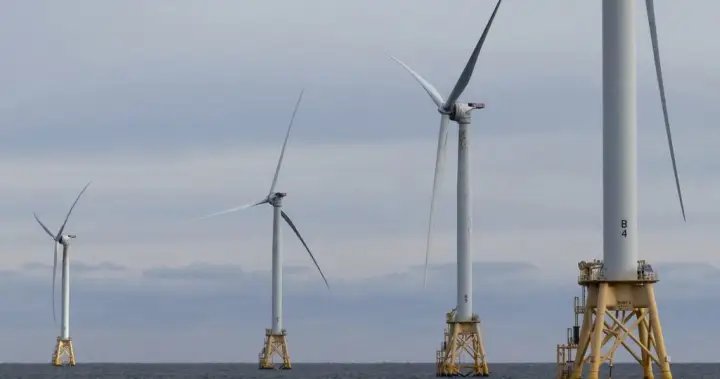
Atlantic Canada is one of the best places in the world to construct offshore wind projects, says a new report, but the amount of energy the region could actually produce isn’t as much as some politicians have been projecting.
The report from engineering firm Stantec, commissioned by the federal government in partnership with the Atlantic provinces and local power companies, says there’s breathtaking wind speed in the region and massive development potential, but it’s not a matter of blanketing the ocean horizon with wind turbines. Limiting factors include ocean floor conditions, marine protected areas, ice issues, shipping lanes and existing fishing areas.
“There are quite a few constraints that need to be layered on top,” said Ericka Wicks, regional sector lead for energy transition and renewable energy at Stantec, said in a recent interview.
“And then the economic reality of it, right? So yes, (a turbine) could possibly be put in this location, but is that going to make economic sense because the transmission line, to get the power from the turbine itself to onshore, might be financially prohibitive?”
Stantec’s projections could take the wind out of the sails of an ambitious energy strategy proposed by Nova Scotia Premier Tim Houston. The engineering firm estimates that the maximum renewable energy production capacity of the four provinces is far less than what the premier has proposed for his province’s Wind West project.
The first phase of Wind West is envisioned as a five Gigawatt development and officials have provided estimates ranging from 40 Gigawatts to 66 Gigawatts if future phases are completed.

Get breaking National news
For news impacting Canada and around the world, sign up for breaking news alerts delivered directly to you when they happen.
The Stantec report says Nova Scotia could generate just nine Gigawatts of power in its existing wind energy areas by 2050, first with fixed-bottom turbines in shallow waters, and eventually floating platforms in deeper areas.
At the high end, the Stantec report says all of Atlantic Canada will be able to generate up to 16.5 Gigawatts by 2050 if it produces electricity for all available markets, including powering a high-export hydrogen sector, selling to other provinces like Quebec and exporting electricity to the New England states.
It says about 2.5 Gigawatts, slightly more than what’s produced by Canadian power stations at Niagara Falls, could be constructed by 2050 if the region serves only its own power needs.
Nova Scotia’s Department of Energy, where Houston is also the energy minister, declined an interview request.
Wicks says the Stantec study focused heavily on constraints facing the sector, and that reduced the real-world potential compared to older studies and projections.
“Regardless of whether it’s 16.5 or 60 (Gigawatts), it’s still a massive number,” said Wicks.
Wicks says Nova Scotia’s offshore sector is the most advanced in the region. The province is pre-qualifying interested companies and is expected to issue a call for proposals this year. The government recently signed a memorandum of understanding with Massachusetts to share expertise and the pact could see Nova Scotian energy sold into the power-hungry state.


Newfoundland and Labrador’s offshore market would likely develop later, says the report. While it has the highest overall capacity in the region, its deep water and other constraining factors mean it would likely be able to bring four to five Gigawatts online by 2050. About two Gigawatts of the total could be installed earlier in shallow water. The province’s Department of Energy and Mines did not provide comment before deadline.
The Stantec report says each floating turbine would be estimated to cost between US$6,360 and US$11,295. This is about 47 per cent more than the fixed-bottom variety. The firm says the technology should get cheaper and more viable in the future.
Talk of offshore wind has been more muted in New Brunswick and P. E. I, but they still hold potential. The report says New Brunswick could develop two Gigawatts by 2050, while P. E. I. could likely contribute one Gigawatt.
Companies considering Wind West have said 2035 is probably the earliest Nova Scotia can expect turbines in the water. Wicks says that’s probably right as high-voltage direct current transmission equipment has a long lead time. She said clients submitting their orders now don’t expect delivery until the 2030s.
The study doesn’t factor in transmission lines, which will be a major cost. About a third of the $60 billion needed for the first phase of Wind West is planned for transmission.
“The technology is there to build the offshore wind platforms … but the transmission system is not nearly developed to the point where we need it to accommodate all the energy that the offshore wind could produce in the Atlantic region,” said Wicks.
The third phase of the $6-million study will dig into transmission infrastructure. It’s funded by Natural Resources Canada with partners including the four provincial governments, P.E.I.’s Maritime Electric, Nova Scotia Power, and non-profit Net-Zero Atlantic.
© 2026 The Canadian Press
