
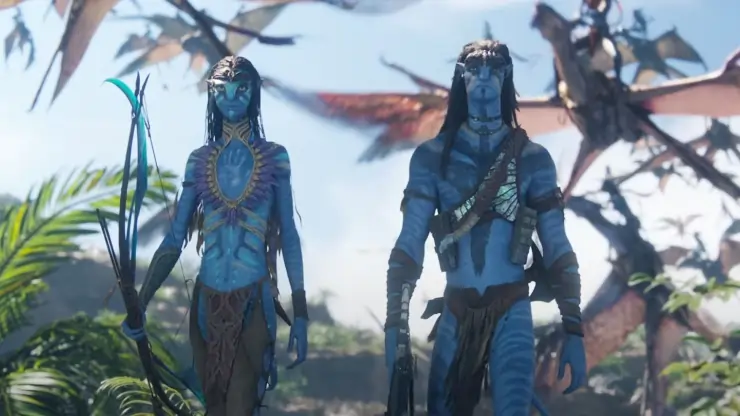
Avatar: Fire and Ash is a hugely successful return to Pandora, filled with everything audiences would expect from the iconic James Cameron franchise with stunning visuals, out-of-this-world fight sequences, and a brand new epic story.
The film starts a year after Jake (Sam Worthington), Neytiri (Zoe Saldaña), and their family have joined with the Metkayina clan as they grapple with grief after their son Neteyam’s death in the previous film, Avatar: The Way of Water. All is well until they encounter a new aggressive Na’vi tribe known as the Mangkwan clan, led by the fiery Varang (Oona Chaplin), who is quick to ally with Jake’s enemy, Miles Quaritch (Stephen Lang), leading to new conflict that means some serious consequences for the future of the franchise.
Once again, Pandora looks absolutely incredible on the big screen. If you have the opportunity to see this in an IMAX screening, then it’s an absolute must. However, don’t worry if you can’t, as you’ll still have an undeniably powerful experience at any screening. The film continues to build on the already seriously impressive visual groundwork laid in Avatar: The Way of Water, with the richly detailed environments and a strong sense of immersion/scale quickly forming the heart of the film.
The visual landscapes continue to look vibrant and carefully crafted, with gorgeous, glowing forests and elemental set pieces that look and feel incredibly realistic. I was particularly impressed by the visuals involved in the sequence revolving around Peylak (David Thewlis) and the Wind Traders, which added more depth to an already richly layered saga. Frustratingly there are moments where the film does rely on the visuals to continue to do much of the heavy lifting but overall we are still reminded why Pandora remains one of the most immersive cinematic worlds in recent memory, even if the story doesn’t necessarily always match the same standards.
One of the other visual elements I was seriously impressed by was how the CGI remained so seamless throughout that often the Na’vi didn’t feel like digital creations at all and instead felt like fully inhabited characters in their own right. This adds a really interesting element to the film because it allows the cast to add to their characters’ journeys with real additional weight and depth. It removes the natural recognition you have towards the cast because it doesn’t feel at any point that you are watching the likes of Sam Worthington, Sigourney Weaver, or Zoe Saldaña as their characters feel real in their own right.
This is particularly important for the ever-evolving journey of Jake Sully because, as a human who has chosen to live permanently in a Na’vi body, he continues to wrestle with his own sense of belonging in their world, a tension that has followed him since the first film. Avatar: Fire and Ash interestingly leans into this unease throughout, as moments of hostility towards humans resurface within Na’vi culture as a result of the events of the franchise.
Across the wider cast, the strength of the acting is one of the film’s most consistent strengths outside of the aforementioned visual elements. Critics are rightly praising Oona Chaplin as Varang, whose commanding presence stands out amongst the latest conflict as adding a new dynamic to the established Na’vi culture as well as offering a different layer to Quaritch’s character.
The film also continues to develop a really interesting storyline involving Spider (Jack Champion), who continues to grow in importance to all parties in this film. Champion continues to bring a sincerity to Spider that captures the awkwardness of a human trying to exist on Pandora, which is only made more impactful by the relationship change with the other Na’vis as a result of the hostility he faces from his maternal figure, Neytiri, whose grief for her son has led to resentment towards him.
Unfortunately, the sheer size of the ensemble does occasionally works against the film. With so many characters competing for attention, some arcs feel light, leaving certain figures more surface-level than their intended emotional beats suggest. The performances are strong, but the film’s scope sometimes limits how deeply each character is able to resonate with the audience.
In the end, Avatar: Fire and Ash proves that James Cameron still knows exactly what audiences love about the franchise. While the story doesn’t always hit the emotional depths it’s aiming for, the scale and ambition of the visuals on display make it hard not to be swept along by the full cinematic experience. It’s a film that arguably prioritises spectacle over story, but when the spectacle looks this good, it’s easy to forgive.
Putting it simply, if you love the franchise, you’ll love everything about this film because it continues to expand the world in meaningful ways that will please fans of the franchise while still setting the stage for the next chapter. It may not be the most impactful entry yet, but it’s still a hugely entertaining return to Pandora and one that comfortably earns its four-star rating.
★★★★
In UK cinemas on December 19th / Sam Worthington, Zoe Saldaña, Sigourney Weaver, Stephen Lang, Oona Chaplin, Cliff Curtis, Britain Dalton, Trinity Bliss, Jack Champion, Bailey Bass, David Thewlis, Kate Winslet. / Dir: James Cameron / 20th Century Studios / 12A
Related
Discover more from
Subscribe to get the latest posts sent to your email.
