
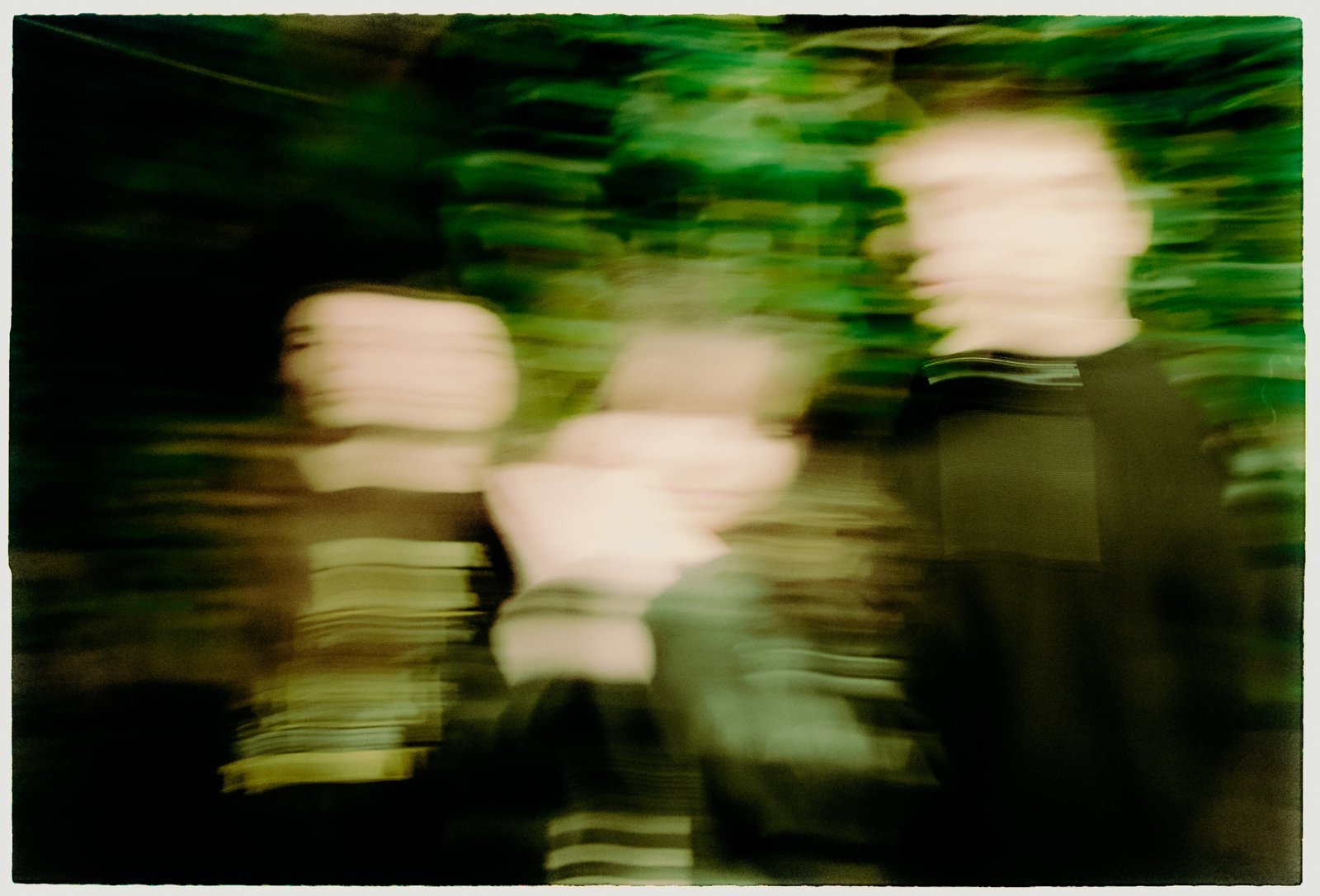
Cobalt Cafe once stood on a crowded stretch of the San Fernando Valley, evolving from an open-mic coffeehouse into an all-ages underground, where Linkin Park (then known as Hybrid Theory), Incubus, and Jimmy Eat World rolled through in its heyday. Within the cramped space, Miles Morris (Bad Suns) and Marisa Shirar (Fleshwater, MIRSY), fast friends through their high school marching band, witnessed countless groups in their infancy, often multiple times a week. “Pretty grimy spot,” Morris recalls. “Tiny stage. Ugly carpet. Sounded bad. Totally legendary. You’d have bigger touring acts come through, but I mostly went to see local bands. It was a lot of punk or hardcore. My old band opened for Crime in Stereo there. RIP.”
“The Cobalt is where I formed a strong bond with hardcore music,” Shirar adds. “The community and its DIY culture were always extremely inspiring to me. From hardcore, I made so many decade-long friendships, started different kinds of bands, traveled, and met people around the world. It shaped who I am today, and I don’t even think Bedelia would exist without it.”
Read more: My Bloody Valentine’s Loveless is still groundbreaking after 30 years
Since then, they’ve both gone on to play in successful bands: Morris flourished in Bad Suns, where his distinct drum beats melted into the band’s glimmery pop — particularly on last year’s Accelerator. Meanwhile, Shirar joined Fleshwater, whose second album, 2000: In Search of the Endless Sky, jumped into denser, moodier heft. While this was going on, the foundations of Bedelia, whose soaring hooks feel like a companion to Endless Sky, started to crack open when Shirar convened with Morris in his garage studio in early 2024. They completed most of the writing in a couple of weeks despite living on opposite coasts — Shirar in Massachusetts, Morris in California — and found a third bandmate in Ethel Cain guitarist Dakota Floeter just as they were about to hit the studio a year later.
Bedelia’s debut EP, Never change, love you always, rings as bright and mesmerizing as you’d expect, basking in the warmth of Heaven or Las Vegas-era dream pop. Swirling riffs and shimmering tones run up against themes of pain, relief, and self-sabotage. These are songs for daydreaming as much as a way of admitting your own faults, reflecting the members’ sweeping tastes. In one of their first interviews, the trio spoke about the making of Never change, love you always, ’90s nostalgia, and what’s next.
Miles and Marisa, you’ve known each other since you were teenagers. Tell me about growing up together. What were your early impressions or memories of each other?
MARISA SHIRAR: I joined our high school marching band, and that is where I met Miles and some of my other longtime friends. Miles’ other band, Bad Suns, had already been actively playing shows in high school under a different name, and I checked them out and thought they were awesome. I bought tickets off him to see his band play, went to the show, and that sparked our out-of-school friendship. A couple of years after graduating high school, we started turning our hangouts into writing music together. Our music tastes always had some crossover, but it wasn’t until a few years ago that we really connected on similar music interests. Realizing this eventually led to a very natural writing process, which then led to Bedelia.
How did you get Dakota involved?
DAKOTA FLOETER: Originally, I thought I’d be coming on just to co-produce with Derek Ted, who also happens to be my roommate and works out of a studio in the garage of our house in Sherman Oaks, just to help add some aggressive guitar tones to the mix. But when Miles asked if I’d be interested in actually joining the band, I jumped at the opportunity. Having known him and Marisa for years and spending several years touring with Miles’ other band, Bad Suns, as their guitar tech, I knew how gifted and creative a drummer he was, but I don’t think I fully realized what he had to offer as a songwriter and lyricist. Additionally, I’ve always loved Marisa’s projects, and her voice has such a special quality to it, so that was really exciting. I think being brought into the fold this way opened up a lot of possibilities in my mind of where we could take these songs together.
SHIRAR: We have been friends with Dakota for years, and I’ve always been very aware of his music taste. When Miles and I started Bedelia, Dakota immediately came to mind, and the second he came in to write with us, it clicked right away.
Isaac Westberg
Given that the music’s steeped in ’90s alt-rock, are you someone who’s prone to nostalgia, or would you rather look ahead?
SHIRAR: I’m a very nostalgic person with an extreme love for a wide range of genres. With that being said, when writing music, I don’t pull from any specific genre or time frame. I just do what comes naturally.
FLOETER: Personally, I don’t really think too much about any of that stuff. I was brought up on bands like the Cure and Depeche Mode, thanks to my mom, and later My Bloody Valentine and Cocteau Twins through high school. Those bands made such a big impact on me that I think it’s just the sonic palette I’m drawn to and naturally the way I hear and write music.
MORRIS: I think the ’90s influence is more of an inevitable byproduct of our influences rather than an intention to make “nostalgic”-sounding music. When a song is done, I do like to imagine the world it could exist in — which requires a bit of looking ahead and thinking about the bigger picture.
I’m curious to hear about the EP’s musical touchstones and how quickly the songs came together. Were you working remotely, sharing files, or able to jam in person? Also, given Fleshwater’s dreamier shift on 2000: In Search of the Endless Sky, was that something that bled into Bedelia?
SHIRAR: Two years ago, I visited LA from living in Massachusetts. Miles and I met up to hang out, which we always did when I was in town, and randomly ended up knocking out five or six songs in one week. A year or so later, we started working on the songs more with Dakota, and they ended up being what is now our EP. As for Fleshwater and Bedelia having a similar dreamy-like quality, I think this just comes with my specific taste and influences showing up in each of the band’s sounds.
MORRIS: Once Marisa returned to Lowell, I flew out there a couple of times to put some finishing touches on lyrics and melody before getting into the studio.
FLOETER: By the time I got involved, the songs were mostly fleshed out — the rest of it just came together in the studio. Filming the video for “Tightrope” was actually the first time the three of us stood in a room and played that song together.
What’s a song that was hard to write and/or record?
MORRIS: I have probably four or five lyric drafts for “Do you miss me at all,” and honestly, I still don’t know how I feel about them. The earlier lyrics were a little too specific to my own life, which made it hard for Marisa to connect to them. It took quite a few rewrites to get it to where it is now.
FLOETER: I wouldn’t say that any of the songs were particularly hard to record; it was actually a bit of a surprise how naturally everything started coming together. I do remember spending a little while trying to really lock in the dueling Bass VI riffs that carry most of the song “I Tried.” They’re so metronomic it felt like if they deviated too much from each other rhythmically, it detracted from the overall energy of the track. On the flip side, I remember coming up with the tuning and the chord structure for “Do you miss me at all” and dialing in the guitar tone I usually strive for. I think that whole process took maybe 30-40 minutes and ended up being one of my favorite parts of the EP.
Fleshwater’s about to go on tour with julie, and Bad Suns have a spring headliner, but are there any loose plans for shows or a full-length project at some point? Is it too soon to say?
MORRIS: I’d love to play some Bedelia shows this summer if we can. There’s a sixth track we recorded for the EP and ultimately held back, which may or may not see the light of day.
FLOETER: All three of us have a pretty busy schedule with our other projects, so it’s tough to say for sure what exactly is in store, but I know we plan to set aside some time later in the year or next year for some shows and more songs. There’s plenty of ideas floating around for songs — it’s just a matter of finding the opportunities in our off time to get together and start carving away at the block.
