
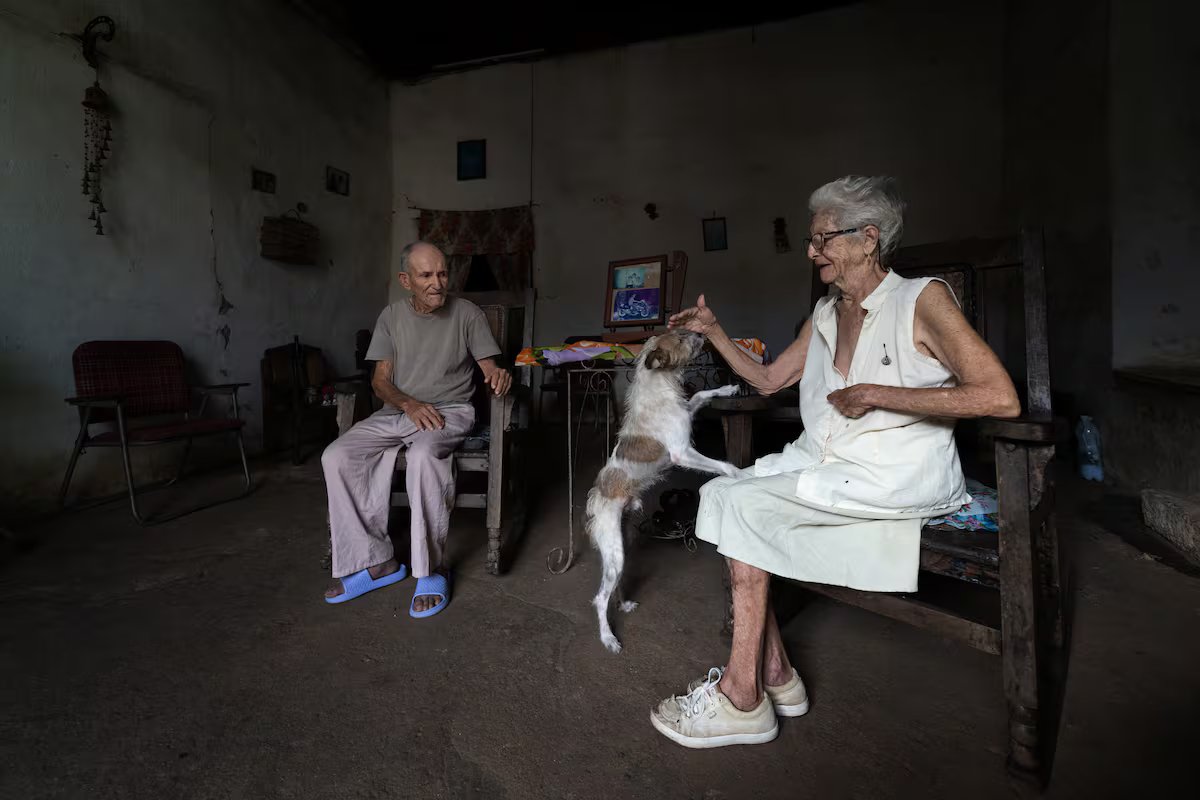
“The good thing about this is how bad it’s getting.” It’s one of those popular phrases that Cubans have heard their grandparents say all their lives, in the face of difficult situations in daily life. Ana Julia T., who is 68, couldn’t help but utter it, sitting in front of the television at home, while the authorities announced some of the contingency measures related to electricity consumption, transportation, work, and education, to cope with the current fuel shortage the island is suffering, a result of the energy blockade imposed by the Donald Trump Administration.
She belongs to a generation that has lived under the Castro regime since the beginning of the political process. As the writer Leonardo Padura reflects in his most recent novel, Morir en la arena (Dying in the Sand), these are people who sacrificed themselves, who did everything their leaders demanded of them, and at retirement age, as the utopia faded away, realized they had nothing. Not even enough money to buy basic necessities.
That’s why people like Ana Julia T. have been forced to “make things up as we go along” to keep going, even without any hope of improvement in the country or any real change. This is reflected in the resigned tone of her voice. “I’ve seen it all. No one can fool me at this point,” she says, incredulous at the authorities’ ability to provide any certainty to the population amidst the sea of dangers that threaten a fractured, frustrated society in the midst of a cumulative crisis.
The situation of this woman, who survived the so-called Special Period of the 1990s thanks to her job at one of Havana’s most famous restaurants — at a time when tourism provided a better standard of living — could be that of almost any retiree today who, in the best of cases, can support themselves and not resort to begging to avoid going hungry. After her retirement, this woman was forced to continue working, close to home, to supplement her pension of almost 4,000 Cuban pesos (CUP; about $8) with two meager state salaries.
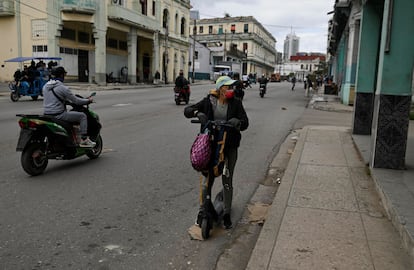
She lives alone in an apartment in Havana’s Cerro neighborhood. She has no children and no relatives or friends abroad who can send her occasional remittances. She says she has managed to organize her finances to survive “without going hungry.” She recently added to her income by renting out one of her rooms to university students from other provinces who come to study in the capital. In total, she can earn around 19,000 CUP (almost $39) a month. But making ends meet requires meticulous budgeting.
Her life is confined to her neighborhood, from work to home and back. Now, her only concern is that the worsening transportation problems will prevent her from visiting her ninety-year-old mother, who lives in a distant town. She prays that neither of them will suffer an illness requiring hospitalization or the purchase of medications, which are scarce in state pharmacies and exorbitantly priced on the black market.
In a society like Cuba, whose main demographic challenge is the aging population — those 60 and over already make up more than 25% of the total population, which is below 10 million — many elderly people feel like the last card in the deck, facing acute crises and the incompetence of the state. When Ana Julia thinks about her future, she shrugs. All she can manage to say is, “For life to improve, we have to change so many things internally.”
The struggle to find medicines
For many families in Cuba, securing the bare necessities for a decent life has been a Herculean task for several years now. In a context where the state has withdrawn from neighborhood life — where private businesses or micro, small, and medium-sized enterprises (MSMEs) provide basic necessities at exorbitant prices — and social policies are ineffective or nonexistent, a relative abroad who can send remittances makes a huge difference. Elderly people living alone, or entire families without a helping hand to turn to, find themselves extremely vulnerable to the high cost of living on the island. This is the case, for example, with the need to find medication for any health problem. It’s a true ordeal.
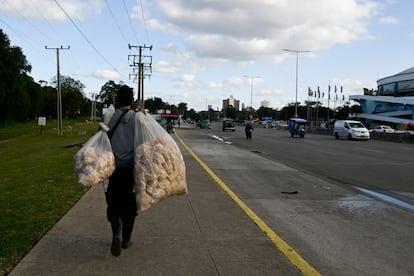
While some families with the means to do so have turned to the informal market and invested around $200 — or received external shipments — to obtain medicines for a year, given the current contingency, others have no choice but to go to state pharmacies to “hunt” for the medicines that are available.
For some time now, to overcome the chaos caused by the lines at pharmacies, an organization has been in place based on the doctor’s office to which a family belongs. Each day of the month, families associated with a particular doctor’s office are allowed to shop. “On your assigned day, you go and buy. The order rotates throughout the month,” says Doris G., 72, who lives in Central Havana, where there are 14 doctor’s offices.
“If you get number 14, that means you’ll be last on the list that month, and there’s usually nothing left to buy. You’ll have to wait until the following month to see if you get one of the first spots,” the woman explains. She consoles herself by saying, “At least this way, the few medications that are available are guaranteed to reach families more equitably.”
Faced with her complicated daily life, Doris, a former cartographer who experienced the Special Period as a “hard” time in her life, says she doesn’t understand the Cuban authorities’ current strategy. “You can’t ask people to resist creatively, or tell them we’re going to eat whatever we can produce. What on earth are we producing?” she asks.
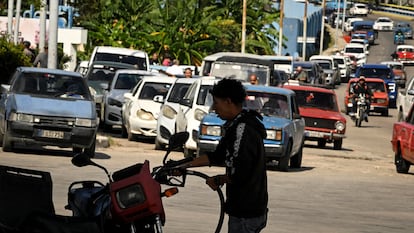
She says her daily life revolves around trying to keep up with a constantly changing world. “I only go to the bodega when word gets around that something’s arrived. Bank branches in the area have been closing in recent years, and you have to go farther and farther away to do those errands; I only go to the pharmacy once a month, when it’s my turn.” And it seems that some errands are going to get even more complicated, now that Cuban authorities have announced that customer service, for example at banks, will be limited to Monday through Thursday.
As time goes on, those who are preparing for the worst-case scenarios, amid blackouts and shortages of all kinds, even from outside the island. Alfredo, a young Cuban living in Madrid who, for security reasons, declines to give his last name, bought a ticket to Cuba to “check on the situation” of his parents in a village in the municipality of Colón, in the province of Matanzas. He is taking them a suitcase full of food and medicine that the couple, who live off what they grow on their small farm, cannot easily access. “My father is diabetic, hypertensive, and has to take a cocktail of pills every morning, of which he is almost always short half of what he should be taking,” the young man says via WhatsApp, while packing his luggage.
Sign up for our weekly newsletter to get more English-language news coverage from EL PAÍS USA Edition
