
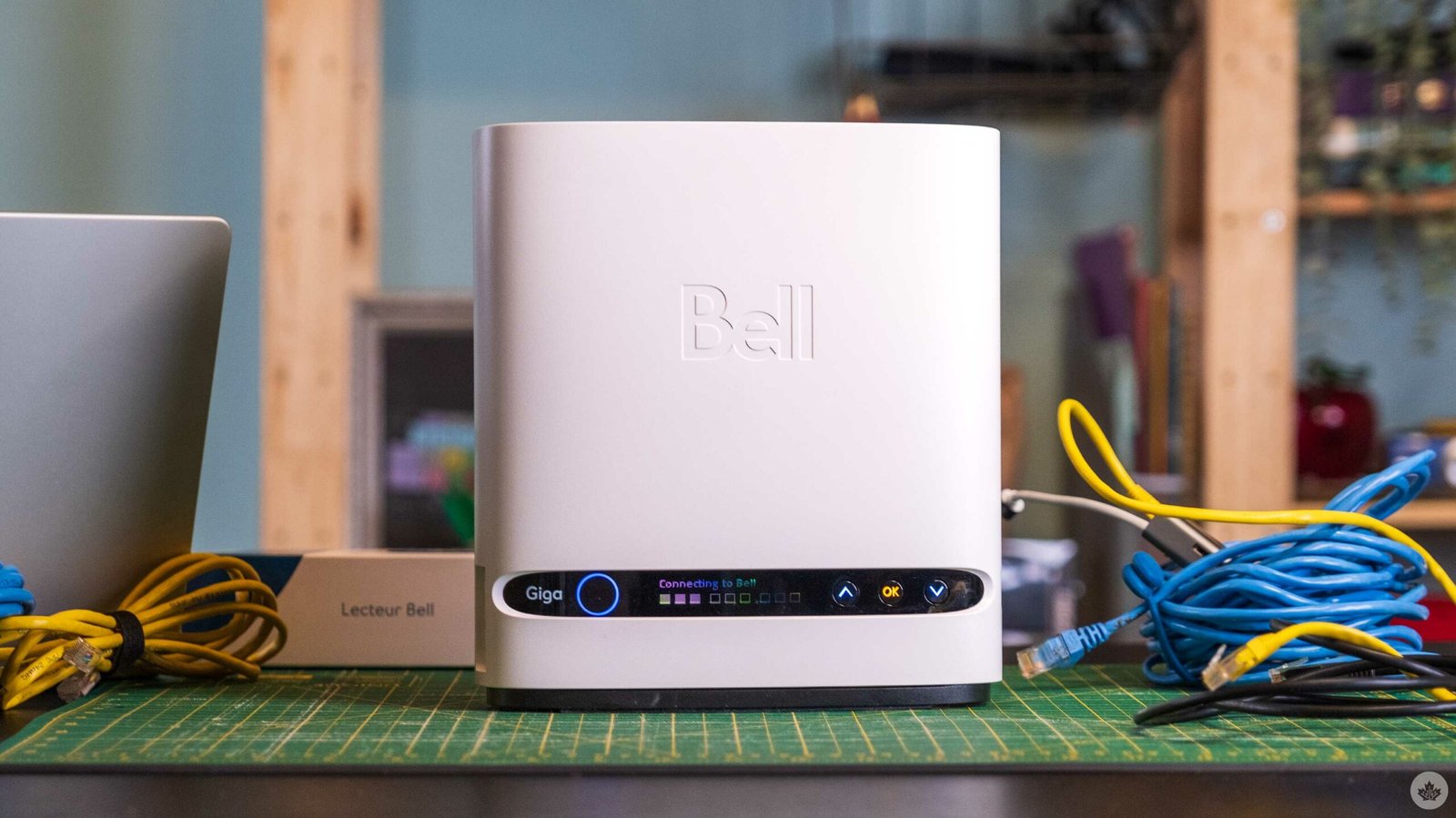
Are you using a modem and/or Wi-Fi router supplied by your internet service provider? Chances are, your internet performance is better than someone using their own hardware.
So says independent analytics company Opensignal in a report diving into the performance of modems and routers — dubbed gateway devices — provided by internet service providers (ISPs).
Opensignal found that ISP-provided home Wi-Fi gateways offer on average higher ‘Broadband Consistent Quality’ compared to third-party hardware — at least 12 per cent better. Moreover, Opensignal found that Bell’s Wi-Fi gateways offer the largest improvement over third-party gateways.
The Broadband Consistent Qualtiy metric measures network experience from the perspective of a single device and whether the network can consistently meet the needs of common tasks on that device. That includes looking at performance metrics like download and upload speeds, latency, jitter, and more. Those interested can read more about the methodology on Opensignal’s website.
Per data Opensignal collected between Oct. 1 and Dec. 29, 2025, Bell-provided Wi-Fi equipment offered about 17.5 per cent better consistent quality than third-party equipment. Telus equipment, meanwhile, was 13.5 per cent better and Rogers came in at 12.7 per cent better.
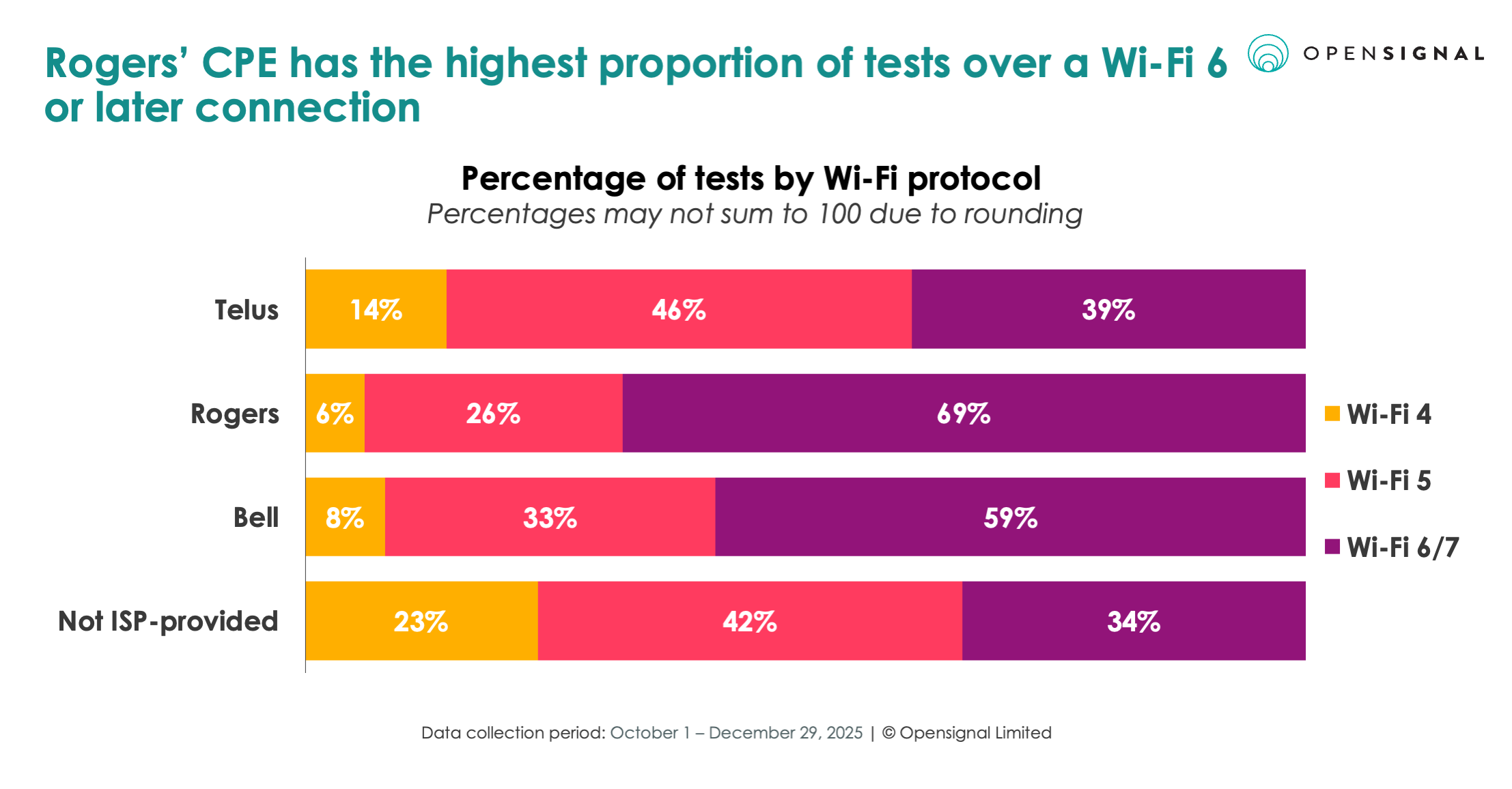
Notably, all three ISPs recently launched improved Wi-Fi gateways sporting newer Wi-Fi 7 technology, Rogers first in June 2025, Telus in July, and then Bell in September. Opensignal notes that using newer Wi-Fi standards, like Wi-Fi 6 or 7, can help boost performance, but it’s only a small piece of the puzzle.
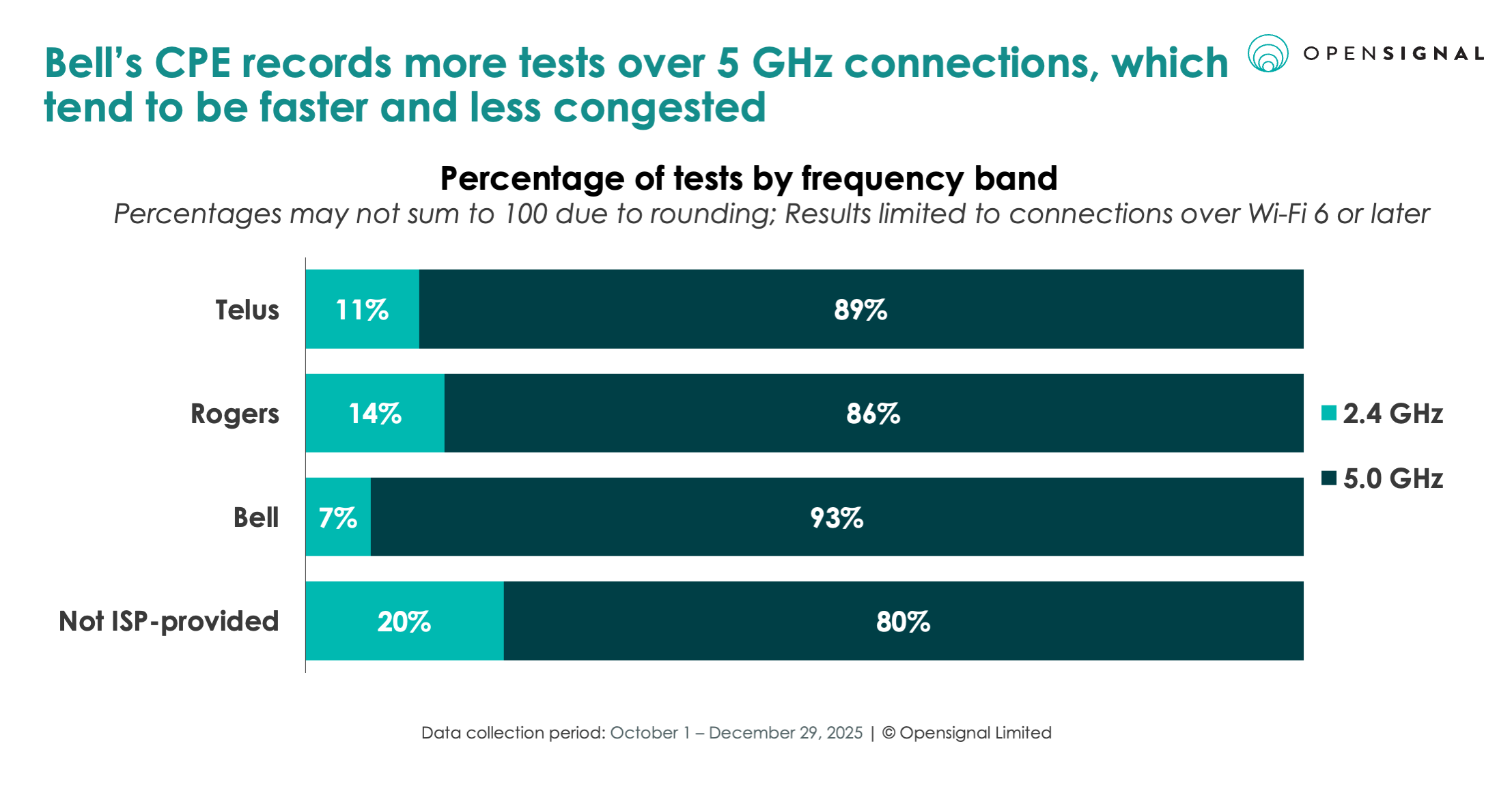
Rogers, for example, had more customers using Wi-Fi 6 and 7 than Bell or Telus did, but the company’s equipment still had the lowest overall consistent quality increase. Another factor Opensignal foudn was the type of connection. Bell’s gateway, for example, had higher performance lift because it used 5GHz connections more than 2.4GHz. 5GHz connections are typically faster and less congested, so Bell’s increased use of those connections further boosted performance.
Another interesting detail Opensignal highlighted is Canada’s shifting internet market, which may increase the role that gateway hardware plays in home network performance. With the Canadian Radio-television and Telecommunications Commission (CRTC) opening up fibre internet infrastructure to the wholesale program, enabling ISPs to resell internet services using other providers’ networks, the network itself will play a smaller role in determining performance.
Bell and Telus in Ontario are a great example of this in practice. Telus expanded its fibre internet offerings into Ontario using Bell’s fibre network — much to Bell’s chagrin. But because Telus uses Bell’s fibre infrastructure, Ontario customers would have the same internet performance from either provider since it’s the same fibre line coming into their home. Instead, the main differentiator would be the Wi-Fi gateway and, at least from Opensignal’s data, it seems like Bell’s has a slight edge over Telus’ gateway.
Opensignal’s findings were particularly notable for me, as someone who has tried many different routers across many different providers over the years. There was definitely a time when using third-party hardware produced better results. For example when I lived in Whitby, Ont., I often used my own Asus router instead of the one provided by my ISPs at the time because it actually gave me much faster speeds.
However, since moving to Hamilton a few years ago, I’ve found my ISP-provided equipment to be more than capable. I was with Bell using the company’s original Giga Hub for a while, and more recently switched to Cogeco (which offered me the same internet speed for less than Bell after the company kept jacking up my rates every few months).
My only gripe with Cogeco’s router so far is that it doesn’t let me disable band steering, a feature that automatically connects devices to 2.4 or 5GHz depending on which one delivers better performance. In my experience, band steering doesn’t play nicely with some smart home tech that only works on 2.4GHz, which means some things like smart lights or my Sonos speaker have regular connection issues. I had the same issue on Bell’s Giga Hub, but I was able to turn of band steering at least.
All this is to say, if you’re having problems with your home internet, you may want to start by adjusting your modem/router equipment. If you’re using a third-party route, trying using the one your ISP provided. And if your ISP-provided hardware doesn’t work great, it might be worth seeing if your ISP has newer hardware you can switch to — who knows, it might actually work better.
Those interested can read the full Opensignal report on the company’s website.
Images credit: Opensignal
