
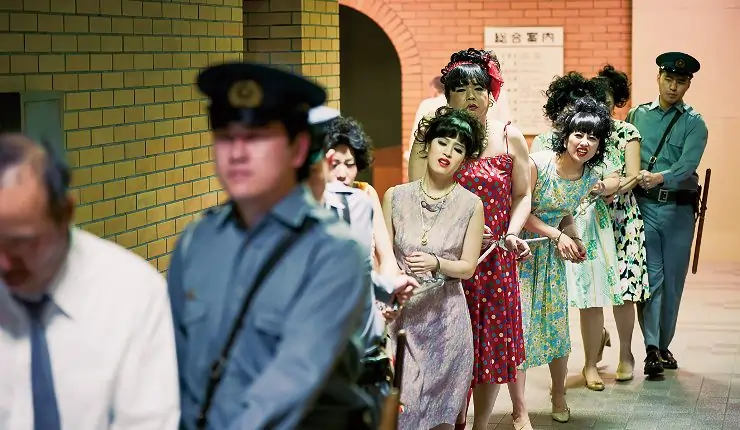
Are you happy? The final song of Bo Burnham’s Netflix special lingers with me to this day. Burnham reflects on whether, despite all the success and fame he has achieved, is he happy? A general audience can relate to this; many of us reach our goals or build the life we imagined, only to confront the same question: Are we happy? Inspired by true events, Blue Boy Trial follows members of the Japanese trans community as a single court case stands to alter their lives forever. Three women risk everything to prove that their lives have meaning and that they are finally happy now that their sex aligns with their gender. Blue Boy Trial is bold, transcendental, and ultimately a remarkable piece of cinema.
It’s 1965 in Tokyo, and after the Olympics, the government introduces measures to reinforce public morals, which means they are cracking down on prostitution by women. However, a group of transgender prostitutes, referred to as the “Blue Boys,” cannot be prosecuted because they are legally male. In a bold act, the authorities decide to arrest Dr Masao Akagi, who performs sex change operations, for violating the Eugenic Protection Law. Sachi is drawn into the case as one of the women who received surgery from the doctor. But is she willing to uproot her life and reveal her true self to defend him?
Blue Boy Trial should serve as a stark reminder of humanity’s shameful past, when trans women, and the same applies to trans men, were demonised simply for being who they are. In the final courtroom scene, something in the film’s presentation shifts: instead of testifying to a judge, Sachi testifies directly to the audience. She proclaims why her life has meaning, that she is happy as a woman, and asks whether her happiness matters at all without acceptance. It’s a haunting reflection of our reality that even now, trans people are forced to justify their very existence. The film showcases how little progress we have truly made, despite its story being set 60 years ago.
Sachi’s actress, Miyu Nakagawa, delivers a powerful yet subdued performance that brings out Blue Boy Trial’s quiet beauty. The rest of the cast is equally as brilliant. Watching Sachi and trans women come together and share moments of joy and fight for future trans women is genuinely moving. It is also hauntingly beautiful that when tragedy strikes, even if they had their differences or were shouting at each other the day before, they still unite as a community and let the past go. None of these moments would resonate as deeply without the incredible performances, which breathe life into the themes and drama.
Writer and director Kashou Iizuka does an excellent job of bringing this important moment in Japanese history to life with the delicacy and care the subject matter requires. From the intense courtroom scenes, where these women are forced to delve into every aspect of their personal lives, to quieter moments of trying on new clothes, there is a clear attention to detail in every frame. That same delicacy carries through into the film’s most impactful moments.
Transphobia is present within Blue Boy Trial, but it’s more than characters using slurs. It’s in the looks people give and the under-the-breath comments that make trans people feel unwelcome in conventional society. Kashou Iizuka’s strong script and direction allow these themes to flourish and feel authentic. Nothing comes across as far-fetched or confined to the past, especially as we are seeing these dynamics unfold in our world right now.
Blue Boy Trial is an incredible watch, a powerful trans story that remains hopeful despite being set during one of the darkest periods for the trans community. While aspects of our society may still resist allowing trans people to be happy and continue to vilify their very existence, the film suggests a different path. If people were more accepting of who others are, perhaps more of us could finally answer “yes” to the question of whether they are happy. Blue Boy Trial is powerful in that regard, and it is a must-watch film.
★★★★1/2
The Japan Foundation Touring Film Programme 2026 takes place in cinemas around the UK from 6 February to 31 March 2026 / Miyu Nakagawa, Takashi Yamanaka, Ryo Nishikido, Kô Maehara / Dir: Kashou Iizuka / 12a
Related
Discover more from
Subscribe to get the latest posts sent to your email.
