
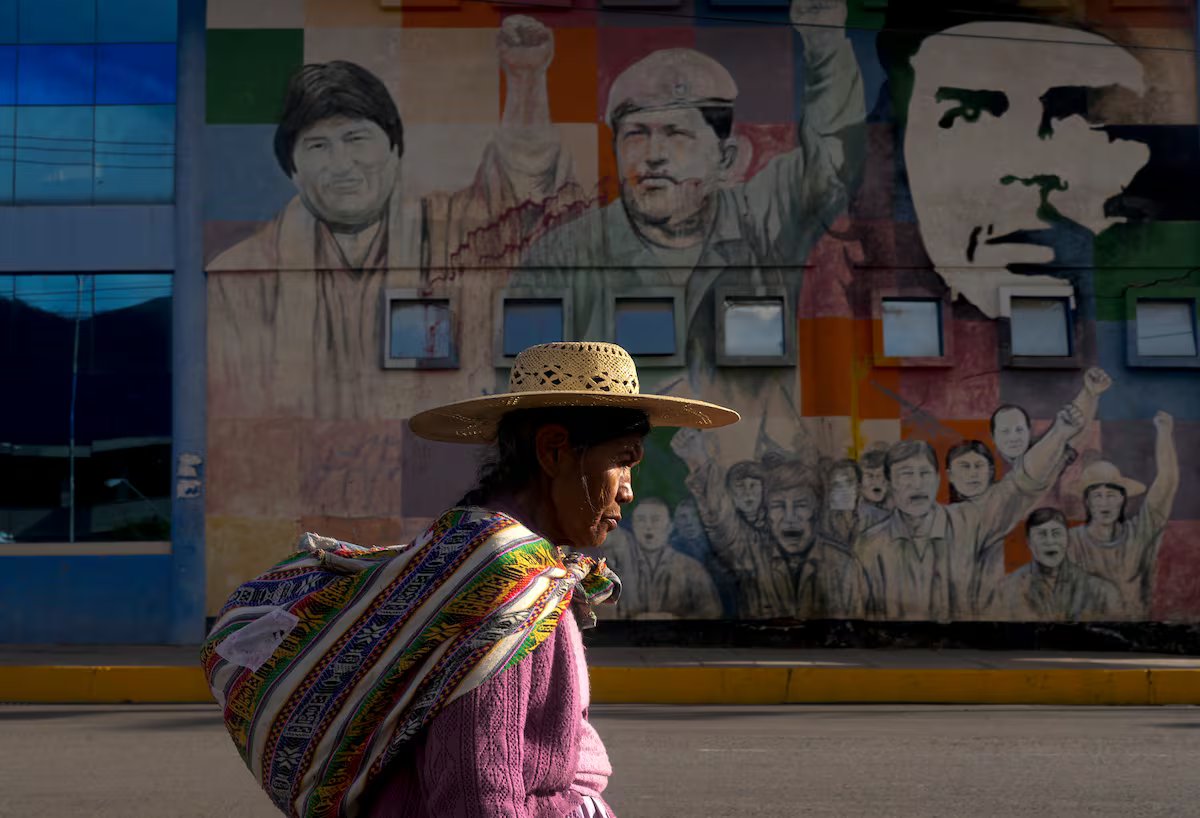
The embodiment of economic prosperity in Bolivia has a name: Santa Cruz de la Sierra. The warm Guaraní city, far from the Andes, consists of 40% of national and foreign migrants. More than one newcomer has been confused by the name of one of its avenues in the east of the city. Locals call it Che Guevara Avenue, but the GPS and the official municipal map call it Monseñor Nicolás Castellanos Avenue. The City Council decided to rename it last November. This is not a simple administrative issue, but a renewed attempt by the center-right government of Rodrigo Paz to sweep aside the memory of the world’s most famous guerrilla fighter, who was assassinated in the Bolivian village of La Higuera in 1967.
Since Bolivia’s Movement Towards Socialism (MAS) lost power to the new government last year, several attempts have been made to rid the country of Guevara’s legacy. His military executioners have been decorated and there have been proposals to remove his face and name from public places. Karaoke bars, liquor stores, and pool halls populate the busy street which most people still call Che Guevara, not because of ideological conviction, but because it has always been so.
A young man waiting for the bus says the street name change is fine by him. “We’ve had enough Che Guevara already,” he says. He is part of the 17- to 25-year-old demographic in Bolivia that has been pushing for an end to the honoring of the leftist icon who, between 1966 and 1967, tried to create a center of armed revolution in the heart of South America that would radiate throughout the continent. Instead, they propose honoring the 700 soldiers who are still alive from the unit of 2,000 who fought Che and his 44 guerrillas — among them 23 Bolivians, 16 Cubans, three Peruvians and two Argentinians. In October of last year, the month of Guevara’s death, these soldiers were honored in the country’s capital, La Paz, by the Bolivian Nationalist Union. The event was held in a public square and was attended by soldiers who, at the time of the conflict, were 18-year-old conscripts, many of them with less than two months of training.
Historical narratives
The 23-year-old lawyer, political activist, and founder of the debate platform Presente.bo, Arturo Berazain, is not part of the union, but he shares some of its ideals, and was present. “We are seeing the vindication of Bolivia’s history. For decades, according to the universal narrative promoted by foreign actors, the guerrillas were romanticized, relegating the Bolivian soldier to the sidelines. Decorating the meritorious people of Ñancahuazú [where Che’s central camp was established] is putting things in their rightful place,” he told EL PAÍS.
The same scenario was enacted in Santa Cruz de la Sierra. The veterans complained that only some of them had received compensation in the form of food. What they are demanding is a pension, but they are also seeking redemption, as one of them, Juan Siles, made clear in his speech: “Those socialists who carry the image of Che are traitors to the homeland,” said Siles. “They shouldn’t be allowed to look a soldier in the face. We were on the side of our country. We were wearing the same uniform for a month, which fell apart on its own.” The venue was the popularly named Heroes of Ñancahuazú Square. Its original name was Litoral, but this was changed when a memorial with the names of the 50 fallen soldiers was erected in 2017.
The construction of the monument was a response to the extravagant official acts for the 50th anniversary of Guevara’s death carried out by the MAS government during Evo Morales’ third term. The former Indigenous president had kept the memory of Che alive since his inauguration in 2006 by naming monuments and cultural centers in his honor. Now a seven-meter-high sculpture of Che made from scrap metal in El Alto is under threat. A TikToker triggered the demand to get rid of it. A similar demand came from Senator Nilton Condori, who tore up a photograph of Che at a press conference in January and suggested that his face be removed from the Confederation of Rural Education Teachers: “Let’s include Bolivia’s coat of arms. Education does not belong to the right or the left, but to the cultural spirit of our nation,” he said.
The project that Morales never carried out, despite repeated promises, was the paving of the road to La Higuera, the small village where Che and his National Liberation Army (ELN) were finally defeated. The community is located on the geographical border between Chuquisaca and Santa Cruz; between the last foothills of the Andean mountain range and the beginning of the tropical plain. Every meter of its dirt streets features paraphernalia from Che’s revolutionary dream: the walls of the adobe houses, the busts and monuments of the only square, the names of hotels.
Lack of support
When a decimated, hungry, and totally encircled ELN arrived in this village in early October 1967, it was deserted. It 300 inhabitants had either left or hidden after the news reached them of the arrival of the “bearded foreigners.” One of the 30 still alive, Inma Rosado, 80, tells EL PAÍS: “We were afraid and we would either hide behind the door or flee to the mountain in front. We couldn’t even go out for water.” Historians agree that Guevara’s defeat was due to his lack of knowledge of the terrain and of the social and political reality. It was also a question of poor communication but, above all, Che lacked peasant support.
Carlos Soria Galvarro, who is considered the greatest expert on the guerrilla experience in Bolivia, explains: “The guerrilla movement did not emerge from social struggles or internal conflicts; therefore, it was seen as something strange and needed more time to take root.” Meanwhile, the propaganda spread by the military and autocratic government of René Barrientos painted the guerrillas as “Castro-communist” invaders and a gang that looted residences and raped women.
With the help of the Church, this image took hold in the collective imagination. That said, Che did manage to influence the two military governments that succeeded Barrientos. Despite their military credentials, they introduced social measures, such as the nationalization of oil, the reopening of relations with the Soviet Union and the release of the anti-imperialists Régis Debray and Ciro Bustos, who had arrived with Che. Even the current president, Rodrigo Paz, was touched by the long arm of the revolutionary. Before beginning his political career, he was seen at historical memory events talking about his uncle, Néstor Paz, a university student who, at the age of 24, decided to reactivate the ELN along with 70 others three years after the fall of Che. He died of starvation, surrounded by the army.
Sign up for our weekly newsletter to get more English-language news coverage from EL PAÍS USA Edition
