
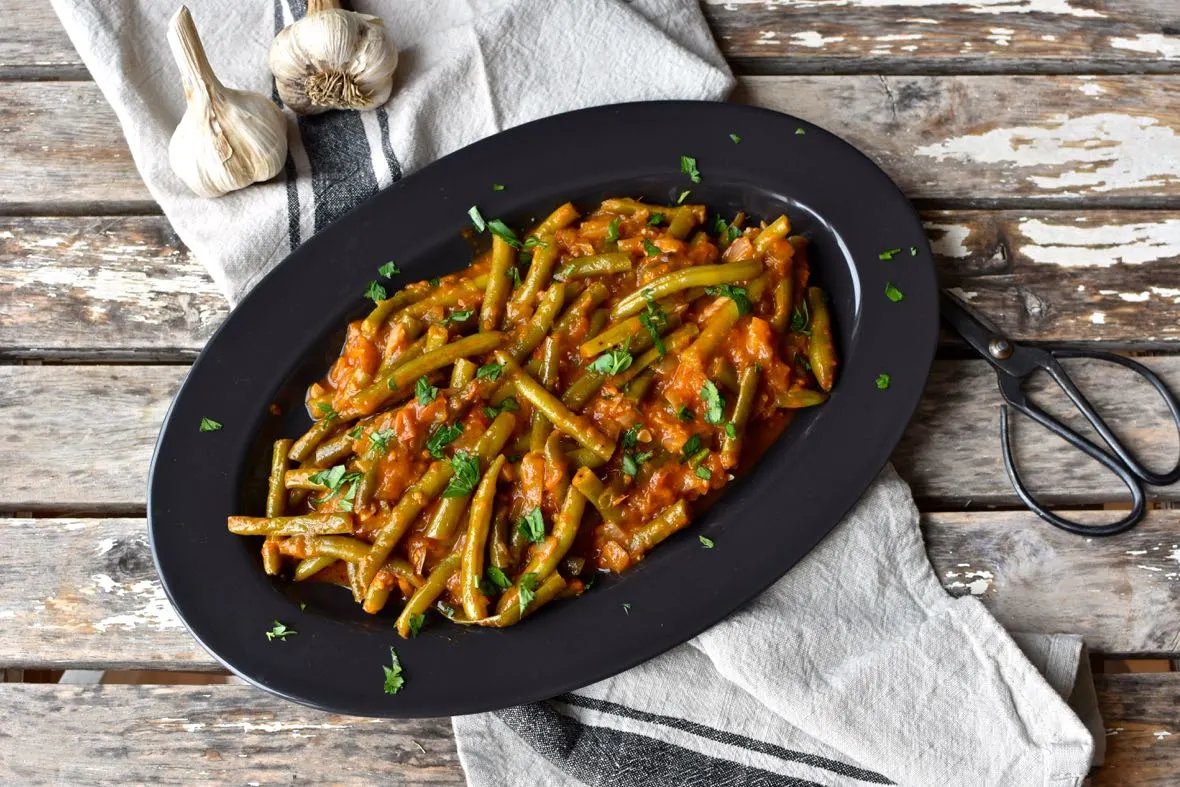
The weather has been incredibly cold and snowy this winter across much of the United States (even in Florida!). And it’s not over yet! February just ended, so there could be even some more snow and cold temperatures in store for us. In these weather conditions, there are some foods that I crave: soups, stews, and rich, filling vegetables, like this braised greens beans in smoky tomato sauce that is so idiosyncratically Spanish, it almost transports me there.

Borrull Palace, Sant Mateu

You can eat it as an accompaniment to any grilled fish, chicken or meat, but you can also have it as a hearty lunch, scooping up the delicious tomato sauce with pieces of crusty bread. Yum!
This cold winter is making me long for summer, and even though it is still a few months away (we just started the season of Lent!), I want to dream of it by writing about the beautiful town of Sant Mateu —San Mateo in Spanish, Saint Matthew in English—to accompany the recipe of braised beans with smoky tomato sauce.
Sant Mateu is located in the province of Castellón, Spain, and I have to admit that I hadn’t heard of this town until last summer, when I discovered it almost by chance. The reason that brought me there was some government business I had to deal with at the Office of the Registrar, located in Sant Mateu.
My husband and I drove there early in the morning, hoping to finish the business that brought us there quickly and return to Alcocebre, the beach town where we were staying. The meeting was short, as we had hoped, and we decided to venture into town for a coffee before driving back home. We ended up spending the rest of the morning there! And we didn’t stay longer because our son was waiting for us back home at the beach.

Driving to Sant Mateu through El Maestrat

View of Sant Mateu

We happened to arrive into the center of town as they were preparing to celebrate their summer festival, in honor of Our Lady of the Assumption. It wasn’t easy to find parking in the streets near the Central Square, and we soon found out why: the next day there was going to be a running of the bulls through the streets, so every home that lined the streets was being boarded up, and the streets closed off with fences.
Eventually, we found parking and walked over a Roman bridge to the Central Square. It was a gorgeous porticated square, lined by bars, restaurants and cafés. As is common in Spain, people were sitting at every table outside each locale, enjoying drinks, tapas and conversation. The square, roundish in shape, was decorated with festive flags and left open as a makeshift bull ring for the festivities. Needless to say, we couldn’t find a place to sit. Never mind, we thought, let’s explore the town a bit more.

The Convent of the Augustinian Nuns, Sant Mateu

Archpriestal Church of Sant Mateu


Geography and Landmarks
Sant Mateu is the historic capital of the region called El Maestrat (El Maestrazgo in Spanish) within the province of Castellón, in the Valencian Community. Visiting Sant Mateu feels like traveling to the Middle Ages. In fact, Sant Mateu shone during the 14th and 15th centuries, in which the exportation of wool to Florence transformed the town into a very important commercial, livestock, artisanal and artistic center. The splendor is reflected in its spectacular historic and artistic heritage, encompassing the Archpriestal Church (dating from the 13th to the 15th centuries), as majestic as a cathedral. Its cobblestone streets were walked on by the masters of the Order of Montessa and its knights.
Sant Mateu‘s past times are represented in its monuments, museums, and historical center, which together with more than 50 km of marked hiking trails, make it a powerful attraction for the off-the-beaten-path tourist. Add to that its gastronomy, with its outstanding extra-virgin olive oil from the millenary olive trees of the native variety Farga.


Palace of the Marquis of Villores, Sant Mateu
Other landmarks of Sant Mateu include:
- The medieval oven (14th century) and the Town Hall (15th century), two beautiful examples of Valencian Gothic civil architecture
- The Borrull Palace (15th century), separated from the Town Hall by the Jewish Alleyway.
- The town walls (14th century)
- The Pla de la Mare de Deu de la Font, the Square of the Lady of the Fountain (15th century)
- Saint Peter’s Church (13–18th century)
- The medieval dungeons (15th century)
- The Convent of the Augustinian nuns (16–18th century)
- The Palace of the Marquis of Villores (16th century), a beautiful example of renaissance architecture
- You can’t miss a visit to the Sanctuary of La Mare de Deu dels Angels (our Lady of the Angels). Dating from the 16th–18th century, it is situated at the top of a mountain, about 2.5 km from Sant Mateu, where you can enjoy the beauty of the church and the panoramic view over Sant Mateu in the Maestrazgo region


Sant Mateu’s Main Square
A bit of history
The origins of Sant Mateu go back to before the conquest of the region by King James I, who gave it to the Order of the Knights of the Hospital. In 1237, Hugo de Follalquer granted the town charter to Saint Matthew. In 1319, during the reign of James II, Sant Mateu became part of the Order of the Knights of Montesa, and was the residence of its Grand Masters, becoming the capital of the Maestrazgo.
As a result of its political importance, Sant Mateu played a notable historic role, given that the parliament of the kingdom was held there five times between the 14th and 15th centuries. Important personalities that visited the town included Saint Vincent, Pope Clement VIII, King Philip II and Pope Benedict XIII. The most important historical event happened at the Archpriestal Church of Sant Mateu, when Pope Clement VIII, the successor of Pope Benedict XIII, renounced the papacy, ending the schism in the Western Church.
Museums
Sant Mateu has four museums:
- The Local History Museum, located in the Palace Borrull
- The Paleontology Museum Juan Cano Forner, considered the most important paleontology collection in the Valencian Community.
- The Parochial Museographic Collection, located within the monumental site of the Archpriestal Church
- The Collection of Models of Historic Monuments of the Valencian Community.


 Hiking
Hiking and strolling for all ages and levels of difficulty are provided by the more than 50 kilometers of marked trails, that allow the visitor to enjoy Sant Mateu’s agricultural landscape of millenary olive tree groves. If you’re interested in oleoturism and enoturism, you can enjoy the products and services of these local companies:
Sant Clement olive oil mill
Varona La Vella Olive Oil
Bessalduch Valls & Bellmunt Winery
Festivities
Sant Mateu celebrates a number of festivities throughout the year. We happened to be there during the festivities of its patron saint, in mid-August. Other festivities include the Feast of Saint Anthony in January, the Holy Week processions of Holy Week and Easter, the Feast of Our Lady of the Angels, which happens after Easter, and the Feast of Saint Matthew in July. This particular feast dates from the Middle Ages, and its central attraction is the medieval market.


Gastronomy
We have mentioned Sant Mateu’s unique extra-virgin olive oil, which is used in most of their dishes, traditional cooking of their ancestors, characterized by the presence of the products of the land, including meats, mushrooms, and herbs. A traditional dish of Sant Mateu is the olleta de San Mateu, a stew that includes some of the local products For dessert, the almond confectioneries of medieval origin called pastissets and primetes.
This summer, we will visit Sant Mateu again, this time with our sons and other family members, but out of pleasure and not for any government related business, even if I have to thank the business trip last summer for our discovery of this beautiful town.
For braised green beans with smoky tomato sauce, make sure you use the best green beans you can find, and if you make it at this time of year, when tomatoes are not in season, use a very good canned tomato —I was lucky to still have some jars of preserved tomatoes from my garden! As for the oil, needless to say, use a high-quality olive oil, preferably from Spain.
Keep warm and Happy cooking!

BRAISED GREEN BEANS IN SMOKY TOMATO SAUCE
Judías verdes estofadas en salsa de tomate
-
Chop the onion finely. Mince the garlic cloves. Cut the beans in half.
-
Heat the olive oil in a large saucepan over medium heat. Stir in the onion and 1 tsp sea salt. Cook, stirring often, until the onion softens, about 5 minutes. Stir in the minced garlic, the Pimentón de la Vera and the black pepper. Cook, stirring until fragant, about 1 minute.
-
Stir in the crushed tomatoes (if using canned tomatoes, add 1/2 cup water) . Bring to a simmer over medium-high. Stir in the green beans and return to a simmer. Cover and cook, stirring occasionally, until the beans are tender, about 40 minutes (the beans must stay very moist in the bubbling sauce, so add some more water if needed).
-
Stir in the lemon juice and adjust for salt. Serve warm with a slice of crusty bread.

