
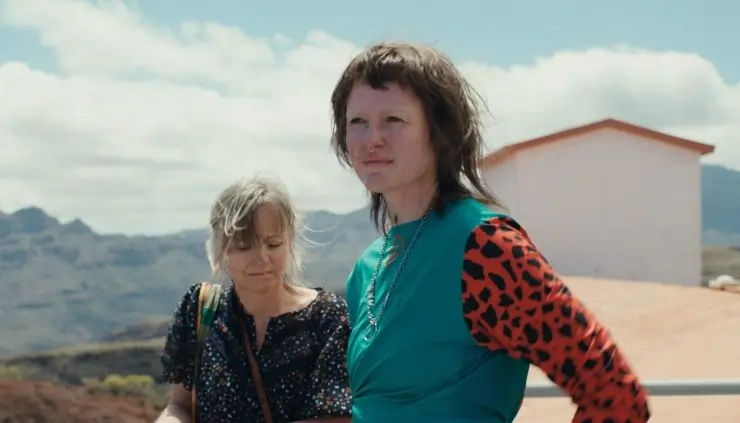
Two seemingly diametrically different half-sisters reunite in the distant Gran Canaria, following their mother’s peculiar death on the island. Together, they make their slow way to what they’ve long been neglecting: understanding their estranged mother and reconciling with the place they grew up. However straight this storyline might read, the image is unorthodox and surprising.
Butterfly tells a tale of redemptive homecoming, in the rhythm of crushing waves from mixed waters. Acid images of fluid colours guide the story through chapters moving along the timeline of our two protagonists who are full of their own colours and oppositions. Diana (Helene Bjørneby) is a kindergarten teacher who walks with a crutch when she gets emotionally overloaded, while Lily (Renate Reinsve) is a performing artist with a very outspoken style and an edgy nerve. As the two sisters land on the island, they leave behind the touristic residues of their childhood, falling into the path their late mother opened towards the mountains. While dealing with the bureaucracy of their heritage and the emotional distance between them, the spirituality of the valley allures them in, becoming both the visual glue and the resolving trope.
Beyond the storyline itself, Butterfly is entertaining to watch, mainly thanks to the impeccable performance of Reinsve, who is constantly theatrically present (how does she do this?) and uncannily well-rounded, as if framed from every possible angle, and the bottomless air of authenticity brought by Bjørneby (whose character becomes inseparable from her face, making Diana a creature of all human emotions).
Under the light of a constant afternoon sun, the story gravitates toward female sexuality and histories of occupations. Playing on different scales, from the body as a landscape to the personal as the collective, the Norwegian director Itonje Søimer Guttormsen forges almost an essay on the affect of relationships (past and present) and on how rituals can function as a way to regain agency, if lost, for the future. This comes as no surprise; the artistic interplay between ceremonies and nature as a lens through which to read society’s oversights was established even as a methodology in the first feature film of Guttormsen, Gritt (2021). I might not understand more than this about her work, but Butterfly – electric and punk – is definitely well-crafted and welcoming.
Which is also rather inevitable, as this is a project of long-lasting cross-collaborations. Renate Reinsve meets Helene Bjørneby in front of a running camera 5 years after The Worst Person in the World (Joachim Trier, 2021). A similar story can be told of director Guttormsen and producer Maria Ekerhovd, who is the founding force behind the production company Mer Film; the key to success, as it seems, for the independent contemporary Norwegian cinema. Their popular titles (Sentimental Value, Ugly Stepsister, La Chimera, Souleymane’s Story, Holy Spider, to name a few recent ones) might suggest Hollywood-scale detailing and polishing standards. But in reality they keep it somewhat independent without compromising the art-house qualities found in their films.
The director (an artist herself) had her feature debut with Gritt in the Tiger Competition at the International Film Festival Rotterdam – a section claiming to showcase emerging and innovative voices. Butterfly marks this achievement as her sophomore film was invited to premiere internationally at the same festival, this time in the Big Screen Competition section – the part of the festival that’s aiming to bridge the gap between popular and art house cinema – and at the 2026 Göteborg Film Festival, Nordic Competition section.
★★★
Butterfly, 120 / Director & Writer: Itonje Søimer Guttormsen / Cast: Renate Reinsve, Helene Bjørneby, Numan Acar / Music: Erik Ljunggren / Producer: Maria Ekerhovd / Norway, Sweden, United Kingdom, Germany
Related
Discover more from
Subscribe to get the latest posts sent to your email.
