
Subscribe to High Margin by Robert Williams: perspectives on creativity and business in the world of luxury.
For the first time in a long time, it feels like fashion is really changing. I’m not talking about the reshuffling of CEOs and marquee creative directors, and their respective visions for brand articulation. But rather which clothes feel right, which clothes feel wrong, and what customers out in the world are actually responding to.
A new silhouette still feels like the missing ingredient to make fashion’s “Great Reset” a reality. The soft, cocooning aesthetic that recently signalled confidence and ease increasingly feels like a cop-out. The icy, voyeuristic nudity some designers have proposed as a counterpoint isn’t quite hitting the mark either. Nor the preoccupation with archival couture glamour seen in recent seasons at Balenciaga, Mugler and more.
Character-driven styling — using the runway to celebrate various personalities (or as a how-to guide for embodying them) — is working wonders in terms of driving engagement online. See Demna’s La Famiglia or Matthieu Blazy’s Chanel cruise. But this feels like a transitional proposition that might be swept away once something more directional takes hold.
This was fashion’s state of play as I saw it going into the fall collections in Milan and Paris.
I won’t overwhelm you with my thoughts on all of the shows so far — but thought I’d share some views on how key brands at some of the industry’s biggest groups are doing this season.
Kering
People want to be sexy. They want to be turned on. But what sexy looks like in 2026 is up for debate.
Demna didn’t resolve that question, but he tackled it head on with his debut Gucci show in Milan last Friday. The show was polarising — perhaps too much so for a brand at this scale, as its target audience is bigger and likely older than the cohort of viewers willing and able to untangle its layers of nuance, humour and social commentary.
But those who didn’t dismiss the collection as skanky may be all in: Body transformation is an inescapable force in culture today, with GLP1-fuelled weight-loss just the tip of the iceberg as demand spreads for a broader menu of hormones, peptides and elective cosmetic surgeries. Demna placed the brand at the centre of that conversation.
I don’t think people paid enough attention to how Demna and his team retailored the clothes to make them fit 2026 bodies in a 2026 way. Despite the heavy references to Tom Ford-era Gucci, the collection didn’t read as nostalgic.
Seeing a collection that really centred the body — as did Matthieu Blazy’s Chanel couture in January, albeit in a totally different way — crystallised my sense that collections that shroud or obscure the body just aren’t where things are headed anymore. That’s my best guess for why Louise Trotter’s Bottega Veneta didn’t appear to land as well as her debut show just a few months ago.
Kudos to her for pushing the brand’s already formidable prowess in leather craft and materials research to new heights, and for marshalling those resources in new ways that do more than merely signal “craft.” But while hers was a very good collection, its focus on big, sculptural jackets just didn’t feel timely.
I had a similar quibble with Kering stablemate Saint Laurent. The tailoring was beautiful, as were the faux fur coats — but the models were drowning in them. A gigantic coat atop bare skinny legs has become a signature silhouette for Anthony Vaccarello, but it’s one I could use a break from. It feels unnecessarily literal amid his otherwise nuanced approach to feminine power and controlled sexuality. Vaccarello did pull back on the huge shoulders, though — he could be gently transitioning to a less exaggerated line.
Balenciaga shows Saturday; McQueen on Sunday.
LVMH

I really tried to like Dior, but I just can’t get on board with the season’s second most polarising show (after Gucci).
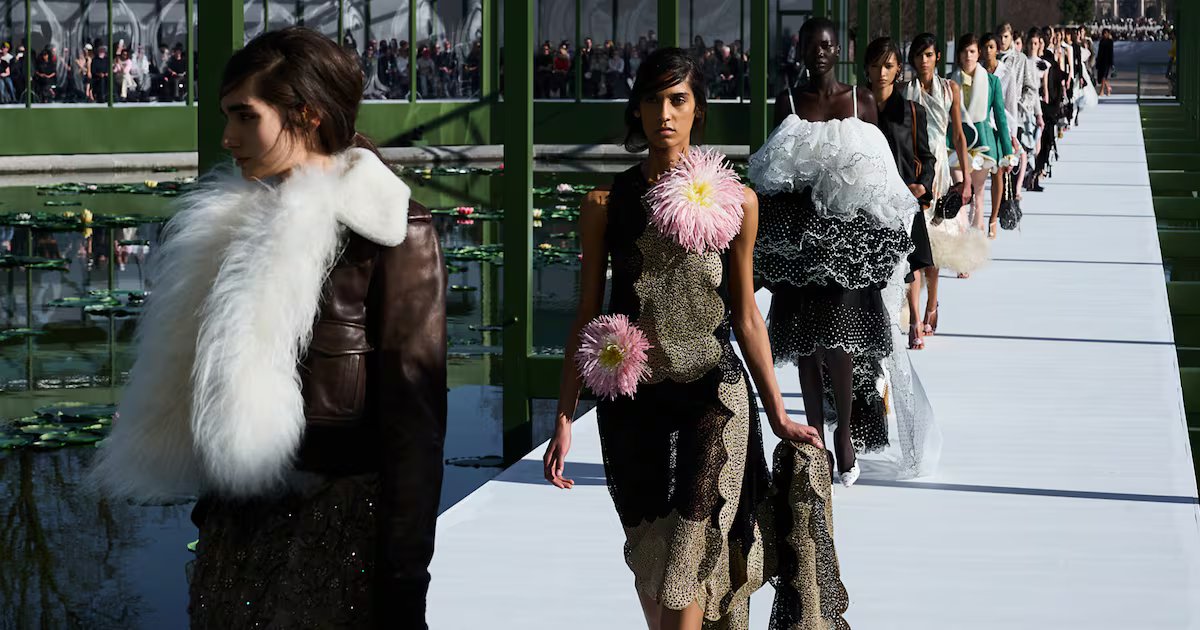
The set, the fabrics were incredible. So were the Bar jackets: the slits up the back, the way they pulsated atop the pleated padding. But all the asymmetry — front-to-back and side-to-side — was hard to digest on top of the iridescent brocade, polka dots and ruffles. So many looks had a truc de trop: the swishing tails on the opening Betta fish-inspired ensembles, a feather-trimmed train sticking off to the side of a brocade robe.
The messiness of the clothes contradicted the notion that they had been inspired by the Tuileries Gardens — their strict geometry and history of inflexible dress codes — without seeming rebellious either.
It’s worth mentioning that a few buyers I spoke to were elated: citing freshness, prettiness, an abundance of recognisable items like frill-neck blouses, filigree scroll jeans and all-around killer shoes. The shrunken, bell-shaped Bar jackets and abbreviated hemlines responded to changing appetites for showing the body—even if the piled-on styling distracted from the line.
Their reaction reminded me that as long as Dior continues to hone a desirable image under Jonathan Anderson, silhouette may be secondary. If the post-Ozempic, post-”quiet luxury” look turns out to be a white T-shirt and jeans, Dior — and other global megabrands — could come out fine: women will want a new bag and shoes to go with that.
Loewe and Givenchy show Friday. Louis Vuitton shows Tuesday. (P.S.: I covered Fendi’s debut show and my interview with Maria Grazia Chiuri in last week’s edition).
Balmain (Mayhoola)

A shout-out to Antonin Tron for his debut show at Balmain. With just three months to put the show together, he managed to interrogate received notions about the brand — like its reputation for exaggerated shoulders (the shoulder ought to be important without calling so much attention to itself, Tron posits) and its founding vision for “Jolie Madame” elegance (the brand has always been more subversive than people realise).
He put that research to work in a debut show that wasn’t exactly a Big Fashion Moment — the clair-obscure set suggested the brand was going for something more cinematic than what it achieved — but which managed to propose a complete and coherent vestiaire. He’s threading a tricky needle: opening a new chapter for the brand in a tricky market where it can’t afford to lose its current clients for the sake of seeking new ones.
My full interview with Tron is here.
Disclosure: LVMH is part of a group of investors who, together, hold a minority interest in The Business of Fashion. All investors have signed shareholders’ documentation guaranteeing BoF’s complete editorial independence.
