
MUMBAI, INDIA
— Canada lags behind its international counterparts when it comes to trading
with India, warned Saskatchewan Premier
Scott Moe, whose province trades more with the country of 1.4 billion than any other province in Canada.
That is why, Moe said, it remains important that Canada not walk away, despite any differences it may have.
Moe made his comments after arriving in Mumbai, India’s financial capital, as Prime Minister Mark Carney’s government deals with the domestic fallout of a senior government official
that agents linked to the Indian government were involved in violent crimes within Canada, as well as allegations that India attempted to interfere in Canadian elections.
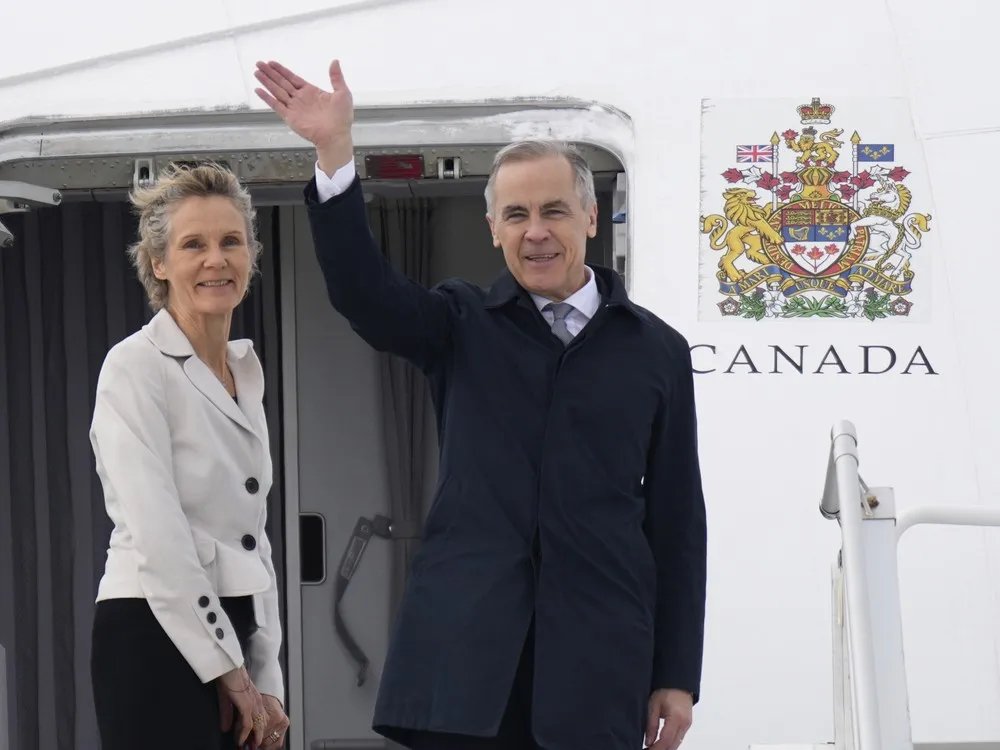
The official made the comment in a not-for-attribution briefing to reporters ahead of Carney’s trip to India, which kicked off on Friday when he and his wife, Diana, touched down in Mumbai shortly before 2:40 p.m. local time.
A red carpet was rolled out on the tarmac of the Chhatrapati Shivaji International Airport to greet the couple, who were presented with bouquets of flowers and welcomed by local officials including India’s High Commissioner to Canada.
Carney’s goal was to shore up more investment into Canada and open up deals for more exports, like energy, into India to meet its growing demand.
It comes as Carney seeks to reset Canada’s relationship with India, which plummeted under former prime minister Justin Trudeau, who in 2023 rose in the House of Commons to announce that Canadian security agencies were pursuing
“credible allegations of a potential link” between Indian government agents and the murder of Hardeep Singh Nijjar, a Sikh activist gunned down outside of a temple in Surrey B.C.
India has denied any involvement.
Moe said on Friday that he was not privy to ongoing Canadian security conversations regarding India and that he trusts the federal government to keep Canadians safe.
At the same time, he underscored the importance of working with India on trade.
“If we just look back to the last number of years, Canada and India have not been at that table, having those discussions.
“I would say, from a trade perspective, that we’ve fallen behind a number of other countries around the world.”
Carney spent his first day in India in a closed-door meeting with the chairman of an investment holding company for an Indian conglomerate based in Mumbai.
Moe, who along with New Brunswick Premier Susan Holt, joined Carney at the invitation of the Prime Minister’s Office and had his own set of meetings including on Friday with India’s Department of Atomic Energy.
It came as Moe seeks to renew what was once an agreement that saw Cameco supply India with Saskatchewan uranium, which India needs more of to achieve its own nuclear power goals.
Saskatchewan boasts Canada’s biggest source of uranium, with its mines located in the province’s far north. Globally, Canada is the second-largest producer of uranium, following Kazakhstan.
Energy was one of the areas India’s envoy to Canada identified as a priority area that will shape how the two countries will seek to deepen their relationship — the overarching goal of Carney’s trip.
“How do we work on oil and gas? Energy, nuclear, renewables, critical minerals, agriculture,” India’s high commissioner to Canada,
Dinesh Patnaik, said in a recent interview.
Moe said India stands as Saskatchewan’s third-largest export market and has long focused on expanding its trading access, particularly when it comes to agriculture products, such as potash. He also said he hopes to return with a reprieve or at least no further increases to the tariffs India has placed on peas and lentils.
Canada sending more uranium, critical minerals, crude oil and liquified natural gas to India was at the heart of discussions Natural Resources and Energy Minister Tim Hodgson had with Indian energy companies back in January.
Hodgson specifically identified India’s interest in crude oil, saying the country boasts the world’s largest refining capacities. He said India wants more of Canada’s oil, whether through the TMX pipeline, or the construction of a new one to the West Coast, which Alberta Premier Danielle Smith is pitching.
Moe echoed those comments on Friday, saying India was among the Asian markets that a new pipeline to the West Coast would open up.
He voiced his support in believing that under Carney, such a project could actually get built, saying he believes the world is becoming more “hungry for energy.”
“I would suggest that we as Canadians have a responsibility to provide and displace some of the dirtier forms of energy, some of the more unethical forms of energy that are being produced in other areas of the world and being provided to those markets today.”
Holt said she sees opportunities to send more natural gas to India through the Port of Saint John.
While her province already has ties to India in terms of nurse training and its use of some forest products, plus trade offices, businesses have been looking to diversify in the face of U.S. President Donald Trump’s tariffs.
“What President Trump has done has demonstrated the volatility of our relationship with our largest export and trading partner, and has motivated New Brunswick businesses to look beyond our next-door neighbour,” she said.
Government officials, speaking on a not-for-attribution basis to reporters earlier this week, said Carney will spend his meetings in Mumbai “to explore opportunities for partnerships” when it comes to energy and agriculture.
The official said that besides launching the negotiations of a comprehensive trade agreement, which both Canada and India anticipate being signed in months, “a number of (memorandum of understandings) … will be signed, coupled with “commercial arrangement deals” to be announced during the duration of Carney’s trip, which will also see him travel to India’s capital of New Delhi, before departing for Australia and Japan next week.
National Post
Our website is the place for the latest breaking news, exclusive scoops, longreads and provocative commentary. Please bookmark nationalpost.com and sign up for our politics newsletter, First Reading, here.
