
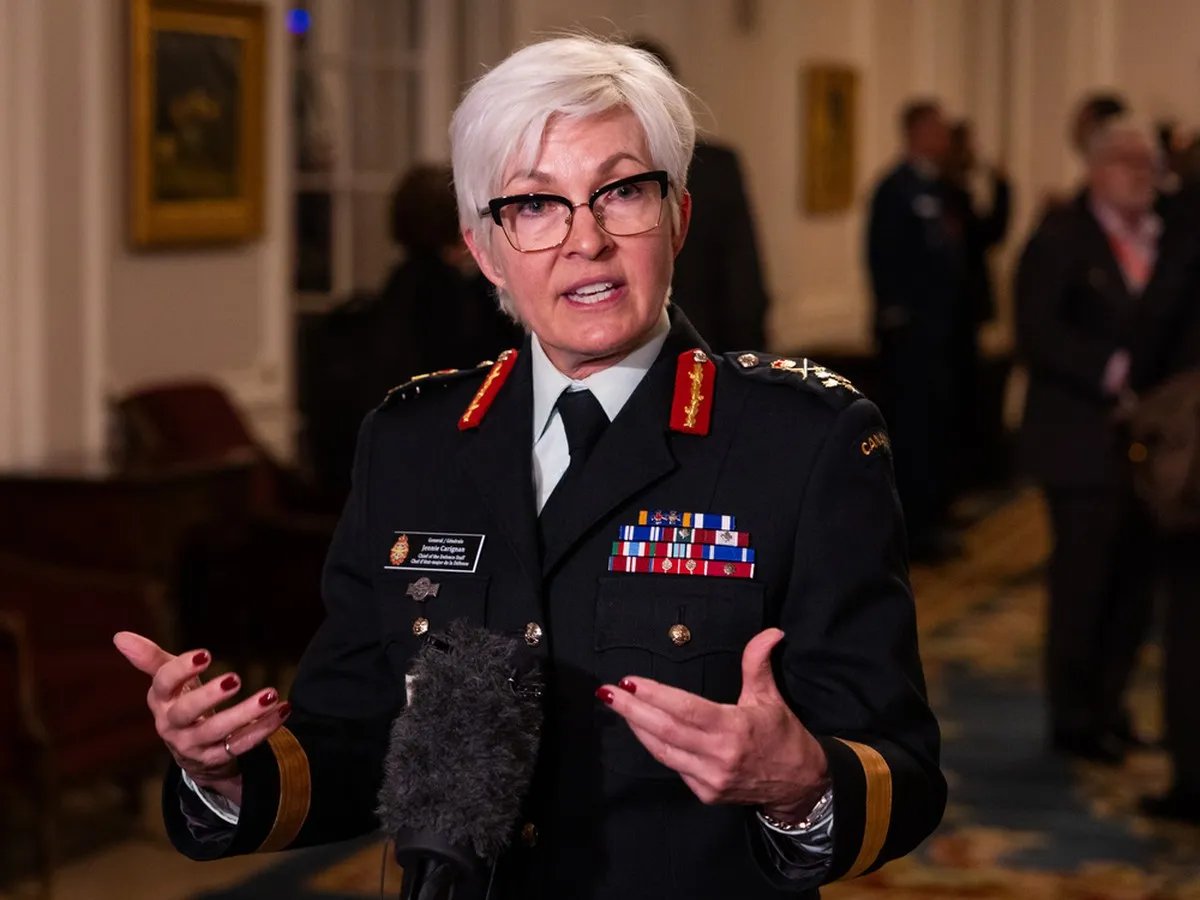
OTTAWA — Canada’s Chief of the Defence Staff General Jennie Carignan said she will be meeting with her European counterparts on Friday morning to discuss military options to support Gulf states. But Carignan ruled out any Canadian military involvement in Operation Epic Fury, the U.S. and Israeli strikes on Iran.
“We are not talking about participating to Epic Fury, per se, this is not the mission that we are considering,” she told reporters on the sidelines of the the Ottawa Conference on Security and Defence on Thursday.
“However, our Gulf partners may require defence and support, so within that context, this would be the type of military options that we could consider.”
Carignan said the situation on the ground is “dynamic” and that any Canadian role would have to be adjusted to the threats on the ground. She noted that the main threat that is being assessed right now is the threat of ballistics and the drone strikes.
“So, any type of military platforms (we) would send in those conditions, would have to be equipped or protected with other types of systems. So, this is why there’s a range of different options,” she said.
Since Israel and the U.S. began Operation Epic Fury against the Iranian regime on Saturday, several Gulf states including Bahrain, Kuwait, Oman, Qatar, Saudi Arabia, and the United Arab Emirates have been hit by Iranian missile and drone strikes.
On Wednesday during his visit to Canberra, Australia, Prime Minister Mark Carney did not rule out future military participation in the conflict, saying “we will defend our allies when it makes sense.”
Carney said “one can never categorically rule out participation.”
Carney’s comments followed reports that North Atlantic Treaty Organization (NATO) defence systems shot down an Iranian missile headed for Turkey, a NATO ally.
Carignan said the Law of Armed Conflict (LOAC), which is the body of international law which sets out rules of behaviour in an armed conflict and is designed to minimize victims of any conflict that are not participants in armed conflict, now applies.
“Therefore any states being attacked can take defensive measures to self defence,” she said. “So therefore any operation would have to be within…that zone of self defence.”
Carignan said Canada is currently reaching out to its partners in the Middle East to gather information and has deployed liaison officers in the region.
When asked what Canada could offer in terms of capabilities in the region, the CDS did not rule out sending more personnel.
National Post
Our website is the place for the latest breaking news, exclusive scoops, longreads and provocative commentary. Please bookmark nationalpost.com and sign up for our newsletters here.
