
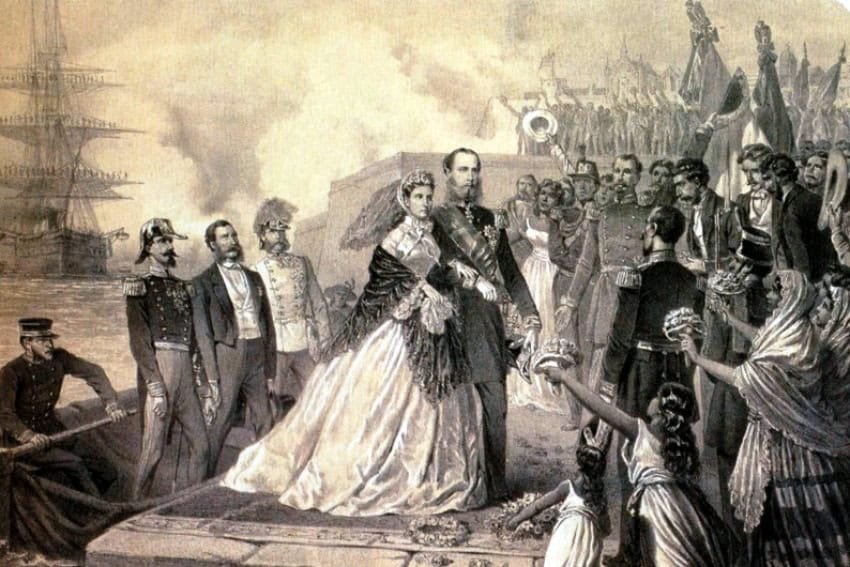
Charlotte of Belgium, the unlikely future empress consort of Mexico — where she was known as la Emperatriz Carlota — had never been to Mexico when she and her husband, the Austrian Archduke Maximilian, arrived in 1864 to rule the nation. Born into European royalty, her grandfather was the French king, Louis Philippe I, and her father was Leopold I of Belgium. So how did this Belgian princess end up as the famed doomed empress of Mexico?
She was small, pretty and intelligent, and when she reached the marriageable age of 16, her family lined up potential suitors. Charlotte herself was attracted to the Austrian archduke Maximilian, the younger brother of Emperor Franz Joseph I. He was a little older than Charlotte but within an acceptable range, and there was a mutual attraction.
The wedding celebrations took place in the Royal Palace of Brussels with suitable pomp, and then, seeking a task for his now married younger brother, Emperor Franz Joseph made Maximilian viceroy of the Kingdom of Lombardy–Venetia.
Based in Milan, at the heart of European culture, the couple appeared happy with their new life.
Recalled from Vienna
However, Maximilian’s liberal leanings did not go down well in Vienna, and he was recalled after two years. The couple busied themselves remodelling a home, Miramare Castle on the Gulf of Trieste, when a new opportunity presented itself. Across the Atlantic, Mexico was being torn apart by civil war, and many in the Conservative Party felt the answer would be to establish a monarchy. European support of an Emperor might bring protection from both their political rivals and possible United States intervention. Their search for a suitable candidate focused on Maximilian. He had the correct royal pedigree and, most importantly, was available. Believing her husband was destined to achieve great things, Charlotte encouraged him to accept the crown.
The Mexican venture started well, but by the end of 1865, twenty months after their triumphant entry into Mexico City, the monarchy was starting to crumble. The Liberals had been pushed out of Mexico City but remained a powerful force in the countryside, and the French — whose muskets held it all together — were anxious to withdraw their troops.
Ruling in Mexico
Maximilian did not help with his increasingly unrealistic ideas. Mexico, he felt, needed a navy, and he drew up plans for ships they could never afford. He became increasingly concerned with his lack of an heir and arranged the adoption — almost the kidnapping — of a two and a half year old child who was the grandson of an earlier Mexican emperor. Pressured into handing the child over, his mother left the city, got as far as Pueblo, changed her mind, and came back for him. It was a ridiculous episode that threatened a diplomatic incident, for the mother was American, and it made Maximilian and his government look ridiculous.

By the end of 1865, there were so many problems that the Emperor decided he could not leave Mexico City, and the planned royal visit to the troublesome Yucatán would be undertaken by his wife. Carlota (she was now referred to by the Spanish version of her name) arrived in Merida in a coach pulled by four white horses along a street decked with arches of flowers, and she was greeted by cheers from a carefully vetted crowd. The Empress took her responsibilities seriously, visiting hospitals, school and the impressive Maya ruins. She was generally well greeted by both loyal officials, still committed to the monarchy, and by many Indigenous people who hoped the foreign emperor could end the vicious civil war raging through the countryside.
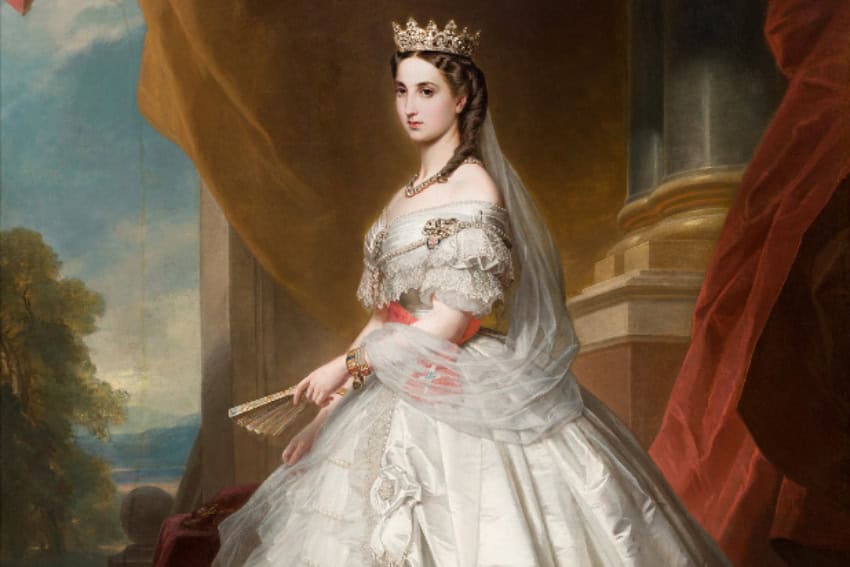
The tour had been a success, but the situation around the country remained critical. When Maximilian wanted to ride out from Mexico City to greet his wife at Veracruz, his French military advisers vetoed the idea. The roads were far too dangerous.
The retreat to Cuernavaca
The royal couple entered 1886 with a false air of optimism and an empty treasury. Maximilian was a man who disliked the cold, and he found winters in Mexico City uncomfortable. His attention had been drawn to Cuernavaca, relatively close to the capital but enjoying a pleasant, almost tropical climate. As tensions rose and a withdrawal of French troops looked ever more likely, the couple increasingly spent time at their Cuernavaca properties.
Here, surrounded by a small group of favorite advisors, the atmosphere could be more relaxed than in their Mexico City palace. The gardens were decorated with fish ponds, caged exotic birds and tropical fauna, and Carlota became interested in the colorful butterflies that fluttered between the plants.
Yet, as political problems mounted, even this retreat no longer offered the comfort it once had. One of the couple often stayed to monitor events in Mexico City, leading to rumors that for Maximilian, the charm of Cuernavaca was less the tropical climate and more the beautiful daughter of one of his servants. As the weeks passed and problems increased, Cuernavaca became less a place to relax and more a place to hide. When a French envoy brought the anticipated news of the withdrawal of French troops, the messenger had to ride out to Cuernavaca to find the emperor.
In search of European support
By June, Maximilian was ready to abdicate, but Carlota argued against it. Her grandfather, Louis Philippe, had surrendered the throne of France, a move she felt had ruined the family. Maximilian should stay and defend his throne, and she would go to Europe to seek support. On reaching Paris, she based herself in the Grand Hotel, where she met with Empress Eugénie, who, somewhat reluctantly, arranged an audience with her husband, Napoleon III.
Princess Carlota was shocked to see how the Emperor had aged, and their meeting was difficult. The situation in Europe had changed drastically since Carlota had been away. Prussia was on the rise, and France had heavy military commitments in both Italy and Algeria. Napoleon III was not in a position to provide Mexico with either soldiers or the 500,00 francs required to meet the monthly bills.
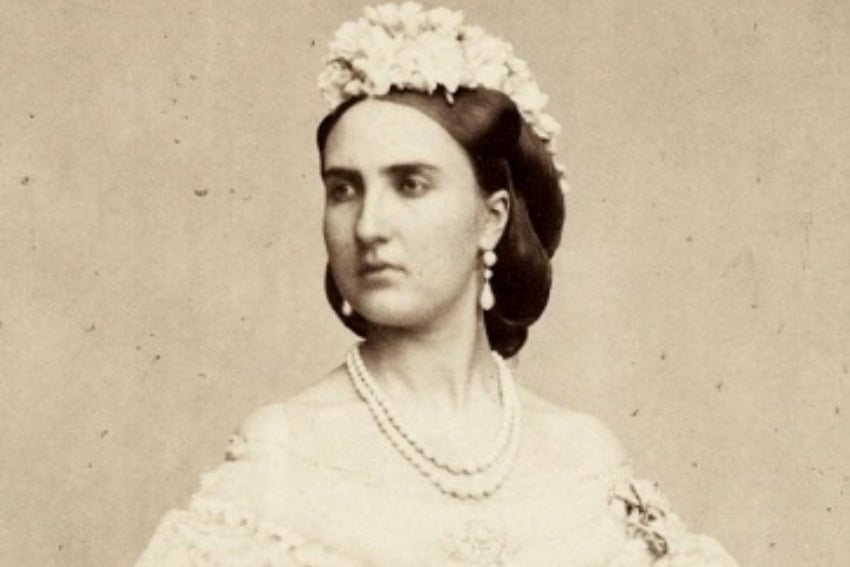
In letters to her husband, Carlota wrote of their “moral victory” and vowed she would take the issue to Pope Pius IX. In September, Carlota was warmly greeted by the Pope, but here too, she was unable to obtain any promise of support. At this point, she was probably falling into a depression that seriously clouded her judgment. The day after her audience with the Pope, Carlota was riding in her carriage when she suddenly demanded to be taken back to the Vatican. She arrived without an appointment and, when Pope Pius IX finally appeared, threw herself at his feet. The issue she wanted to discuss was not Mexico but the belief that she was being poisoned by her own staff. Concerned about Charlotte’s health, her family had her escorted to Miramare Castle, where she was attended by doctors and guarded by Austrian security agents.
The death of an emperor
As news of his wife’s illness reached Mexico, there was an expectation that Maximilian would use this as an excuse to abdicate and rush to her. Instead, he followed the fatal path to Querétaro and the firing squad. He walked to his execution, falsely believing that his wife was already dead, and the thought that they might soon be reunited seems to have eased him during those last difficult days.
The Belgian royal family was visiting the Paris International Exposition when they received the shocking news from Mexico. They elected not to inform the Empress of her husband’s death, and she did not learn of his fate until early the following year. Carlota was brought to Belgium, where she disappeared from public view behind the walls of Bouchout Castle. Her only visitors were a few close family members, and she passed the time with walks, embroidering, playing cards and listening to her gramophone. The Great War swept past, and the castle remained unmolested during the German occupation of the country. Charlotte died peacefully on Jan. 19, 1927, at the age of 86.
Bob Pateman lived in Mexico for six years. He is a librarian and teacher with a Master’s Degree in History.
